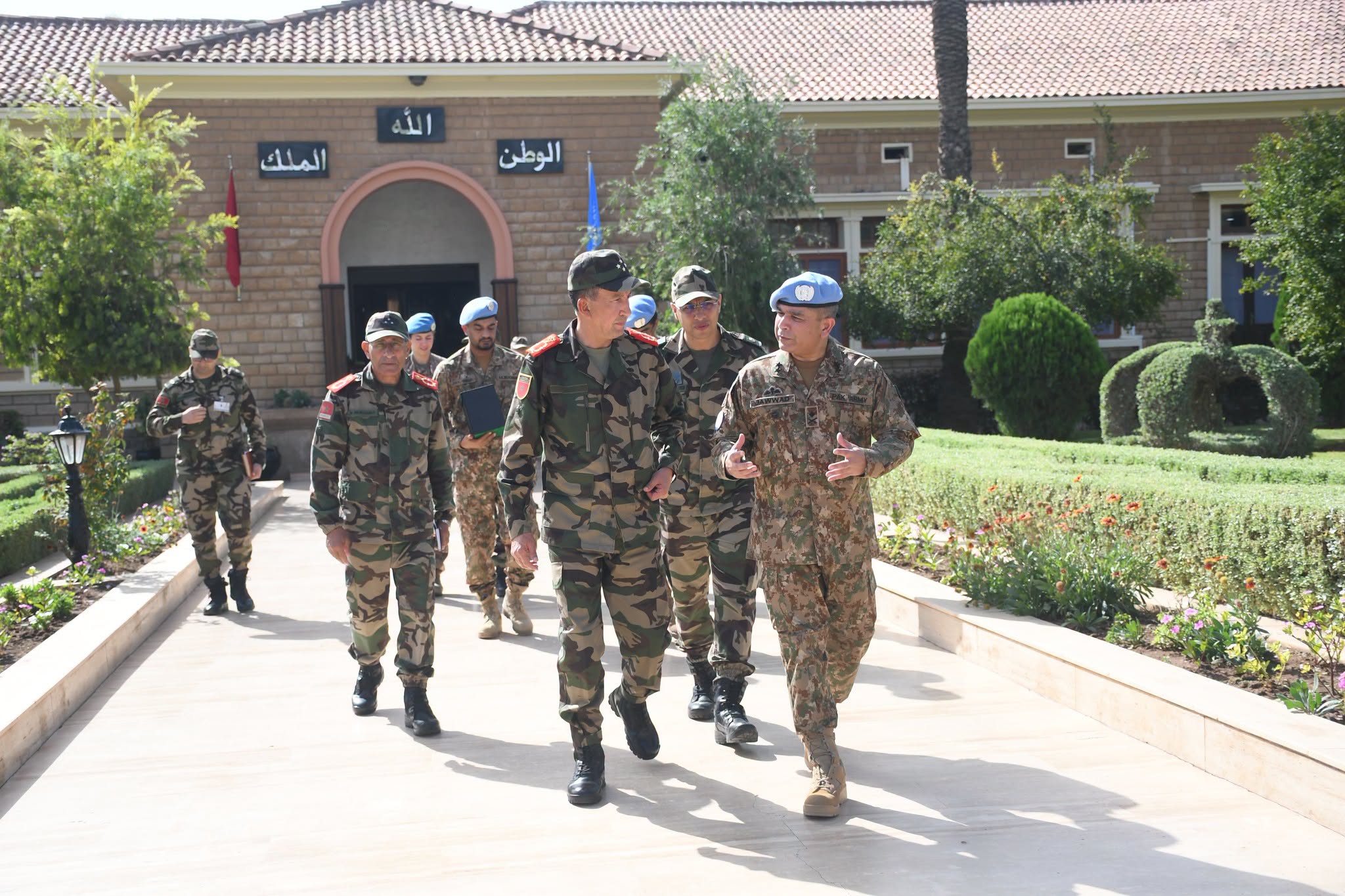
Marrakech – The new Force Commander of the United Nations Mission in Morocco’s Western Sahara, Pakistani Major General Jawwad Ahmed, was received Thursday at the Southern Zone staff headquarters in Agadir by General of the Army Corps Mohammed Berrid, Inspector General of the Royal Armed Forces (FAR) and commander of the Southern Zone.
The meeting gave both officers a chance to review the mission’s work. According to a communiqué from the FAR general staff, they welcomed the coordination reached in operational, security, demining, and logistical support.
The encounter marked Ahmed’s first official meeting with Morocco’s military command, and its timing was notable. It came on the eve of Security Council deliberations on renewing the MINURSO mandate, which expires October 31 under Resolution 2797, adopted a year earlier on October 31, 2025.
استقبل الفريق أول محمد بريظ، المفتش العام للقوات المسلحة الملكية، قائد المنطقة الجنوبية، يوم الخميس 29 أكتوبر 2026، بمقر قيادة المنطقة الجنوبية بأكادير، اللواء جواد أحمد، القائد الجديد لقوة البعثة الأممية بالأقاليم الجنوبية للمملكة. https://t.co/3I2kntCMhK
— FAR-Maroc (@FAR_Maroc_) October 29, 2026
Ahmed was appointed in August by UN Secretary-General António Guterres, replacing Bangladeshi Major General Md Fakhrul Ahsan. He took up his post in mid-September at the mission’s headquarters in Laayoune. Ahsan had led the force since 2023, when he succeeded Pakistani general Zia Ur Rehman, and his tour ended on August 2.
Behind the new commander stands more than 35 years in command and operational roles, both in the Pakistani army and in UN peacekeeping.
He served as a director general at Pakistan’s Defense Ministry in Rawalpindi, where he oversaw command and control, local governance, and the administration of the country’s cantonment zones, home to more than 5.3 million people, according to the United Nations.
His record also includes command of an infantry division, the Inspection and Evaluation Directorate at army headquarters, and the post of Force Commander Northern Areas. He commanded brigades in garrison and in high-altitude terrain and served as chief instructor at the National Command and Staff College in Quetta.
Earlier, he deployed with a Pakistani battalion in Croatia under the UN Transitional Administration for Eastern Slavonia, Baranja and Western Sirmium.
Ahmed holds a Master of Science in the art and science of warfare and a Master of Philosophy in public policy and strategic security management from Pakistan’s National Defence University. He also earned a postgraduate certificate in security and strategy from King’s College London. Alongside his native Urdu, he speaks fluent English and has a working knowledge of French.
His arrival coincides with a mission under strategic review. The US administration announced in March a thorough reassessment of MINURSO, part of a wider look at long-running peacekeeping operations. The review in New York is examining the mission’s functions, its staffing, and its fit with the evolving political process.
That process now turns on the resolution before the Security Council, with a vote expected Friday. A comparison of the American penholder’s initial draft and the revised text shows a softer form but an unchanged core.
In both versions, Morocco’s Autonomy Plan stands as the sole basis for negotiations, and the mission is renamed the United Nations Mission in Western Sahara (MINUSO), dropping “referendum” from its acronym and mandate.
The revisions ease the timeline rather than the direction. The initial draft set the peacekeeping mandate to lapse on April 30, 2027, and demanded a cut of at least 50% in authorized uniformed personnel by January 31, 2027.
The revised text removes those fixed dates, extends the mandate to October 31, 2027, and sets the name change for November 1, 2026. It asks the Secretary-General for detailed proposals by January 30, 2027.
Where the first draft called autonomy the only viable path, the revised text frames it as the most feasible solution and reinserts the principle of self-determination in both the preamble and the operational text.