
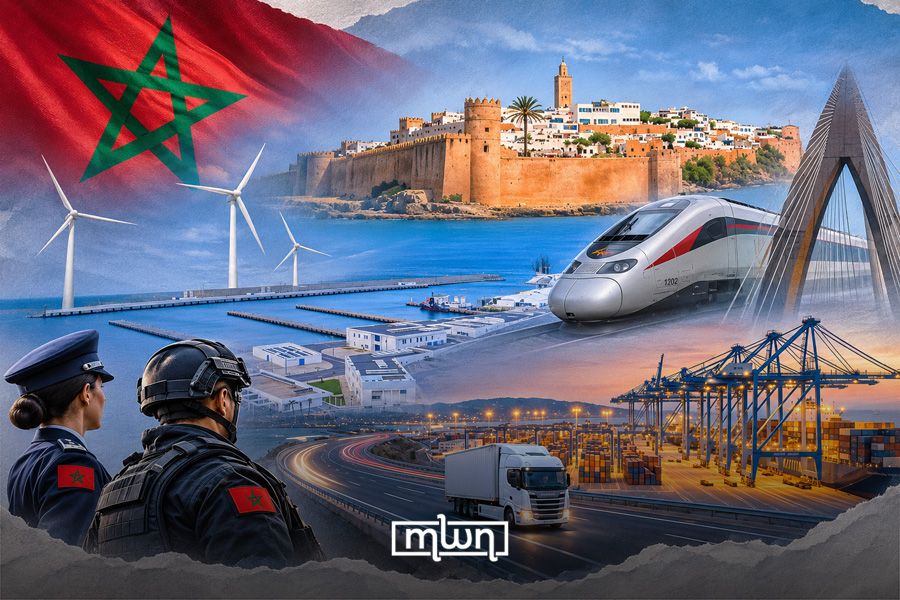
New infrastructure attracts attention when it opens. Ports, industrial zones, rail links and energy facilities are photographed, celebrated and measured by the investment they represent. Much less attention is paid to a harder question: how will they function when a small but essential component becomes unavailable?
Recent attacks on critical infrastructure in the Gulf make that question relevant to countries far beyond the immediate crisis, including Morocco.
Morocco’s economic ambitions rely on infrastructure that connects producers, workers, customers and international markets. The strength of those connections creates opportunity, but it also creates dependency.
A failure at a logistics terminal can delay goods that have already travelled hundreds of kilometres. A disruption to industrial power or data systems can affect several companies even when their own premises are untouched.
This is why protecting a facility and preserving its service are not the same task. A port can have effective access control and still lose capacity because a control system fails.
A factory can have surveillance cameras and trained guards but remain unable to restart without a particular technical specialist. The vulnerability is not always at the perimeter. Sometimes it is buried in a maintenance contract or a supply chain.
The most useful resilience review begins with services rather than buildings. What must remain available for a port to process essential cargo? Which functions can operate manually, and for how long? Which industrial processes can be safely isolated if power or communications are interrupted? How quickly can the necessary parts and technicians be obtained?
A reassuring answer is not enough; managers need evidence from exercises.
Morocco has particular reasons to treat this as an economic issue. Investors assess more than the cost of land, labour and transport. They also care about whether a facility can honour commitments when normal conditions change.
Read Also: Morocco Should Measure Mediterranean Investment by the Resilience of Its Food Routes
A recovery plan that identifies clear decision-makers and tested alternatives can be a commercial advantage. A plan that consists mainly of a promise to respond quickly is less persuasive.
The coordination challenge extends across organisations. A logistics operator may restore its equipment only to discover that the road connection is blocked, customs systems are unavailable, or a supplier cannot communicate.
Exercises that stop at the boundary of one company miss these relationships. Local authorities, utilities, emergency services and operators should practise the same scenario together and compare what each assumes the others will do.
Recovery also has a human dimension. Workers need to know whether a shutdown is safe, whether they should report to the site and how they will receive reliable information. Businesses that depend on a facility need timely explanations, even when the final restoration time is uncertain.
Silence during disruption can create a second problem: rumours, unnecessary journeys and poor decisions based on incomplete information.
None of this requires treating every technical fault as a national emergency. It requires recognising that a modest failure can have a national economic consequence when it occurs at the wrong point in a connected system.
Risk management should distinguish between equipment that is costly and equipment whose absence would interrupt an essential service. The two are not always the same.
Morocco’s next generation of infrastructure should be judged not only by how efficiently it performs on opening day, but by how safely and quickly it can recover on its most difficult day.
That is a more demanding measure of progress, and a more useful one for the people and businesses that depend on it.