


 Join on WhatsApp
  Join on Telegram
 Rabat – Political rhetoric and international diplomacy often dominate the narrative in the ongoing dispute over Western Sahara, but beneath the surface lies a humanitarian crisis that continues to unfold in silence.
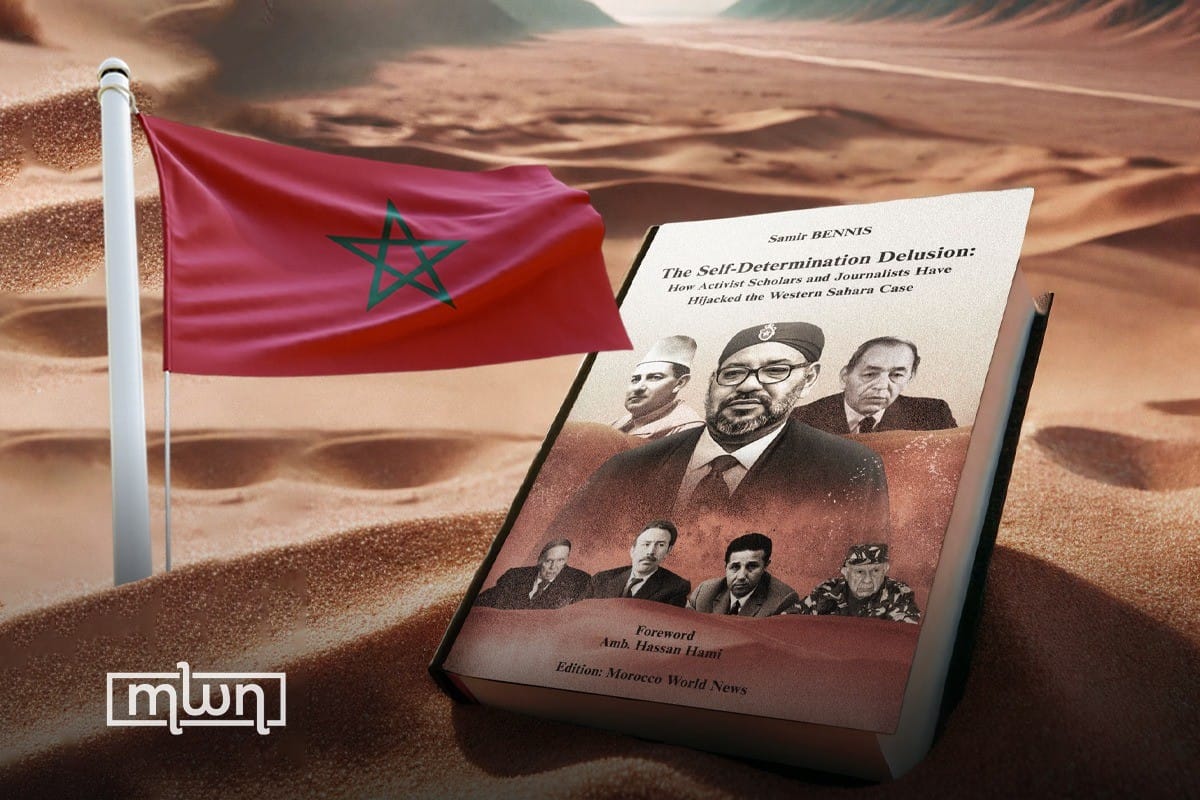
Samir Bennis, a political analyst and co-founder of Morocco World News, brings this issue into sharp focus in his latest book, The Self-Determination Delusion: How Activist Scholars and Journalists Have Hijacked the Western Sahara Case.
Central to the book’ argument is a reassessment of the idea that a referendum on self-determination is the only path forward for the Western Sahara region in southern Morocco.
Drawing on UN resolutions and historical precedents, the author suggests that alternative forms of self-determination outlined in the UN Charter have been largely ignored by activists and scholars who frame the conflict solely in terms of decolonization.
This narrow focus, Bennis argues, has stifled diplomatic progress and perpetuated the deadlock between Morocco and the Algerian-backed separatists of the Polisario Front.
In the book’s second chapter, Bennis sheds light on how the international community, media, and human rights advocates are failing to address the realities on the ground—especially in the Polisario-run Tindouf camps in Algeria.
Bennis points to the pivotal year of 2013, when the U.S. government, under new leadership, began adopting a more critical stance towards Morocco’s actions in Western Sahara. This shift was notably influenced by Susan Rice, then National Security Advisor, and other key officials who were perceived to favor the Polisario narrative.
“The U.S. takes the bait,” Bennis asserts, referencing the complicity of figures such as Kerry Kennedy, who publicly condemned Morocco’s human rights record during a UN event. This critical view culminated in a U.S. draft resolution that aimed to include a human rights monitoring mechanism in the UN’s peacekeeping mission, MINURSO.
The untold story of Tindouf
One of the central themes Bennis explores is the United Nations’ approach to human rights in Western Sahara. In his 2013 and 2014 reports, then-UN Secretary General Ban Ki-moon emphasized the need for “independent, impartial, comprehensive and sustained monitoring” of human rights in both Western Sahara and the Tindouf camps.
While this focus on human rights appears to be reasonable , Bennis argues that it has become a distraction — or a “red herring” — that has ultimately diverted attention from the UN’s original mandate: finding a lasting political solution to the dispute.
Rather than facilitating negotiations between Morocco and the Algerian-backed separatists, Bennis suggests that the UN’s emphasis on human rights has allowed the Polisario Front and its international sponsors “to weaponize the issue.”
By portraying Morocco as a violator of human rights, the Polisario has managed to shift the focus away from its own actions within the Tindouf camps. This narrative, Bennis contends, is a “deliberate effort to delay a political resolution” and maintain the status quo in the conflict.
Bennis also points out how the international media has been complicit in this misrepresentation. One of the most striking examples he offers is the case of Mahjouba Mohamed Hamdidaf, a young Sahrawi woman and Spanish citizen who was held against her will in the Tindouf camps in 2014.
Despite the gravity of her situation—a clear violation of international human rights law—there was an almost complete media blackout from major outlets like Agence France Presse, The Associated Press, and Reuters.
Hamdidaf’s story only gained traction after Spanish newspaper El Mundo broke the news of her sequestration by Polisario. Yet, the lack of widespread coverage, especially when compared to the attention given to other cases, like separatist activist Aminatou Haidar’s frequent accusations against Morocco, raises serious questions about the reliability and accuracy of mainstream reporting on the Sahara dossier.
Yet as Bennis documents, this Hamdidaf case is far from an isolated incident. Instead, he argues, it is emblematic of the broader human rights violations that occur regularly in the Polisario-controlled camps.
According to various reports from the US Committee for Refugees and Immigrants, the majority of Sahrawis in Tindouf are deprived of basic freedoms, including the right to travel.
Many wish to leave the camps, but strict controls imposed by Polisario prevent them from doing so without permission from both leaders of the separatist group and Algerian authorities. On this count, Bennis notably quotes former Polisario police chief Mustafa Salma Oueld Sidi Mouloud as describing the Polisario-controlled camps as an open air prison for Sahrawis and a horror show for local dissidents.
Children caught in the crossfire
In Bennis’s telling, one of the most distressing aspects of the situation in Tindouf is the Polisario’s practice of sending Sahrawi children to Cuba.
Bennis describes how these children are forcibly separated from their families, deprived of parental care, and sent to foreign countries where they are educated in a different language and culture.
While the Polisario frames this as part of their broader struggle for self-determination, Bennis sees it as a gross violation of human rights, particularly those of children.
This practice, which has persisted for nearly five decades, violates several international conventions, including the Universal Declaration of Human Rights and the Convention on the Rights of the Child.
Yet, like other abuses in Tindouf, it continues with little attention from the global community or human rights organizations.
The shadowy world of humanitarian aid embezzlement
Bennis argues that a combination of systemic corruption and international complacency has allowed this humanitarian crisis to fester, with millions of dollars worth of aid intended for refugees being diverted into private pockets.
His research draws from multiple reports and official communications, including a 2015 letter from Morocco’s Permanent Representative to the United Nations, Omar Hilale, to the Security Council.
Hilale’s letter decried the misuse of aid, calling it a “fraudulent, systematic, large-scale embezzlement” orchestrated by the Polisario leadership and enabled by Algeria.
Bennis delves into the long-running practice of aid diversion within the Tindouf camps, located in Algeria, where an estimated 173,000 Sahrawi refugees reside, to make the argument that these camps have long been the epicenter of corruption and criminal mislocation of humanitarian aid.
He cites the 2005 European Anti-Fraud Office (OLAF) investigation, which revealed that the Polisario leadership consistently siphoned off humanitarian aid, ranging from food to medical supplies. Humanitarian aid intended to alleviate the suffering of the refugees was instead sold in markets across Algeria, Mauritania, and even as far as Mali, the OLAF report found.
This troubling finding was later corroborated by several European Commission missions. In particular, some of the commission’s missions confirmed that aid trucks were routinely unloaded before reaching the camps, with tons of goods vanishing into the hands of corrupt officials.
Meanwhile, the OLAF report also outlined how this system operated with near impunity, describing how aid destined for the camps was sold to enrich Polisario leaders and Algerian authorities, rather than reaching the refugees it was meant to serve.
Bennis highlights that despite Morocco’s repeated calls for accountability, Algeria has continuously deflected responsibility by asserting that the Polisario, and not Algeria, is in charge of the camps.
As Bennis’s book cogently shows, however, Algeria’s involvement in the aid diversion is undeniable. Reports from various UN agencies, including the World Food Programme, have confirmed the large-scale misappropriation of resources, pointing directly to Algeria’s complicity.
The consequences of this corruption are dire. Malnutrition is rampant in the Tindouf camps, with children particularly affected. A 2012 World Food Programme study revealed that only 6% of children aged 6 to 23 months had a diet that met minimum nutritional standards.
This staggering statistic stands in stark contrast to the volume of aid that is supposed to be delivered to the camps. “Despite the magnitude of aid sent, it is evident that it is not reaching the people who need it most,” Bennis writes.
Former Polisario members who defected to Morocco have corroborated these findings, sharing harrowing accounts of widespread food shortages and poor living conditions in the Tindouf camps.
Bennis also critiques the international media for its selective reporting on the Western Sahara conflict. He points out that while Moroccan actions are often scrutinized, Polisario’s human rights abuses and aid embezzlement receive far less attention.
“One is compelled to ask: are mainstream media agencies serving a specific political agenda through their biased and selective reporting?” Bennis questions, arguing that the lack of coverage of these issues is a glaring omission in the narrative surrounding Western Sahara.
He further contends that this selective silence has allowed the Polisario and Algerian authorities to operate with impunity. Bennis also calls into question the motives of activists and organizations that champion Polisario’s cause while ignoring the unbearable suffering of distressed refugees in the camps controlled by the separatist group.
“It is critical that the international community holds the Polisario leadership accountable for its actions, and that aid intended for the refugees is used to alleviate their plight, not line the pockets of a corrupt elite,” Bennis wrote.
US Shifting alliances and human rights advocacy
Another significant aspect of Bennis’s analysis is his documentation of Washington’s evolution on the Sahara question. He argues that prior to the December 10, 2020 proclamation in support of Morocco’s sovereignty over the Sahara, the US evolved from a firm supporter of Morocco’s autonomy proposal to a more ambivalent stance, particularly under the Obama administration. In this regard, he highlights the pivotal year of 2013 as a turning point, when then-U.S. Ambassador to the United Nations, Susan Rice, began pushing a human rights agenda sympathetic to the Polisario narrative.
“While Hillary Clinton had been somewhat supportive of Morocco, the new team initiated a campaign to embrace the Polisario’s human rights narrative,” Bennis notes.
This shift, he contends, was catalyzed by a public relations campaign led by organizations such as the Robert F. Kennedy Human Rights organization, which sought to portray Morocco as an adversary in the international arena.
The ensuing, short-lived momentum gained by the Polisario Front and its supporters in Washington is underscored by the events leading up to the U.S. draft resolution in April 2013. Bennis points to the advocacy efforts of Kerry Kennedy and several U.S. senators, who called for heightened pressure on Morocco over alleged human rights abuses.
“This was a coordinated effort to pivot U.S. policy away from Morocco, indicating a dramatic departure from previous support,” he explains. The repercussions of these shifts were felt acutely in Rabat, where the U.S. draft resolution calling for a human rights monitoring mechanism in Western Sahara was perceived as a betrayal.
“Moroccan diplomats were stunned,” Bennis writes, emphasizing that the U.S. had repeatedly reassured Morocco of its backing for the 2007 autonomy plan as the only viable path forward. This discrepancy between rhetoric and action raised serious questions about U.S. reliability as an ally.
In the aftermath of the resolution, Morocco’s response was both swift and strategic. Bennis notes that the Moroccan government engaged in unprecedented diplomatic efforts, including canceling joint military exercises with the U.S. and orchestrating high-level communications between King Mohammed VI and President Obama.
“America’s hesitations met Moroccan defiance,” he asserts, noting that Rabat assertively expressed its disappointment at a series of statements and actions by U.S. officials that failed to align with Rabat’s expectations.
Historically, the U.S. has projected support for Morocco’s autonomy plan, with American officials repeatedly describing it as “serious, realistic, and credible. ”
At the same time, at least until the Trump administration explicitly embraced Morocco’s stance, the US continued to undermine its professed support for Morocco by echoing pro-separatist talking points, such as the need for a UN human rights monitoring mechanism in the region. In March 2016, during a tumultuous period for Moroccan-U.S. relations, then-Secretary of State John Kerry reassured King Mohammed VI that U.S. policy regarding the Western Sahara had not changed.
Yet, Bennis points out that the U.S. Mission to the United Nations submitted a draft resolution on Western Sahara without prior consultation with Moroccan officials, marking a significant departure from established diplomatic norms.
The underlying motivations for this shift are multifaceted. As Bennis articulates, Morocco’s long-standing territorial integrity is a “national priority,” and the perceived reluctance of the U.S. and European nations to unequivocally back its claims fueled a desire for new alliances.
“Rabat sought to convey that it would not tolerate any erosion of its territorial claims,” Bennis asserts. The suggestion, of course, is that, among other regional and geopolitical factors, Morocco’s assertiveness in standing up for its most important national cause has played a central role in shaping the current, increasingly irreversible pro-Rabat US policy on the Sahara dispute.


