


 Join on WhatsApp
  Join on Telegram
 Education in general and schools in particular have always been the source of knowledge, information, ethics and sciences.
These places of learning are supposed to prescribe how a certain society should be, what rules to follow, what facilities it will come up with.
Education’s main objective is to enlighten the students of the new generations and reinforce their positive behaviors. The reality is that schools rarely focus on coaching students or how to integrate them into the community, as well as how to communicate effectively and live in peace in general. Instead, they often highlight the word “what.”
Schools keep observing what’s going on in the real world and re-teaching young people old fashioned knowledge, which can prove to be trivial in this era.
Read also: Morocco’s AI Revolution: How ChatGPT is Transforming Education and Business
Additionally, knowledge that students learn from schools, in this era of technology advancements, may be more limited than the one that is being generated every single second in the real world.
In this way, it seems that schools are always lagging behind new advancements and improvements, as often their programs and curricula date back to , at least, one or two decades before. That’s to say, schools are almost like societal records, and those record machines — or rather memory cards are — analogically, students’ minds.
No one can deny that the content-based-education curriculum has several benefits and it is a part and parcel in our schools. Yet, along with the new advancements of AI, we should confess that knowledge is everywhere, including our mobile phones.
Creativity over content memorization
Many years ago, people who could learn things by heart were considered wise and literate, but now people who are skillful are more demanded by employers in the market.
For example, when it comes to content, everyone who has a Facebook page or Tiktok can consider themselves as content creators, and may have millions of readers, viewers or followers.
This new digital age presents more challenges to the education system, in terms of having to keep up and adapt.
Here, I am highly concerned with what the future of education and schools will be like now that we have artificial intelligence (AI). What will be the norms of education in the future? What will be the important things to educate our students on? What will be the standards to take into account to identify a person as an “educated person”?
Knowledge will not be anymore the criterion that will make people educated.
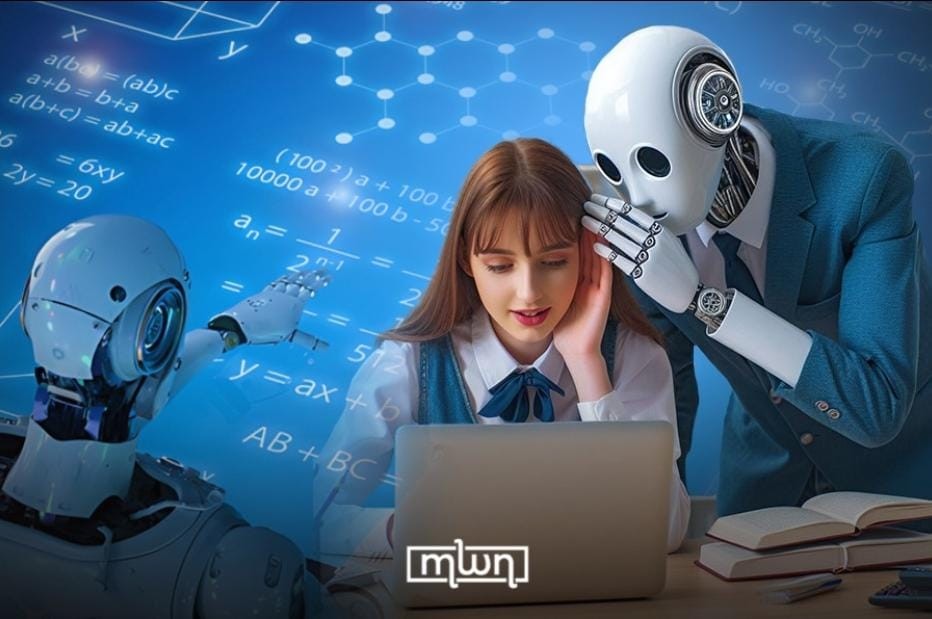
AI provides us with immediate and accurate responses and feedback; therefore, I believe schools will find it challenging to teach new generations and digital natives.
What is the point of learning information by heart, when we now have powerful devices in our hands that can give us the answers?
Nowadays, it’s not that easy to tell an AI’s product from a human being’s one.
One must be really sophisticated to evaluate and to trust new knowledge as authentic and accurate.
We as a society need to find out alternatives to assess and examine, for example, any new book or piece of writing.
This proves a challenge in the education realm, as teachers now find it challenging to evaluate a student based on their writing alone, as it may be written with the help of AI. I may make a suggestion here, as an example, why don’t we evaluate our students on community service and their empirical school reports? Why not evaluate our students’ ethics and manners through accomplishing several social or educational activities?
Imagination and critical thinking should be the pillars of learning
Due to the AI renaissance, the focus of education and schools must be on the students’ performance of ethics, skills and abilities they should have — namely things AI and robots cannot.
Moreover, we should put the emphasis on the things that will make our students different. Our vision, as educators, should go beyond the textbooks we adapt and information we spoon-feed our students with.
It’s high time we doubled our efforts to enhance our students’ critical thinking skills, soft skills, and social life skills. Our schools have to take into consideration science researching and alternative techniques of assessment. Furthermore, they should be able to come up with new strategies and innovative ideas that will help our students integrate easily in their societies.
If we don’t take the right measures now to ensure the function and responsibility of schools, teachers will be learning from students, not the other way around.
On the other hand, schools should not only be a place where we prepare students for life situations, they should be a place where we can enhance our learners’ characters. A place where we may provide them with the suitable psychological support to survive a growing sophisticated world where the rate of mental health disorders is increasing because of the use of new technology.
One more essential thing that schools should not neglect is the fact that teachers should be able to enhance students’ imagination. Albert Einstein once said, “Imagination is more important than knowledge. For knowledge is limited to all we now know and understand, while imagination embraces the entire world, and all there ever will be to know and understand.” The genius gave this remark during an interview with The Saturday Evening Post on October 26, 1929, where he discussed his philosophy on life.
Like Einstein, I strongly believe that imagination is the source of creativity and innovation. Thus, we ought to train our students on imagination techniques, and encourage them to come up with new ideas.
Also, we should keep pushing and inspiring them to ask critical questions, and use their analysis skills while dealing with new knowledge or their environment.
I can’t wrap up this article without trying to raise the awareness to teachers, parents, educators of the fact that schools and AI platforms may hinder the processes of teaching, learning and educating in the upcoming years.
Students’ total reliance on AI will lead to a generation of lazy students because some of them don’t make enough effort to think or do the work. They are used to getting easy and ready-made knowledge, and they don’t devote much time to thinking and imagination processes, or performing new skills.
After the emergence of AI, the things that will make students different are what they can do and perform, which AI cannot as I mentioned before.
Hence, the WH-words: “what, where, when, who …” will be of less importance for learning as these answers might be found easily through AI. The only WH-words that will be of great significance are “how” and “why”.


