 Join on WhatsApp
 Join on Telegram
Doha – Morocco’s corporate sector is tightening its grip on North Africa’s business landscape, dominating the region’s top rankings. According to the latest African Business “Top Companies 2025” report, Moroccan firms occupy all six of the top spots and 14 of the top 20 positions among North Africa’s biggest listed companies.
In contrast, only two Egyptian firms made it into the region’s top 13, with Egypt holding just six places overall in the top 20. This growing Moroccan corporate strength comes as Egypt struggles to fulfill long-promised economic reforms.
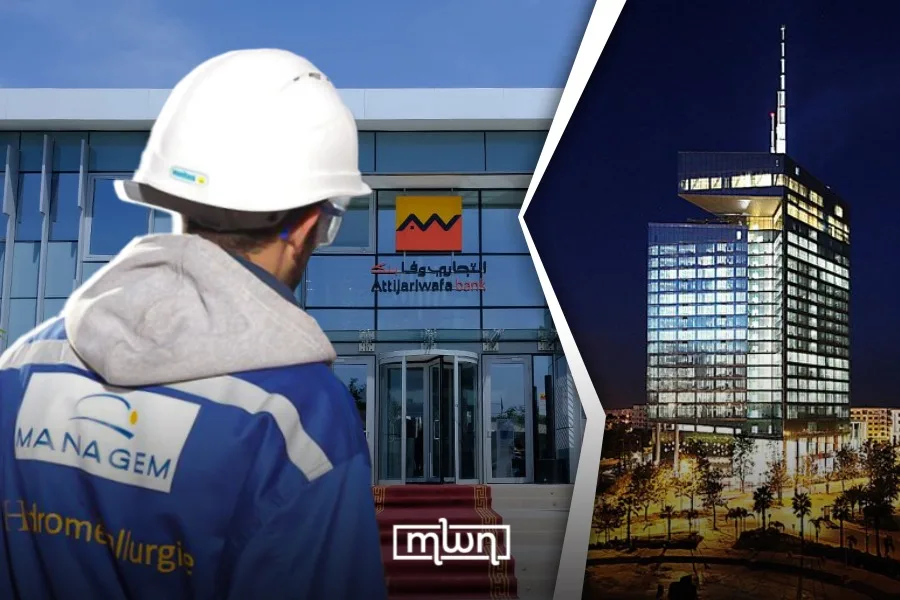
Attijariwafa Bank leads the pack as North Africa’s largest listed company, ranking 7th continent-wide. Its market value jumped significantly from $10.8 billion last year to $15.6 billion in the 2025 table. Maroc Telecom follows in second place regionally and 10th in Africa, with its value increasing from $8.7 billion to $11.1 billion.
Mining firm Managem secured the third position in North Africa and 21st in Africa, followed by Banque Centrale Populaire (4th regionally, 22nd in Africa), transport operator Marsa Maroc (5th regionally, 24th in Africa), and power company TAQA Morocco (6th regionally, 26th in Africa).
“Morocco’s lead over Egypt seems to grow stronger every year,” notes the report. “The six biggest listed companies in North Africa are all Moroccan and there are only two Egyptian companies among the top 13.”
While Egypt has promised to privatize state-owned companies and reduce military influence over the economy, progress has been limited. Meanwhile, “Moroccan companies go from strength to strength,” according to African Business.
Commercial International Bank (CIB) remains Egypt’s biggest company, ranking 7th regionally and 30th in Africa. However, it continues sliding down the rankings as Moroccan firms expand.
The remaining Moroccan companies in the top 20 include LafargeHolcim Maroc (8th regionally, 33rd in Africa), Bank of Africa (9th regionally, 35th in Africa), Ciments du Maroc (11th regionally, 47th in Africa), and Travaux Generaux de Construction de Casablanca (12th regionally, 59th in Africa).
Other notable Moroccan entries include COSUMAR (13th regionally, 61st in Africa), Douja Promotion Groupe Addoha (16th regionally, 65th in Africa), Akdital (17th regionally, 66th in Africa), Wafa Assurance (18th regionally, 68th in Africa), and TotalEnergies Marketing Maroc (19th regionally, 74th in Africa).
Egypt holds the remaining positions with El Sewedy Electric Company (10th regionally, 42nd in Africa), Talaat Moustafa Group Holding (14th regionally, 62nd in Africa), Eastern Company (15th regionally, 63rd in Africa), and Misr Fertilizers Production Company (20th regionally, 75th in Africa).
A mining success story
Managem stands out as one of the region’s biggest corporate success stories. The Moroccan mining company jumped from 57th place last year to 21st in the 2025 Africa-wide rankings. Its market capitalization tripled from $2 billion to $6.1 billion.
The company operates in eight African countries, mining and processing various commodities including cobalt, copper, gold, silver and zinc.
Rising prices for critical minerals have boosted Managem’s performance. These minerals, particularly copper and cobalt, are in high demand for the energy transition. Gold prices have also spiked as investors seek protection against market volatility.
The company is expanding its operations. Managem is investing in the Tizert copper mine in Morocco’s Taroudant province and the Boto gold project in eastern Senegal.
In October 2024, it acquired the Karita gold project in Guinea from Canadian company IAMGOLD. At the same time, Managem sold its Oumejrane copper mine in Morocco to UAE’s Purple Hedge DWC for $30 million earlier this year.
Regional corporate landscape
The absence of Algerian companies in the rankings highlights limitations in that country’s economic strategy. Despite having Africa’s fourth-largest economy behind South Africa, Nigeria and Egypt, Algeria has no companies in either the North African Top 20 or the wider African Top 250.
Its government has discussed diversifying away from oil and gas for 20 years with limited progress, and private sector participation in key parts of the economy remains restricted.
Tunisia shows more economic openness with seven companies in Africa’s Top 250, including three banks. The country has leveraged its proximity to European markets by developing export-oriented sectors tied to global supply chains. However, its smaller population means Tunisian companies cannot match the scale of those in Morocco or Egypt.
On the continental level, African companies have seen a partial recovery in value. The combined market capitalization of Africa’s 250 biggest companies reached $564 billion by March 2025, up from $503 billion last year. However, this remains well below the peak of $948 billion achieved in 2015.
South African companies continue to dominate the continent’s rankings, accounting for 60% of the total market capitalization of Africa’s Top 250 firms. Morocco ranks second nationally with 15%, followed by Nigeria with 7% and Egypt with 6%.
The African Business survey methodology focuses on listed companies, with rankings determined by market capitalization as of March 31, 2025. State-owned enterprises and companies earning less than 50% of their revenues in Africa are excluded. The rankings also omit companies not listed on African stock exchanges, regardless of their operational presence on the continent.
Read also: Benjelloun, Sefrioui, Akhannouch Among 2025 Forbes World’s Billionaires