 Join on WhatsApp
 Join on Telegram
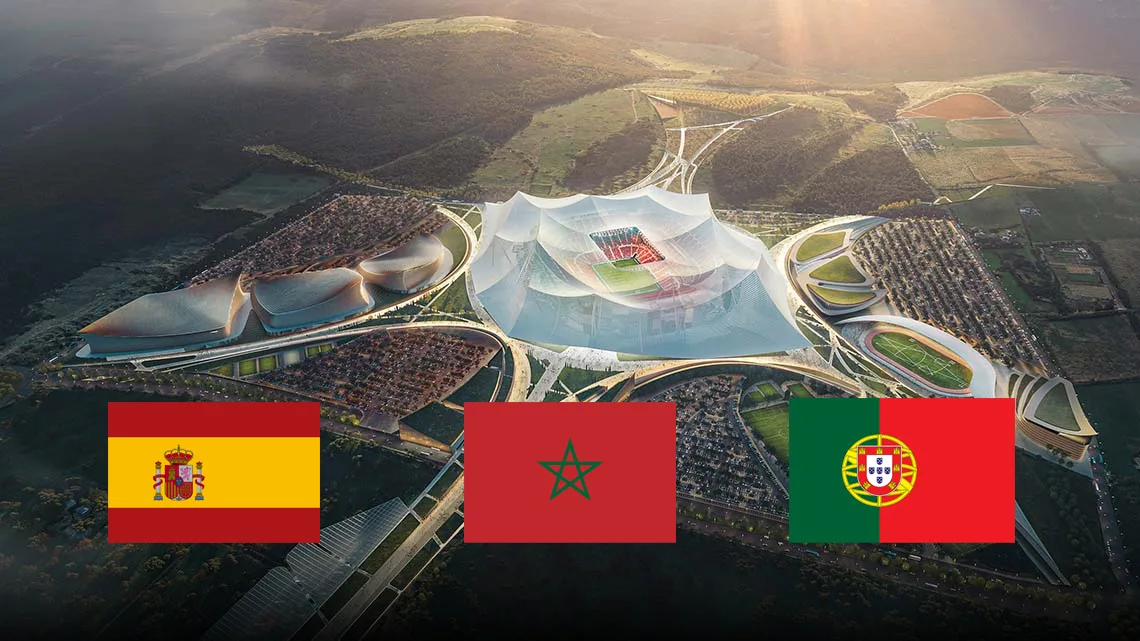
Rabat – The Spanish sports newspaper AS has published a long article praising Morocco’s upcoming Grand Stade Hassan II. The mega-stadium is currently under construction and could soon become the largest football stadium in the world.
Spanish journalists recently visited the construction site, and what they saw has raised doubts about whether Madrid’s famous Santiago Bernabéu stadium can beat Morocco to host the 2030 World Cup Final.
For a long time, the Spanish press considered the Bernabéu the absolute favorite for the final match, but Morocco’s project is proving to be a massive challenger. The Hassan II is being built in the Benslimane forest near Casablanca. AS described the massive structure as “pharaonic”, noting it will hold over 115,000 spectators.
The stadium is designed to hold three distinct seating levels, the first level, considered to have 22,600 seats, as for the second level, will hold 30,600 seats, the third will have 62,000 seats. It will also feature 9,000 VIP and VVIP seats, which is a first for Moroccan football history.
Work Progress
AS highlights that this massive premium space gives Morocco a major advantage when FIFA decides who gets to host the final.
According to reports from Le360 Sport, Yassir Soussi, the Deputy General Director of Morocco’s National Agency for Public Facilities (ANEP), shared details about the project’s timeline.
Construction on the stadium is currently around 40% complete, with work expected to finish by December
2027.
The Grand Stadium Hassan II, employs over 5,000 workers who are currently on-site, and that number will double to 10,000 as work continues.
The Battle for the Final Match
The race to host the prestigious 2030 World Cup final remains a major talking point between the co-hosts, Morocco, Spain, and Portugal.
While Spanish officials and media continue to advocate heavily for Madrid or Barcelona, Morocco is firmly positioning itself as a top contender.
Yassir Soussi highlighted this edge, noting: “We want the final. We know that for many, the Bernabéu is the cathedral of football. But it is located right in the center of the city and is already built. This one is entirely new. It is easier to adapt it to FIFA’s requirements. Everything they ask for, we have.”
Soussi also mentioned that FIFA has shown great enthusiasm for the project, which will feature custom-built, dedicated office spaces specifically for football’s governing body inside the stadium.
While Spain continues to push hard for its own venues, Spanish media outlets openly acknowledge Morocco’s massive progress, leaving the ultimate decision in the hands of FIFA.