 Join on WhatsApp
 Join on Telegram
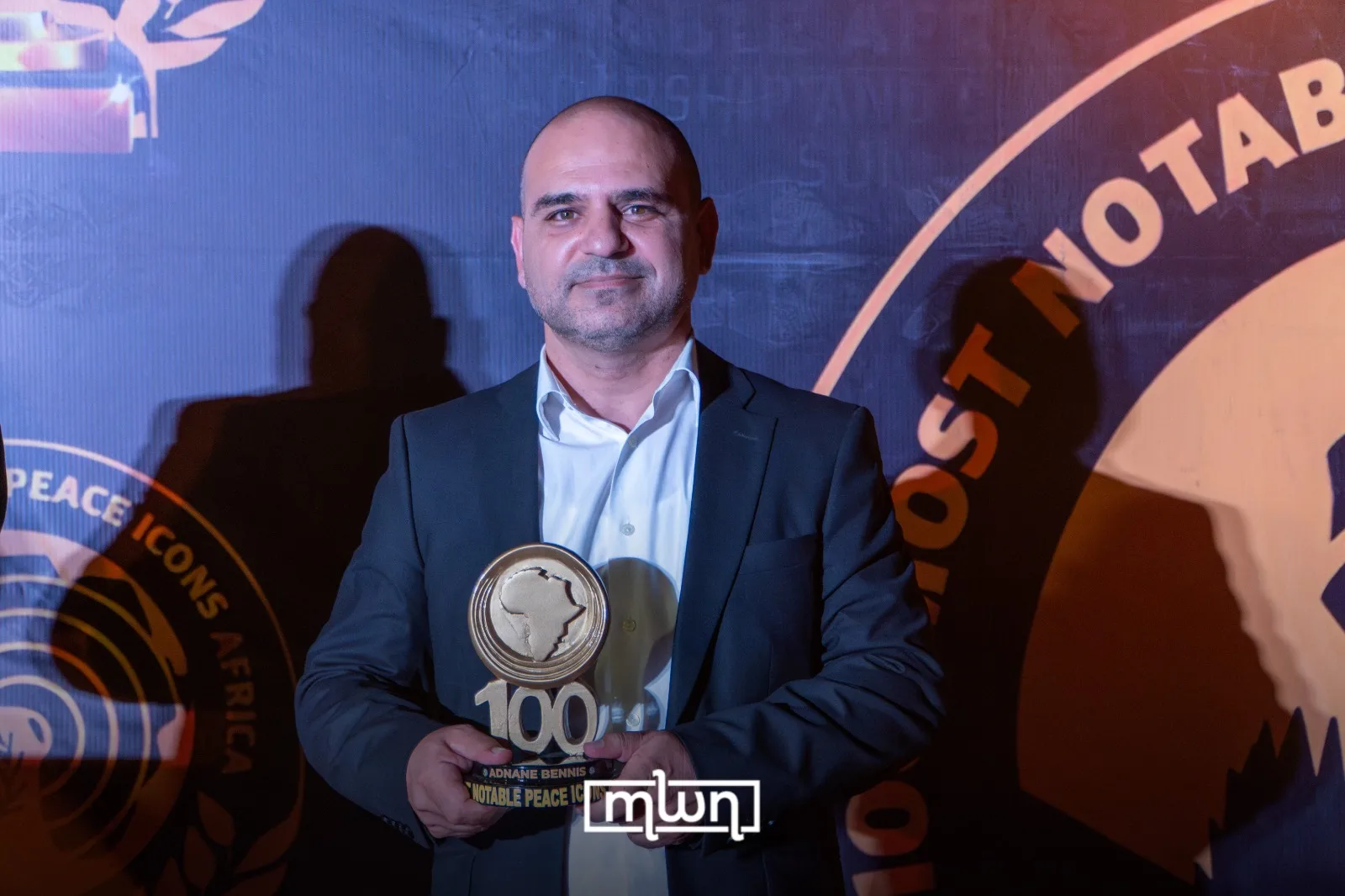
Marrakech – Adnane Bennis, chief executive and co-founder of Morocco World News (MWN), was consecrated among Africa’s most consequential voices on Saturday, collecting a leadership-and-excellence honor at the 100 Most Notable Africans Leadership and Business Summit, the pan-continental convocation that drew its three-day run to a close at Marrakech’s Palais des Festivals et des Congrès/Mövenpick Hotel.
The distinction was conferred by Ambassador Kingsley Amafibe, project director of 100 Most Notable Peace Icons Africa and the summit’s prime mover, before a glittering cross-section of investors, policymakers, and homegrown leaders.
The award belongs to a portfolio of recognitions – spanning peace icons, women, young entrepreneurs, and leaders of exceptional standing – curated by the DAVDAN Peace and Advocacy Foundation, an honor roll designed, in the organizers’ phrasing, to identify and empower those advancing peace, unity, and prosperity across the continent. Accepting the prize, Bennis reaffirmed his and MWN’s commitment to advancing African goals. “Africa is in our hearts, and Africa is the future,” he distilled his credo into a single cadence.
View this post on Instagram
For Amafibe, the choice of venue was no accident of geography but a deliberate reading of where the continent’s center of gravity is migrating. “Today we are honoring resilience,” he told MWN. “Today we’re honoring people who have contributed to peace and community development.”
After two editions hosted in Kigali, he recounted, the summit ventured north for the first time – and Morocco all but selected itself. “Morocco is the next destination for Africa, Morocco is the next destination for commerce, Morocco is the next destination for investment,” he ventured, adding that the kingdom’s tranquility was itself part of the calculus: “without peace we can’t strive, and we’re all here today because Morocco is a peaceful country.”
Honoring a fifteen-year fight for narrative sovereignty
Yet if the laurel rewarded fifteen years of journalistic graft, Bennis seized the moment to advance a far more combative thesis that recasts media less as a profession than as a frontier of unfinished sovereignty. Invoking the African proverb popularized by Chinua Achebe – “Until the lions have their own historians, the history of the hunt will always glorify the hunter” – he laid out a panoramic case for what he called digital decolonization.
The numbers, in his telling, are deceptively flattering. Africa now accounts for roughly 11.5% of the world’s social media users; in Morocco alone, nearly 23 million people are active on these platforms daily. But connectivity, he cautioned, is not command.
“While we are vocally, and sometimes proudly, present on these digital platforms, we are not sovereign on them,” he observed, “because the same companies mining our data are quietly shaping how our stories get told, and often whether they get told at all.”
The platforms, in his diagnosis, are anything but neutral conduits – they are “political, interested gatekeepers” that “decide what spreads and what gets buried.” The corollary is unforgiving: “If we don’t control the infrastructure, we don’t fully control the message.”
That conviction is not abstract grievance but lived injury. A year ago, MWN’s hard-built Instagram presence – an audience cultivated painstakingly since 2014 – was extinguished by Meta over the outlet’s refusal to soften its coverage of the war on Gaza. “We were helpless and frustrated spectators,” Bennis recalled of the suspension, an episode he frames as emblematic of the broader silencing of Global South media.
For him, the geography of censure is itself the scandal: “We are not censored in Rabat or Africa, we are censored in California, in the Silicon Valley.” The deeper alarm, he maintained, is structural – “the fact that the MENA region, Africa in general, and the Middle East, do not have any digital sovereignty.”
From that wound, he draws a historical analogy with a sharp polemical edge. “Most of Africa achieved political independence in the 1960s,” he noted, “but independence that doesn’t extend to the handling of our narratives, our data, and our digital infrastructure is incomplete.” Hence, his self-appointment as “a digital sovereignty crusader,” and his insistence that the unfinished business of liberation now runs through servers and algorithms.
‘Digital decolonization is the next chapter’
“Digital decolonization is the next chapter of African wholeness and dignity in this AI age,” he argued, “and that fight needs the same determination as the struggle for political independence over six decades ago.” It is absolutely necessary, he professed, “that we reclaim our right to define who tells the African story, and on whose terms.”
The narrative, left unguarded, does not stay vacant; if Africa will not tell its own story, others will tell it for the continent – and tell it badly, reductively, through the warping lens that MWN was founded to shatter.
Tellingly, Bennis’s lodestar is a regional precedent. He reached for the Casablanca Group – the bloc that midwifed the Organization of African Unity, forerunner to today’s African Union – as the template for an African-owned data governance to come, and pointed to Morocco’s ascendant heft in tech and supercomputing as conferring “real standing to help lead that effort.”
If digital sovereignty is the battlefield, pan-Africanism is the banner Bennis marches under – and not the brittle, ceremonial variety. For more than a decade, MWN has cast itself as a chronicler of what he terms Morocco’s “genuine and collectively beneficial pivot to Africa,” a recalibration he files under the rubric of “pan-Africanism 2.0”: less a nostalgia for the founding rhetoric of the 1960s than a hardheaded, infrastructure-minded reboot fit for the algorithmic age.
The summit itself was a tableau of that ethos – the theme, “Uniting Africa’s Changemakers for Growth and Impact,” and a hall thronged with delegates from across the continent and its diaspora, gathered on the premise, as the organizers like to phrase it, that Africa is not fifty-four fragmented states but one voice with many stories.
Africa’s story must be told from the inside out
Amafibe gestured at the same chord. “You can see the glamor, the class of people cut across the African continent here today,” he told MWN, framing the gathering as a tribute to “people who are contributing to peace, because without peace we can’t strive.” For Bennis, that continental solidarity is precisely what foreign-owned platforms imperil: a story Africa tells about itself, in concert, only to watch it throttled by gatekeepers an ocean away.
His peroration carried the timbre of a manifesto more than a valedictory. The real question, he posited, “isn’t whether African digital media matters; it is whether we, the people who make media on this continent, will write the next chapter ourselves, or let it be written for us again. Our predecessors didn’t wait for permission to claim political sovereignty.”
The remedy he prescribed was threefold and unambiguous: “to invest in our own platforms, to protect our own data, and above all, to insist on our right to be the authors of our own stories.” The remaining variable, he conceded, is political will: “the ball is now increasingly in the court of African governments.”
That argument is, at its core, a question of representation in the most rigorous sense – who holds the pen, who frames the subject, who renders the continent legible to itself rather than merely consumable to others.
Born in a cramped New York apartment in 2011 and founded by Bennis and his brother Samir, MWN was conceived precisely to puncture the Orientalist shorthand that flourished during the Arab Spring, when foreign outlets flattened distinct national realities into a single, serviceable caricature.
Fifteen years on – anchored by an uncompromising defense of Morocco’s territorial integrity in the Western Sahara and a newsroom of young journalists – the outlet has converted a once-derided gambit into an indispensable current of the country’s media ecosystem.
The Marrakech honor, in the end, ratifies not merely a career but a wager: that the lions are at last assembling their own historians. Because if Africa does not own the telling of its own story, someone else invariably will – and the version that returns is warped, flattened, drained of its complexity, a hunter’s chronicle in which the lion is forever the quarry and never the author.
Or, as Bennis distilled it, “We remain faithful to our principles, which are to defend our narrative. We defy the stereotypes against us.”