 Join on WhatsApp
 Join on Telegram
Marrakech – Morocco produced 394,000 vehicles for Renault Group in 2025. That figure represents nearly one in every six cars the French automaker sells globally – placing the North African kingdom as the company’s second-largest manufacturing platform in the world, behind only France itself.
According to a detailed report by Renault published Monday, the group’s two Moroccan plants – in Tangier and Casablanca (Somaca) – exported 82% of their combined output to 63 international destinations last year.
The list of export markets includes France, Italy, Spain, Germany, and Turkey. Nearly 10,000 workers staff the company’s Moroccan operations. The Tangier facility alone employs 6,000 people, making it the largest automobile factory on the African continent.
Renault has operated in Morocco for close to a century – the first automaker to establish a presence in the country. Since 2016, successive agreements with the Moroccan government have expanded the local automotive supply chain.
Today, 87 Tier 1 suppliers feed both the Tangier and Casablanca plants. A significant share of them are housed within the Tanger Med free trade zone, just kilometers from the assembly lines.
On the domestic front, Renault and Dacia together hold 38% of Morocco’s car market, making the group the country’s top-selling automaker. Morocco ranks as its eighth-largest market worldwide by sales volume. The best-selling models as of May 2026 are the Dacia Logan, Dacia Sandero, Renault Clio, and Renault Express.
The port that ties factory floors to global shipping lanes
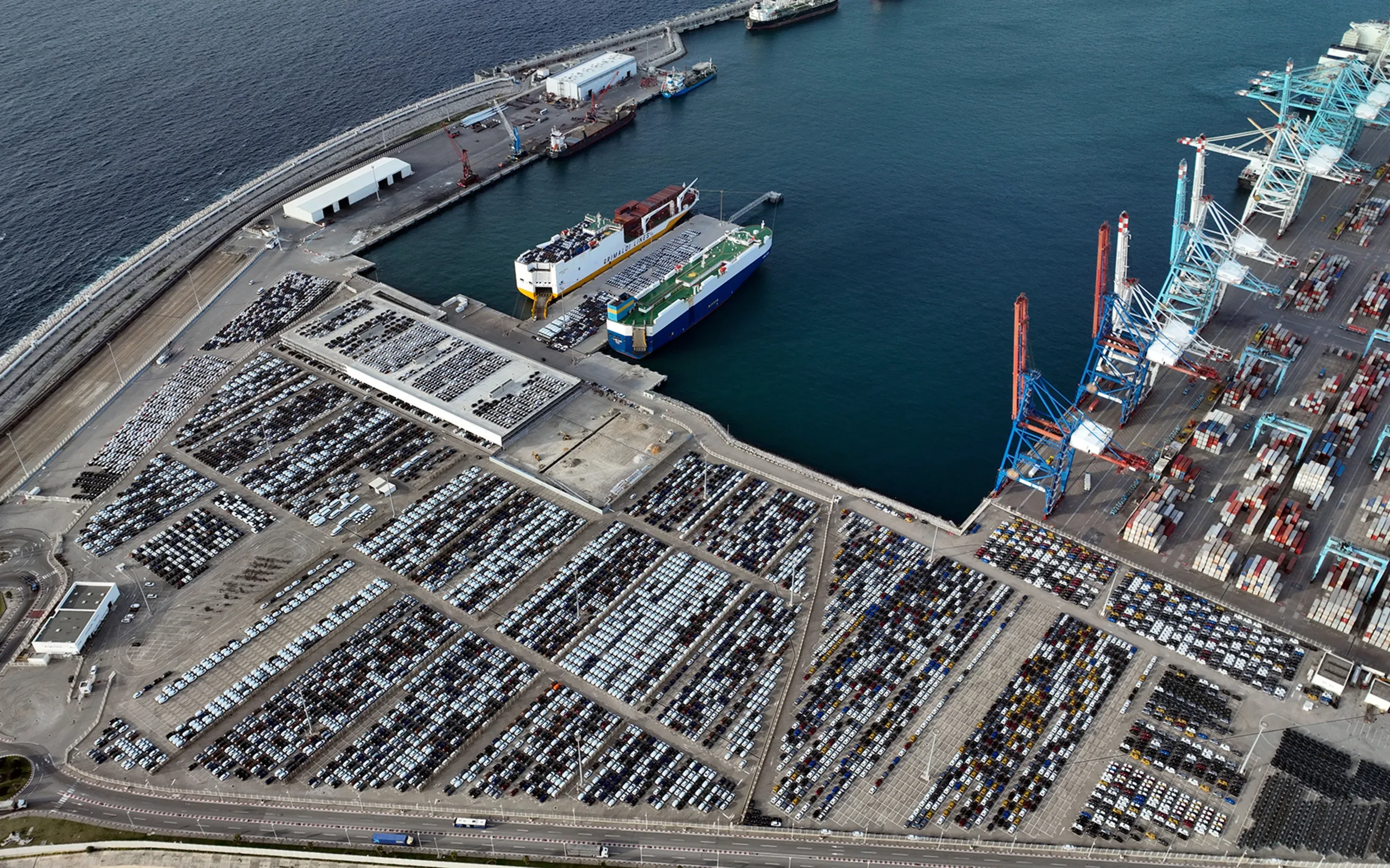
What sets the Tangier operation apart is geography. The Tanger Med port complex sits just a few kilometers from the plant. It processed 161 million tonnes of cargo and more than 11.1 million containers in 2025.
Tanger Med is the largest port in Africa and the Mediterranean, and the 17th largest globally. Its vehicle terminal spans 20 hectares, with an annual throughput capacity of one million vehicles. Direct shipping links connect it to 24 countries, including Australia, South Africa, Romania, Slovenia, and Turkey.
More than 1,500 companies operate within the port’s surrounding activity zones. The model integrates port operations, manufacturing, logistics, and services within a single geographic cluster on the Strait of Gibraltar.
“In a radius of a few kilometres, Morocco concentrates the Tangier plant, the supplier free trade zone and the Tanger Med port, creating a model of efficiency unique in the automotive industry,” said Thomas Denis, Renault Group’s Supply Chain Director. “This exceptional proximity between production, suppliers, and logistics makes northern Morocco one of the most integrated automotive ecosystems in the world.”
Rail lines cut through the plant, moving 8,000 cars a week
The logistics figures reflect the scale of this integration. On the inbound side, 69,100 trucks and 12,000 containers arrive each year to supply the two plants.
On the outbound side, 26,400 trucks, 1,440 trains – each carrying 240 vehicles – and 290 ships depart annually. The weekly output: roughly 8,000 finished vehicles leaving the Tangier complex. Renault holds a dedicated quay at the port.
Two railway lines run directly into the Tangier factory. Multiple daily rotations move vehicles straight from the assembly line to the port terminal.
Rail serves a dual operational purpose. It compensates for a shortage of truck drivers through optimized capacity management over long distances. And it cuts carbon emissions by approximately 90% compared to road transport.
AI-powered control towers monitor every link in the chain
Renault’s supply chain in Morocco operates through three specialized control towers, each driven by artificial intelligence. The Inbound Control Tower tracks parts and component deliveries heading to the factories, flagging potential disruptions before they occur.
The Outbound Control Tower monitors vehicle shipments across road, rail, and sea routes through to the commercial network.
A third unit – the Business Continuity Plan Control Tower – continuously scans global conditions, from strikes and extreme weather to geopolitical crises, and triggers contingency measures to keep flows uninterrupted.
Together, the three towers provide real-time visibility across all supply chain movements.
Green energy covers 90% of the Tangier plant’s needs
On the environmental front, the Tangier plant ranks among Renault’s most advanced facilities. A biomass heating system and wind energy supply approximately 90% of the site’s energy requirements, sharply reducing fossil fuel dependency. A closed-loop industrial water recycling system further limits resource consumption on site.
Workforce development runs parallel to industrial operations. Renault has administered the IFMIA – Morocco’s Institute for Training in Automotive Industry Professions – since 2011.
The public institute has delivered 3.2 million hours of training in automation, robotics, and electrification. Thirty percent of its activity goes toward supporting supplier companies, industrial partners, and youth employability programs in the Tangier region.
A market growing at historic speed
Morocco’s broader automobile market recorded a 33% increase in sales in 2025 – a historic performance. The surge was driven by renewed product offerings, recovering consumer demand, improved access to financing, and the arrival of new market players.
“Over the years, Morocco has become a key pillar of Renault Group’s global industrial footprint, built on industrial excellence, world-class logistics, qualified talent, and a strong public-private partnership,” noted Mohamed Bachiri, Director General of Renault Group Morocco.
“This long-term collective commitment has enabled the emergence of a competitive automotive ecosystem with growing international reach, while supporting the kingdom’s industrial ambitions.”
From local sourcing to exports reaching 63 destinations, Renault’s Moroccan platform now functions as one of the group’s core industrial bases – a position the automaker has signaled it intends to build on further in the years ahead.
Read also: Renault to Cut Up to 20% of Engineers, Morocco Among Affected Sites