

































































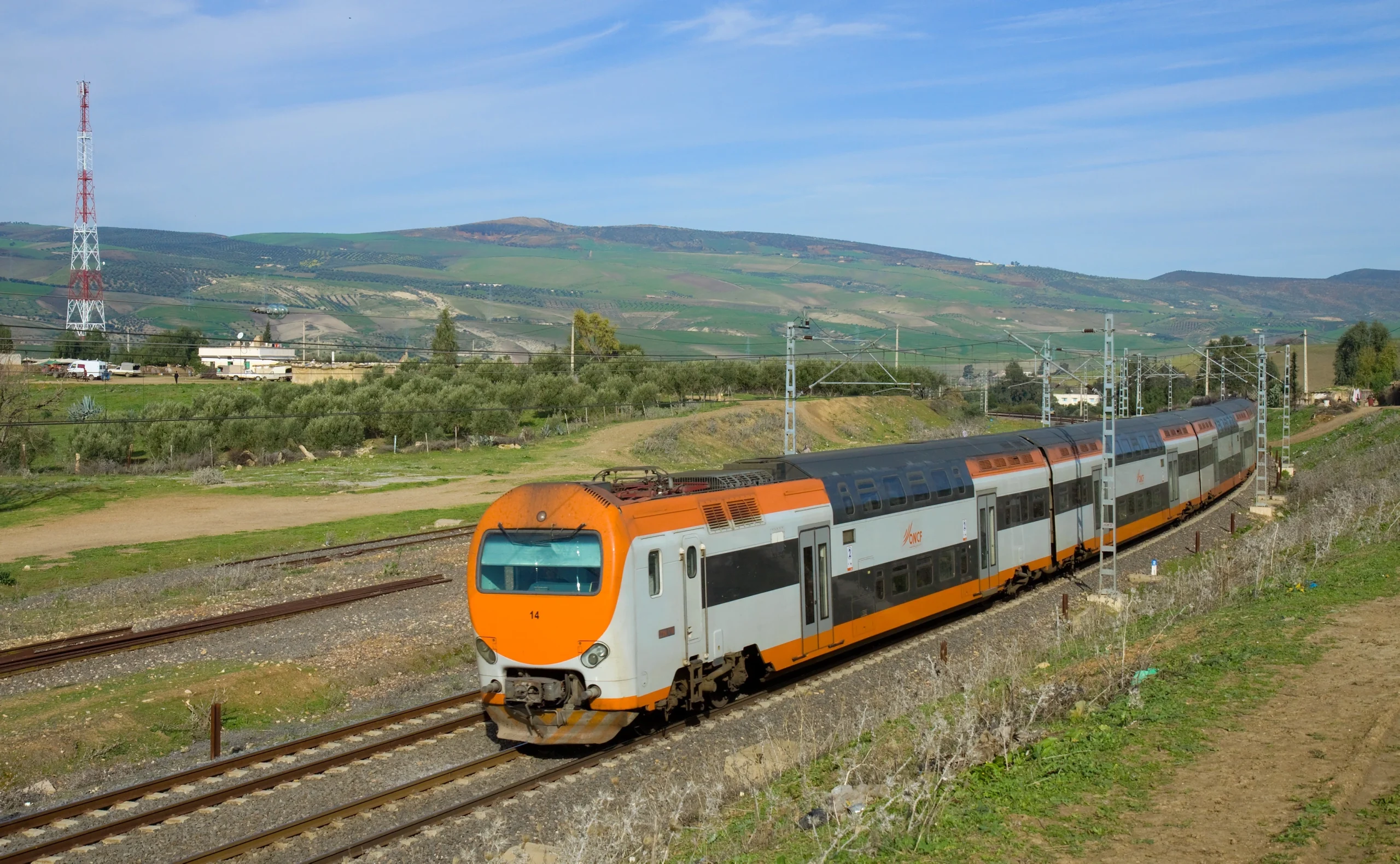
Marrakech – The National Railways Office (ONCF) has informed travelers that train circulation will undergo temporary adjustments over the coming weeks. The changes stem from the advancing works on the Kenitra-Marrakech High-Speed Rail Line (LGV), along with parallel interventions carried out on conventional lines.
According to an ONCF statement, the measures are needed as construction gathers pace. They are designed to accompany the ramp-up of works under optimal safety conditions while maintaining service continuity as far as possible.
The adjustments will unfold in two stages. The first involves targeted changes on September 5 and 6. Works scheduled from 11 p.m. on Saturday, September 5, to 11 p.m. on Sunday, September 6, will affect train circulation across several routes.
To keep affected passengers moving, ONCF plans to deploy alternative solutions and connection arrangements. On the El Jadida TNR (Train Navette Rapide, or fast shuttle) line, trains will be limited to Bouskoura, with connections toward Al Atlas trains. Service on the Settat TNR line will be temporarily suspended, with travelers redirected to Al Atlas trains.
The Airport TNR link will also be suspended and replaced by Supratours shuttle buses. The direct train between Safi and Casablanca will not run during this window. On the Khouribga line, trains will be limited to Berrechid, again with connections toward Al Atlas trains. ONCF also warns that Al Atlas trains may face delays and adjusted journey times.
Throughout this period, the office says it will reinforce its information and support arrangements to keep travelers updated, guide them, and ease their movements.
The second stage introduces a new transport plan starting September 14. Following an initial phase launched on September 15, 2025, the Kenitra-Marrakech LGV works will enter a further stage from that date. The new plan is meant to align circulation with the constraints of the worksite while preserving service and limiting the impact on passengers.
That plan will bring adjustments to certain routes, timetable changes, and shortened services. It will also involve the gradual closure of some stations, including the Facultés station and the Ennassim station.
To help travelers plan ahead, ONCF will publish the full details of these adjustments, and their impact on each axis, starting the week of September 7. Information and support arrangements will be deployed in stations, aboard trains, and across the office’s digital channels.
The disruptions trace back to one of Morocco’s largest infrastructure programs. Launched by King Mohammed VI on April 24, 2025, at Rabat-Agdal station, the 430-kilometer Kenitra-Marrakech line extends the existing Tangier-Kenitra route and forms part of a MAD 96 billion ($9.6 billion) national railway program.
The line alone carries a budget of MAD 53 billion ($5.3 billion) excluding rolling stock, and is designed for speeds of up to 350 kilometers per hour.
Once operational, it will cut the Tangier-Marrakech journey to 2 hours and 40 minutes, saving about 2 hours and 35 minutes compared with current travel times. The Tangier-Rabat trip will fall to one hour, while Tangier-Casablanca will take 1 hour and 40 minutes. Rabat-Marrakech will also take 1 hour and 40 minutes, and Casablanca-Marrakech 1 hour and 15 minutes.
It will also connect Rabat with Casablanca’s Mohammed V International Airport in 35 minutes and Marrakech with the airport in 55 minutes. The project will introduce a high-speed Fez-Marrakech service with a projected journey time of 3 hours and 40 minutes. Trains from Fez will initially use the conventional network to north of Kenitra before joining the new high-speed track to Marrakech.
Heavy civil works run in phases from September 2025 through the end of 2027, with the line scheduled to enter service in 2029, ahead of the 2030 World Cup that Morocco will co-host with Spain and Portugal.
ONCF advises travelers to check their train times before any trip through its official channels: the oncf-voyages.ma booking site, the ONCF Voyages mobile app, the customer relations center on 2255, and the M’ONCF chatbot on 06 67 65 22 55.
Read also: One Year After Launch, What Has ONCF Delivered on Its High-Speed Rail Program?