

Revisiting Bertrand Badie’s book on political development and remembering the lectures by my Professors, among others, Aziz Belal, Bruno Etienne, Mohamed Lahbabi and Driss Slaoui (at that time Moroccan ambassador to UN) on the various distinctive features of underdevelopment, I came up with the idea of understanding the recent political developments in these countries in the light of their respective perspectives, economics, political science, geoeconomics and diplomacy, which remain relevant.
Indeed, the societies of the Global South are often described as disarticulated, dualistic, alienated, dependent, but these concepts remain models that simplify reality to make it intelligible; like the fable of the blind and the elephant, these complementary prisms analyze a part of the social reality of developing countries.
This is why sociology and political science often falter in the face of the eruption of new phenomena that are shaking both traditional societies, in transition, and post-modern societies, such as populism, the resurgence of charismatic authoritarian leaders (big men) and far-right parties in the West, the retreat or even the disappearance of democracies (flawed democracies) and the hybridization of political regimes that is undermining approaches to transitology and theories of political modernization.
The theory of the “silent revolution” formulated by Ronald Inglehart in 1977 was based on a premonitory intuition: the enrichment of post-industrial societies was to lead to a gradual shift from materialist values (economic security, order) to post-materialist values (individual freedom, expression, tolerance). However, it was not until 2019 that the author reneged on his initial predictions with Pippa Norris, when he proposed the concept of “cultural backlash” to designate the mechanism by which a fraction of the electorate, perceiving the transformation of dominant values as an identity threat, reacts negatively to what it considers to be the loss of its status and cultural landmarks. This reaction has its source in the ambiguities of globalization, which opens up markets while producing, in a mirror, particularism consciousnesses and identity withdrawals (François Bayart, L’Impasse nationale-libérale, 2017).
It is also clear that identity withdrawal feeds on both the lack of modernization and its excess, depending on social contexts, and this would partly explain, in our opinion, right-wing populism and identity movements around the world.
Are these trends collateral effects of globalization, is the world moving towards a convergence of political systems, not towards the liberal democracy so much chanted by Francis Fukuyama, but towards the hybridization of democracy that would be confined to free and fair elections and formal political freedoms without counterpart in other aspects of well-being (in particular health, decent housing, education and employment)?
The social Production of conservatism in hybrid regimes
Political conservatism has always been a central object of electoral sociology and comparative politics, traditional explanations generally associate it with religiosity, attachment to tradition or cultural values favorable to social order and age. Another factor is believed to be behind the conservative phenomenon, and that is the tendency to withdraw into oneself through excessive modernization (the Brexit vote is an illustration of this).
These explanations show their limits in the contexts of hybrid political regimes when it comes to explaining the recurrent support given to conservative forces by populations living in rural peripheries, precarious peri-urban areas and informal settlements. Theoretically, economic and social precariousness could lead them to support more transformative projects or redistributive policies (voting in favor of change), yet they regularly constitute electoral bastions of political conservatism.
To understand this paradox, it is necessary to examine the effects of unequal modernization and spatial inequalities, value systems and forms of political mediation; by mobilizing the contributions of Ronald Inglehart on materialist values, Stein Rokkan on the center-periphery divide, and Herbert Kitschelt and Steven Wilkinson on clientelism in order to build an integrated model of the conservative vote in hybrid regimes.
Ronald Inglehart demonstrated in the 1970s that political values are the product of conditions of economic socialization; thus in regions where material precariousness dominates, individuals are materialistic and prioritize economic survival and physical security over freedom of expression and good governance, so in contexts of chronic insecurity the survival reflex prevails over the aspiration to self-expression. This is in contrast to post-modern regions and societies where post-materialist values predominate.
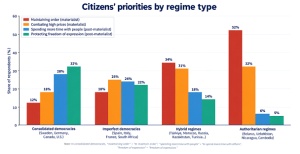
The data from the World Values Survey (7th wave 2017-2022) are revealing on this point; in hybrid regimes, 34% of citizens choose “Maintaining order in the nation” as their top priority, compared to only 12% in consolidated democracies. Conversely, freedom of expression only garners 14% support, compared to 32% in democracies. The index of post-materialist values (freedom of cultural expression, etc.) collapses to 32% in hybrid regimes, compared to 60% in liberal democracies. These are averages that hide the differences between urban, rural and educational settings.
It is no cultural coincidence that these attitudes are the direct product of territorial and economic relegation, measured by a composite index aggregating poverty rate, youth unemployment, educational deficit and digital divide called “peripheralization”, which has a massive effect on materialism (β = 0.68, p < 0.001), explaining 46% of its variance. In other words, in relegation zones, chronic precariousness mechanically activates survival values: priority to order, physical security, the high cost of living, to the detriment of freedom of expression and political participation.
Materialism, once activated, powerfully directs the conservative vote (β = 0.42, p < 0.001), but it is not enough on its own, peripheralization also feeds clientelism (β = 0.54, p < 0.001), which in turn captures the peripheral vote (β = 0.31, p = 0.017), when a rural voter has to choose between an abstract promise of “public moralization” and the concrete distribution of a job, a subsidy or a road, his calculation is rational: he chooses subsistence. The parties close to the government only have to activate these networks of dependence to lock entire constituencies.
However, the clientelist dimension does not work uniformly, it is mediated by individual resources – education, employment, place of residence.
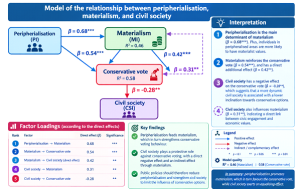
This first lock – social, upstream – inherent in materialism is structural and is not based on any direct coercion or manipulation, it is the natural product of material precariousness and territorial relegation. The peripheral voter votes conservative not because he is forced to do so, but because it is rational in his environment.
The drivers of depoliticization
Our analysis identifies a third, even more insidious mechanism, which we propose to call the “triple lock” of depoliticization; data from the World Values Survey reveal that hybrid regimes differ from consolidated democracies by three cumulative dimensions that form a matrix of political withdrawal.
- The “first spring” of weak post-materialism, illustrated by the fact that only 14% of citizens in hybrid regimes favor the values of self-expression and freedom of speech, compared to 32% in consolidated democracies. The social demand for freedom of expression, transparency, and good governance remains structurally in the minority.
- The “second spring” is cognitive demobilization. Nearly 70% of citizens in hybrid regimes say they are “little” or “not at all” interested in politics, compared to 42% in consolidated democracies. This massive apathy is not a simple natural disinterest; it is the product of cognitive demobilization. By saturating the public space with technical, economic or security discourses, hybrid power succeeds in convincing a large part of the population that politics is a matter for elites, complex and disconnected from the concerns of daily survival.
- The “third spring” is relational self-censorship. Nearly half of citizens (48%) admit to never discussing politics with their friends, compared to only 28% in democracies. Citizens prefer self-censorship, which prevents the formation of organic counter-narratives and isolates potential opponents, preventing them from coordinating collective action.
The perception of the usefulness of elections in bringing about change also plays an important role in political participation in general and in urban areas in particular, where political participation is based more on individual and non-community motivations, which could contribute to the hypertrophy of the electoral weight of rural constituencies and leave the field open to conservative parties. (work by political scientist Pippa Norris, Harvard University, on electoral integrity measured by perceived credibility of elections).
These three springs are interdependent and form a loop: material precariousness feeds cognitive disinterest, which reinforces conversational withdrawal, which in turn prevents the formation of a critical public opinion. The regime does not need coercion: society censors itself.
Institutional engineering
After the first stage relating to constitutional engineering and rationalization of regimes, in particular the parliamentary regime in order to assure the dominance of the executive power and avoid parliamentary hegemony and political instability like in 4th republic in France, many hybrid regimes and democracies as well , recourse in second stage to careful choice of suitable voting methods and the strategic delineation of electoral districts do not spare democracies and are not the prerogative of the hybrid regimes of the South, it is above all a Western invention as is the case of gerrymandering and invented by American politician and governor of Massachusetts, Elbridge Gerry, who signed an electoral division in 1812 favoring his party, thus giving its name to this practice.
An empirical study carried out on a sample of 38 elections in 19 hybrid regimes confirms Shelder’s theory of electoral manipulation and politicians’ apprehensions about the impact of electoral engineering on electoral results. Indeed, pre-electoral redistricting would be by far the most powerful predictor of the marginalization of opposition parties; with a coefficient of β = -0.58 (p < 0.001), it alone explains 71% of the variance in the electoral performance of opposition parties. Voting day fraud weighs only β = -0.21.
The process of peripheralization generates materialist values that constitute the foundation of electoral conservatism. By weakening the demand for change, it contracts the political space available to the opposition. Deprived of a credible counterweight, the hybrid state no longer needs intervention and retains neutrality: its intervention is punctual and minimal, confined to the pre-electoral windows.
The preconditions of democracy
The classics of political development – Lipset, Dahl, Barrington Moore, Huntington – had identified the preconditions of democracy: economic development, reduction of inequalities, civic culture, institutions, modernist bourgeoisie. The data show that the simultaneous absence of these factors produces the hybridization of political systems, but their partial presence opens up a possibility of democratization. (see Zagrebina Anna 2017)
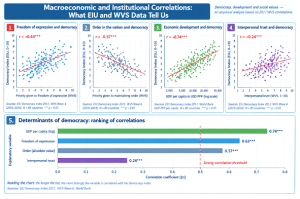
Without falling into determinism and teleology, a political process does not ipso facto lead to democracy, generally the appearance of a democratic regime is associated with four virtuous correlations :
- The first positive one, the strongest of the lot, links GDP per capita and democracy (r = +0.74, p < 0.01) and validates the thesis of asymmetrical modernization: economic development reduces peripheralization, deactivates materialism and dries up the breeding ground for clientelism.
- The second, positive, links freedom of expression and democracy (r = +0.63, p < 0.01): in societies where individuals privilege freedom of speech, democratic regimes are structurally more consolidated.
- The third, negative, associates priority with order and democracy (r = −0.57, p < 0.01): societies that give absolute priority to maintaining order systematically have lower indices of democracy.
- The fourth, positive but more modest, combines interpersonal trust and democracy (r = +0.24, p < 0.01), shedding light on the protective role of civil society in our model (β = −0.28, p < 0.01).
What lessons can be learned from the above; firstly, hybrid regimes are not transitional anomalies, they are fully-fledged sui generis political systems, rational, adapted to their environment; secondly, authoritarianism is not inevitable and democratic transition is not inevitable, it is not necessarily the final stage of a political process, and finally hybrid regimes are based on traditional, religious or charismatic legitimacy, political control of populations as well as on political engineering that adapts to the sociological realities of each country.
References
Badie, B. (1996). “Political Development”. Presses de Sciences Po.
Dahl, R. A. (1971). «Polyarchy». Yale University Press.
Diamond, L. (2002). Thinking About Hybrid Regimes. «Journal of Democracy»..
Inglehart, R. (1977). «The Silent Revolution». Princeton University Press.
Inglehart, R. (1997). «Modernization and Postmodernization». Princeton University Press.
Kitschelt, H. & Wilkinson, S. I. (2007). «Patrons, Clients, and Policies». Cambridge University Press.
Levitsky, S. & Way, L. A. (2010). «Competitive Authoritarianism». Cambridge University Press. Moore, B. (1966). «Social Origins of Dictatorship and Democracy». Beacon Press. Rokkan, S. (1970). «Citizens, Elections, Parties».
McKay. Schedler, A. (2002). The Menu of Manipulation. «Journal of Democracy», 13(2), 36-50.
Schedler, A. (2013). «The Politics of Uncertainty». Oxford University Press.
Zagrebina Anna (PhD thesis UQAM 2017) Bien-être personnel dans les sociétés démocratiques et non démocratiques contemporaines : une analyse comparative.