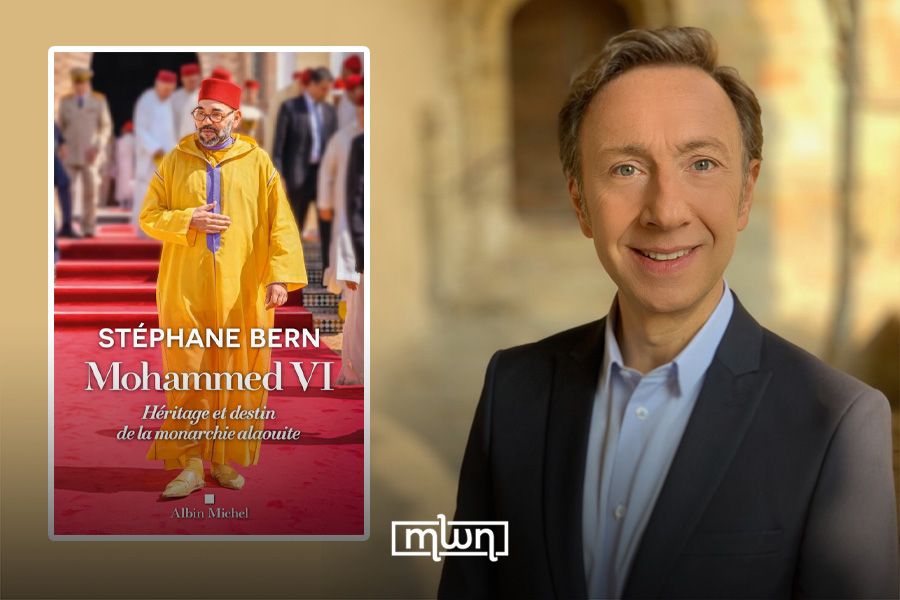
Marrakech – French historian and broadcaster Stéphane Bern, a specialist in royal families, has published “Mohammed VI. Héritage et destin de la monarchie alaouite” (“Mohammed VI: Heritage and Destiny of the Alaouite Monarchy”), a historical account that traces the dynasty governing Morocco for close to four centuries.
The book arrives as the kingdom marks 25 years of Mohammed VI’s reign and ahead of the king’s state visit to France, announced for January.
Bern frames the project as an attempt to fill a gap. “The French love Morocco, know Morocco well, they go to Marrakech,” he told Europe 1, “and yet they know the history of the monarchy poorly.” He describes himself plainly as a friend of Morocco who loves the country a great deal.
To write the saga, he drew on the work of many historians to understand what sets this dynasty apart from those before it and to explain the particular place of the Moroccan sovereign.
The work profiles three Alaouite kings and the dynasty’s sultans – numbered at thirteen in his interview with Le Journal du Dimanche and twenty-nine in his account to Europe 1 – from Ali Chérif in the 17th century to Mohammed VI.
Bern counts the Alaouites among the oldest dynasties still reigning anywhere. He traces the family’s rise to power to 1666, under the impulse of Moulay Rachid, who lived from 1631 to 1672. That ascent sits within a far older line of Moroccan statehood, which traditionally dates to 789 and Idriss I, founder of the Idrisside dynasty, the country’s first Muslim lineage, descended from the Prophet Muhammad through his daughter Fatima and his son-in-law Ali.
The Almoravids, Almohads, Merinids, Wattassids, and Saadians followed before the Alaouites took the lead in the second half of the 17th century. Across that span, he argues, the Alaouites worked to preserve the unity of the Sharifian Kingdom and defend its sovereignty, acting over the long term with Moroccans’ interests in view.
A dynasty rooted in religious authority
Much of that continuity, in his account, rests on the religious character of the throne. Speaking to Le Journal du Dimanche, Bern explained that the sultans and kings hold a temporal and a spiritual role through their descent from the Prophet of Islam, and that the word “alaouite” derives from Ali, the Prophet Muhammad’s cousin and son-in-law.
The king is Commander of the Faithful and carries a religious aura known in Arabic as “baraka,” which Bern credits for the monarchy’s durability. That singularity, he told Europe 1, calls to mind the Japanese monarchy, another institution he has written about.
That identity, he recounted to Le Journal du Dimanche, shaped Hassan II’s reaction to the 1979 Iranian revolution that ended the Shah’s rule. Mohammed VI’s father watched the rise of religious radicalism in Iran with concern and worked to shield Morocco, keeping the country’s religious identity intact without abrupt westernization.
Bern also returns to the French protectorate. Marshal Hubert Lyautey, named resident general in 1912, a Saint-Cyr-trained Catholic and monarchist, respected Moroccan identity where other French officials sought to suppress any move toward independence.
From 1912, Lyautey ordered the protection of traditional Moroccan architecture and the restoration of mosques, made Rabat the political capital, and “gave” the country its flag, a solid red field bearing a green five-pointed star, the color of Islam.
The dynasty nearly fell, he recounts, when France forced Mohammed V into exile in Corsica and then Madagascar from 1953 to 1955 over his closeness to the Istiqlal independence party. The move backfired, uniting Moroccans behind the sultan and consolidating the nationalist movement, which led to independence in 1956.
He credits Mohammed V as the father of the modern Moroccan nation and recalls his role in protecting the country’s Jewish community during the Second World War; General de Gaulle made him a Companion of the Liberation in June 1945.
A quarter-century of reform, and a visit to Paris
On the current reign, Bern’s assessment is favorable. Speaking to Le Journal du Dimanche, he called the work of Mohammed VI “quite impressive.”
He recalled that in 1999 Morocco faced heavy unemployment, regions without drinking water and electricity, and illiteracy affecting half the population. Mohammed VI came to the throne at 35. “In twenty-six years on the throne,” he writes, the king “methodically reformed the country as he had committed to, despite successive crises.”
Social disparities and endemic poverty have been intolerable to the king since the start of his reign, in Bern’s account, earning him the nickname “the king of the poor.” Those disparities persist, he concedes, but the king presses his government to move faster on inequality and to accelerate decentralization.
He points to social coverage now reaching 88% of Moroccans, electrification of more than 99% of the territory, highways that grew from 400 kilometers in 1999 to 1,800 in 2023, and investment in aeronautics, solar and wind power, automotive, and logistics. Morocco, in his telling, is the continent’s leading industrial power, ahead of South Africa.
“The king sets the course,” he told Europe 1, “but he works over the long term,” while conceding that several worksites remain open.
On succession, Bern notes to Le Journal du Dimanche that Moroccan tradition avoids the subject, since the king alone holds the function of Commander of the Faithful. Crown Prince Moulay El Hassan, 23, prepares out of view and carries out official duties; in May, his father named him coordinator of the army general staff’s offices and services, a role Mohammed VI once held himself. Things happen naturally, in his words.
He closes on France. The January visit, the first since 2000, will see France sign a friendship treaty with a country outside the European Union for the first time.
Bern situates it within Morocco’s wider standing – its return to the African Union in 2017, the Abraham Accords of 2020, and American and French recognition of Moroccan sovereignty over Western Sahara – which, he argues, places the kingdom at the front rank of the international scene. He also notes the access he obtained, telling Europe 1 of a fairly privileged view of the way the king reigns.