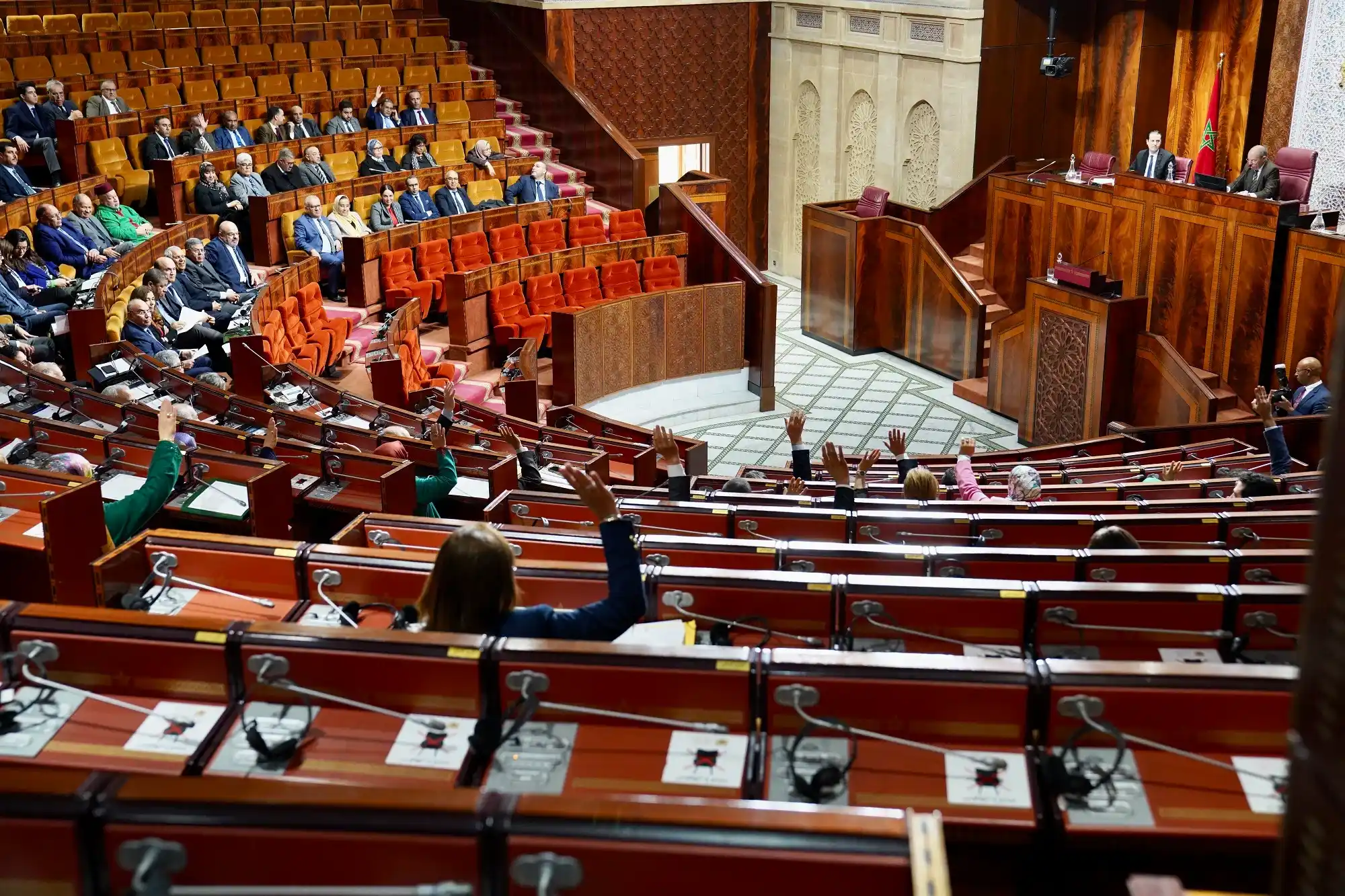
Marrakech – Morocco’s House of Representatives completed the formation of its leadership bodies on Wednesday, electing eight vice presidents, appointing nine permanent committee chairs, and announcing the heads of parliamentary groups following the September 23 legislative elections.
The plenary session, chaired by newly elected House Speaker Ahmed Touizi, approved a single list of candidates with 293 votes out of 295 ballots cast. Two ballots were declared invalid, while 100 lawmakers were absent from the session.
The vote came one day after Touizi, a senior figure in the Authenticity and Modernity Party (PAM), was elected Speaker of the House of Representatives, securing 220 votes against 59 for Idriss El Azami El Idrissi of the Justice and Development Party (PJD).
Wednesday’s proceedings completed another stage in establishing the parliamentary leadership and distributing responsibilities among political groups for the new legislative term.
New House bureau takes shape
Mustapha Baitas of the National Rally of Independents (RNI) was elected first vice president of the House, succeeding PAM’s Mohamed Sibari.
Khalid Chennak of the Istiqlal Party secured the second vice presidency, replacing fellow Istiqlal member Khadija Zoumi, while the PJD’s Abdellah Bouanou became third vice president, succeeding Socialist lawmaker Driss Chtaibi.
Mohamed Ouzzine of the Popular Movement retained his position as fourth vice president, making him the only member of the previous vice-presidential lineup to remain in the same position.
The fifth vice presidency went to Mohamed Mellal of the Socialist Union of Popular Forces (USFP), succeeding Mohammed Joudar, who was elected sixth vice president, representing the Constitutional, Democratic, and Social parliamentary group. Joudar replaces Nadia Thami of the Party of Progress and Socialism (PPS).
Meryem Ou-Hssata of the PPS secured the seventh vice presidency, succeeding Hassan Benomar of the RNI, while PAM’s Adil Bitar was elected eighth vice president, replacing Zina Idahli of the RNI.
The new appointments also brought changes to the House’s financial and administrative management.
Amina Maelainine of the PJD and Houda El Mghari El Mberred of PAM were elected quaestors, replacing Mohamed Hamouti of PAM and Abdelaziz Lachab of Istiqlal.
Meanwhile, Fatimaezzahra Bassraoui of the RNI, Mbarek Hmia of Istiqlal, and Aziza Badad of PAM were elected secretaries of the House bureau, taking over positions previously held by Mohamed Boudrika of the RNI, Tariq Kadiri of Istiqlal, and Ilham Saki of PAM, respectively.
Nine parliamentary committees get new leadership
Beyond the bureau, lawmakers elected the presidents of the chamber’s nine permanent committees, which oversee legislation and parliamentary scrutiny across different areas of government policy.
Under Article 59 of the House’s internal regulations, as amended following an August 2025 Constitutional Court decision, the chamber operates through nine permanent committees.
Mohamed El Gherras, representing the Constitutional, Democratic, and Social group, was elected president of the Committee on Foreign Affairs, National Defense, Islamic Affairs, Migration, and Moroccans Residing Abroad, succeeding RNI lawmaker Nadia Bouaida.
Istiqlal’s Moncef Toub was appointed president of the Committee on the Interior, Territorial Communities, Housing, Urban Policy, and Administrative Affairs, replacing PAM’s Hicham Mhajri.
The Committee on Justice, Legislation, Human Rights, and Freedoms will be chaired by Mohamed Ghayat of the RNI, who succeeds Mohamed Laâraj of the Popular Movement.
Hicham Mhajri, meanwhile, moves to the presidency of the Committee on Finance and Economic Development, replacing RNI lawmaker Mohamed Chouki.
The PJD secured the presidency of the Committee on Social Sectors through Mustapha Ibrahimi, who succeeds Hamid Noughou of the Constitutional, Democratic, and Social group.
Mohamed Laâraj of the Popular Movement was elected president of the Committee on Productive Sectors, replacing Istiqlal’s Jamal Diwani.
The Committee on Infrastructure, Energy, Mines, Environment, and Sustainable Development will be chaired by USFP lawmaker Abdelhak Amghar, who succeeds fellow Socialist Mohamed Mellal.
Hassan Derhem of the PPS was elected president of the Committee on Education, Culture, and Communication, replacing fellow PPS lawmaker Addi Chajri.
PAM also retained the presidency of the Committee on Public Finance Oversight and Governance, with Hanane El Massi succeeding fellow party member Latifa Lablih.
Political parties announce parliamentary group leaders
Alongside the election of the bureau and committee presidents, the House formally announced the leadership of its parliamentary groups.
Hicham Sabiri will lead PAM’s 97-member parliamentary group, succeeding Touizi following his election as Speaker.
Yassine Oukacha will retain the leadership of the RNI’s 66-member parliamentary group, which has moved into opposition following the September 23 elections. Oukacha previously took over the position from Chouki in March.
Madiha Khayr was named president of Istiqlal’s 65-member parliamentary group, while Idriss El Azami El Idrissi will lead the PJD’s 54 lawmakers.
Rim Chabat will head the Popular Movement’s 29-member parliamentary group, while Abderrahim Chahid retains the leadership of the 26-member Socialist group.
Chaoui Belassal will continue leading the Constitutional, Democratic, and Social group, which comprises 25 lawmakers, while Rachid Hammouni retains the presidency of the PPS parliamentary group, consisting of 22 members.
Nabila Jalal was also announced as coordinator of the Left Alliance parliamentary grouping, which comprises nine members.
With the completion of these appointments, the House of Representatives has established its bureau, permanent committee leadership, and parliamentary group structures, allowing the chamber to proceed with its legislative and oversight responsibilities during the new parliamentary term.