
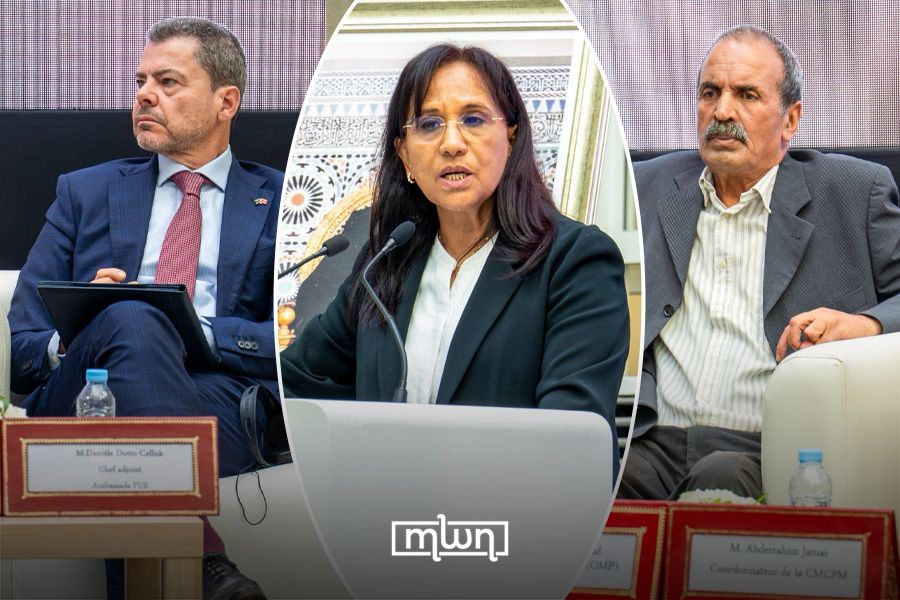
Casablanca – The National Human Rights Council (CNDH) and Moroccan human rights advocates called on the government and Parliament to abolish the death penalty during a press conference in Rabat today, arguing that the country should turn its longstanding suspension of executions into a legal ban ahead of the 10th World Congress Against the Death Penalty in 2029.
CNDH President Amina Bouayach said the annual meeting aimed to strengthen efforts to defend the right to life and make abolition a priority in the next round of legislative reforms, particularly the revision of Morocco’s Criminal Code.
“Our goal is to reach the international conference in 2029 with the death penalty abolished in Moroccan legislation,” Bouayach told the press.
She cited Morocco’s constitutional protection of the right to life and its recent support for international efforts to suspend the use of capital punishment. She also pointed to the country’s commitment to host the next World Congress Against the Death Penalty in Marrakech.
In her opening speech, Bouayach framed the debate as a question of society’s values and the limits of punishment.
“The debate on the death penalty is, at its core, a test of society’s own humanity,” she said, calling for an approach that considers victims, their families, people sentenced to death and the wider community.
“Humanizing the debate does not mean forgetting the crime, minimizing its impact or equating the victim with the perpetrator. It means refusing to make the taking of life one of the tools of justice, and protecting society without abandoning the human being,” she said.
Bouayach noted that Morocco had gone 33 years without an execution, with the last one taking place in 1993. She argued that this record showed the country could protect society and pursue justice without putting people to death.
Death row population falls to 56
Abdellah Mouseddad, secretary-general of the Moroccan Prison Observatory and a member of the Moroccan Coalition Against the Death Penalty, also pointed to a decline in the number of people on death row.
“The current number stands at 56, compared with more than 800 in the past,” he said, attributing the decline partly to royal pardons and judicial decisions. The current figure includes one woman, according to Naima El Ghalaf, coordinator of the lawyers’ network advocating abolition.
Mouseddad said Moroccan courts issued between five and 11 death sentences annually in recent years, with seven sentences handed down in 2026. He also cited a moratorium on executions dating to 2011 and changes to criminal procedure law that require judges to reach a unanimous decision before imposing a death sentence.
Abderrahim Jamaï, coordinator of the Moroccan Coalition Against the Death Penalty, urged Moroccan officials across all branches of government to make their position clear before the 2029 congress.
“When will Morocco announce the abolition of the death penalty from its criminal justice system? When will it announce the replacement of death sentences with alternative penalties? And when will it decide to sign the protocol attached to the International Covenant on Civil and Political Rights?” he asked.
Jamaï said advocates needed a joint action plan to prepare for the congress and called for a clear political decision to remove capital punishment from ordinary and military criminal legislation.
El Ghalaf raised concerns about the legal status and prison conditions of people sentenced to death, particularly because Morocco no longer carries out executions.
“Are they being held indefinitely? Are they effectively serving their sentences without a clear legal framework?” she asked, arguing that the law should no longer allow courts to impose the death penalty.
Read also: CNDH: Low Turnout Raises Trust, Other Concerns for 2026 Elections
A joint declaration issued at the meeting called on the government to prioritize abolition in its legislative reforms, urged Parliament to end what it described as legislative hesitation, and asked the government to ratify the Second Optional Protocol to the International Covenant on Civil and Political Rights.
The declaration also stressed that abolition would not mean tolerating crime or disregarding victims and their families. Instead, its signatories argued that Morocco should pursue justice that protects society, supports victims and allows room for rehabilitation without taking human life.
Bouayach urged the government and Parliament to act during the current legislative term, moving Morocco from its long-standing suspension of executions to the complete abolition of the death penalty in law.