



















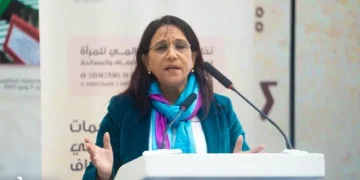





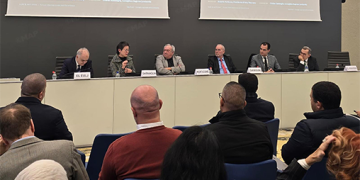









































Marrakech – The Economic, Social, and Environmental Council (CESE) presented its opinion on the place of the douar in rural development on November 16, in Errachidia, in the Drâa-Tafilalet region.
The presentation, presided over by Abdelkader Amara, laid out a document titled “What Place for the Douar in Rural Development?”, adopted unanimously by the council’s General Assembly on August 31. It comes as the state prepares a major move into the countryside.
The financial commitment behind that move is substantial. The kingdom is targeting a single-speed Morocco, an end to the “two-speed” divide, and plans MAD 210 billion ($21 billion) for an eight-year program of integrated territorial development.
Of that, MAD 25 billion ($2.5 billion) comes from the 2027 Finance Bill (PLF), with a further MAD 1.68 billion ($168 million) earmarked for 24 emerging rural centers.
The council’s authority to issue the opinion rests on a 2023 tripartite convention with the Interior Ministry, represented by the General Directorate of Local Authorities, and the Association of Regions of Morocco, which grants the option of self-referral on advanced regionalization.
Fishing villages and douars bordering forest regions fall outside the study’s scope, given their distinct socioeconomic and regulatory features.
Coverage on paper, distance in practice
The report’s key findings concern how far rural residents must travel to reach basic services. Access to education declines steadily as students advance through the system.
While 63.9% of douars, home to roughly 70% of the rural population, sit within two kilometers of a primary school, only 8.4% are within two kilometers of a lower-secondary school (collège), and just 4.4% are that close to an upper-secondary school (lycée qualifiant).
The gaps widen at longer distances. More than a quarter of the rural population (26.4%) lives over 10 kilometers from a collège, while nearly 43%, or approximately 5.54 million people, live at least 10 kilometers from a lycée qualifiant. That burden falls most heavily on the continuity of schooling, particularly for girls.
Health care follows the same pattern. Only 35.6% of douars have a health facility within five kilometers, covering 44.2% of the rural population. The remaining 64.3% of douars, representing 55.4% of rural residents, lie five kilometers or more from any health structure.
For older people, pregnant women, and children, distance combined with transport conditions can turn a nominally available service into one that is hard to reach.
Infrastructure coverage, by contrast, has advanced considerably. Census data from 2024 show 75.7% of douars served by a paved road and 90.2% by a road passable to vehicles, reaching more than 92% of the rural population. Rural household access to electricity reached 98.2% in 2024.
Yet coverage figures hide the real conditions of access. In some remote douars, the council found connection costs that can exceed MAD 80,000 ($8,000) per household, alongside recurring voltage drops and outages.
This drives the council’s central critique. In its reading, public action still rests on “making equipment available” rather than on residents’ effective access to infrastructure and services. The council points to a persistent gap between the place the douar occupies in rural realities and the place granted to it in the design of local public action.
The opinion opens with the 2025 Throne Day speech, which acknowledged that some areas, especially rural ones, “still endure forms of poverty and precarity” for lack of basic infrastructure.
Making the douar the base unit
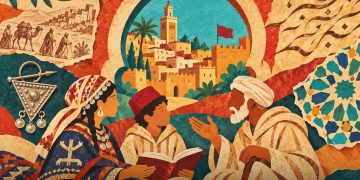
The douar remains the nuclear unit of rural Morocco, known variously as dcher, ksar, or ighrem. The 2024 census counts 33,189 douars, grouping about 3 million households and close to 13.5 million inhabitants, an average of 25.9 douars per commune.
The CESE defines the douar as a cluster of rural dwellings whose residents are tied by kinship, neighborhood, and socioeconomic bonds, with no institutional status of its own and administratively attached to a commune.
That unit is changing. Urbanization, road building, and digital communication have opened the douar to cities and markets without erasing it, drawing graduates, entrepreneurs, and returning migrants back into local life. The rural population is still projected to fall, from 13.7 million in 2024 to 10.8 million by 2060.
From this diagnosis, the council holds that the douar should be established as the base unit of rural development, the first scale at which local realities are read, needs identified, and priorities set.
Its recommendations run along several lines. The council calls for concerted douar development plans built with existing local bodies, including the Jmaâ and village committees, ensuring the participation of women and youth.
It wants a harmonized national reference framework to make reliable douar-level data available, noting such data is often missing or under-reported. It urges adapting urban-planning documents and construction norms to rural realities while preserving traditional architecture.
The council also recommends developing local value chains in agriculture, terroir products, crafts, and rural tourism; documenting and codifying local knowledge and heritage before demographic change interrupts its transmission; and strengthening environmental resilience through sustainable management of water and farmland and adaptation to climate change.
Read also: A Rural School Bus Is an Education Policy, Not a Side Expense