
In January 1912, French painter Henri Matisse traveled to Tangier, seeking new inspirations and a different environment after losing his father. He crossed the Mediterranean, hoping to incorporate Morocco’s light into his art, but when he arrived, it rained nonstop for two weeks.
Stuck in the Hotel Villa de France, Room 35, Matisse started painting his bedroom and discovered a new model in Zorah, a Moroccan prostitute.
The story of Matisse’s voyage to Tangier is the inspiration behind French-Moroccan cartoonist Abdel de Bruxelles and French writer Fabien Grolleau’s “Tanger sous la pluie,” a graphic novel that combines historical fact and fiction to depict Matisse’s time in Tangier. De Bruxelles and Grolleau recently published an online English version.
“We can also tell the story this way, without twisting the truth,” Grolleau wrote in the book’s foreword.
Morocco World News interviewed the two authors on June 23.
Exoticizing Morocco
De Bruxelles, who is fascinated by Matisse’s work, has always wanted to draw Morocco, the country of his family’s origin. During de Bruxelles’ collaboration with Grolleau, which started in 2018, Grolleau proposed drawing and writing about the french painter’s travel to Tangier, the impediment of the rain, and his encounter with Zorah.
“When he told me his idea about Matisse’s travels, Zorah and the rain, I thought it was amazing,” de Bruxelles said.
As little is known about Zorah, this void allowed Grolleau and de Bruxelles’ imagination to flourish. In their graphic novel, her character possesses a strong personality, posing for Matisse while simultaneously devising ways to escape her brothel.
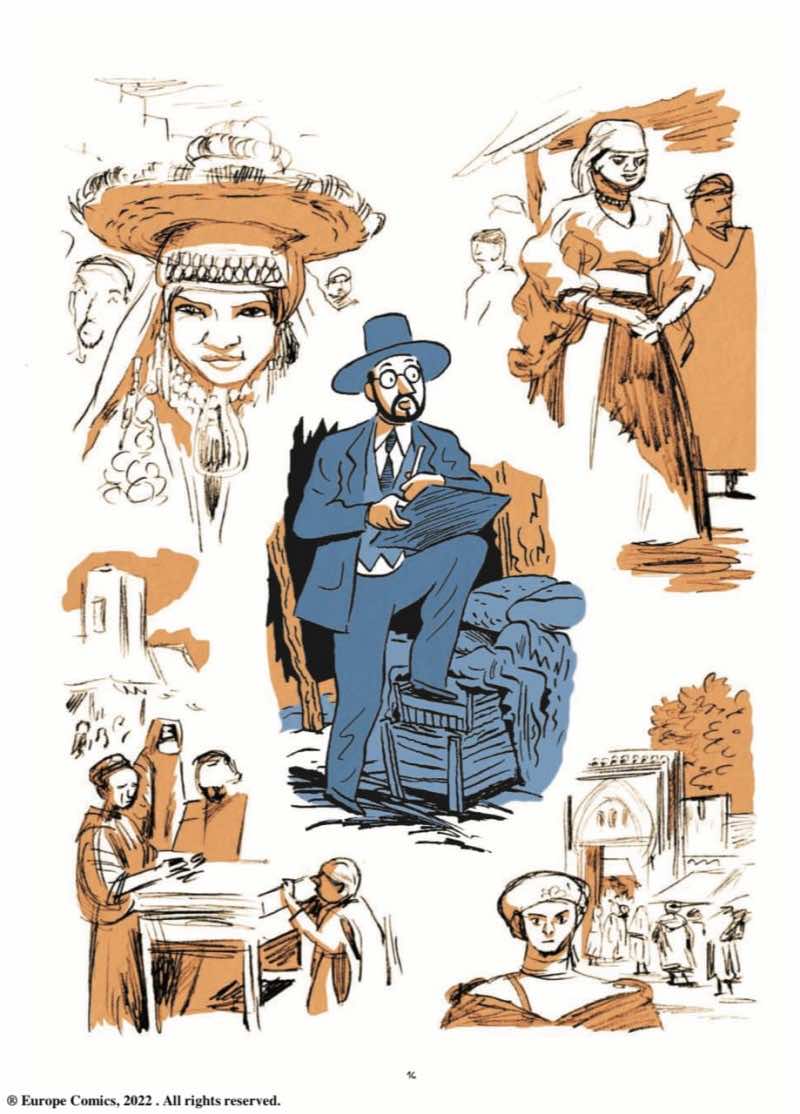
Source: The Europe comics edition
According to the MoMA archives, Matisse visited Tangier twice between 1912 and 1913, where he stayed for several months each time at the Hotel Villa de France in the same room. This room, which he painted in his 1912 painting “Triptyque marocain,” offered stunning views of the Casbah and the Medina, the oldest parts of Tangier.
The painter came to Tangier with specific expectations about Morocco’s atmosphere, inspired by Delacroix’s paintings. The rain was not a part of his plan, however, and the graphic novel depicts Matisse with an unsatisfied fantasy. Throughout the novel, the two authors indirectly criticize the way Matisse’s character, as a European artist, perceives Morocco: a land to use for a purpose, rather than a foreign country to discover.
“Matisse’s paintings of Tangier helped to build my script,” Grolleau said.
Grolleau and de Bruxelles gave life to Matisse’s models represented in his masterpieces of Tangier. Amido’s character, a young Moroccan boy working for the Hotel, came from the painting “The Moroccan Amido.” Zorah is featured in three different portraits: “Zorah on the Terrace,” “Zorah in yellow,” and “Standing Zorah.”
“It’s not a documentary, and at some point, to keep the story alive, we need to recreate some parts with our imagination,” de Bruxelles noted. “I really enjoyed drawing this story because [Grolleau] created details which make this story real and human.”
One character does not hail from Matisse’s sketches, but from Morocco’s art history: Muhammad Ben Ali ar-Ribati, one of the earliest figurative Moroccan painters. Based in Tangier at the dawn of the 20th century, ar-Ribati is known for his watercolor paintings.
A cultural mecca
Grolleau said he wanted to imagine a meeting between Matisse and a local painter, after he discovered Ben Ali ar-Ribati’s work in his research. While they most likely never met in reality, they did encounter each other in “Tangier in the Rain.”
De Bruxelles, who knows Morocco very well, frequently discussed with Grolleau how to best create a realistic representation of what Tangier looked like at the beginning of the 20th century.
As Tangier received a unique international regime status while the rest of Morocco became a French protectorate in 1912, the northwestern Moroccan city became a mecca for Western writers, artists, and diplomats.
At the beginning of the graphic novel, we see British, French, and German travelers staying at the Hotel Villa de France. The two authors found an effective balance between historic facts concerning Tangier in 1912 and their own imaginations.
“A lot of people tell me that they didn’t know about Matisse’s life in Morocco before reading our comic,” de Bruxelles said. “It’s an aspect of Matisse that stayed quite unknown.”
Colors, motifs, and techniques that Matisse discovered in Morocco impacted the rest of his work and the overall European artistic scene as well. French, Swiss, Danish, and Russian private collectors immediately demanded Matisse’s Morocco paintings, according to a 1990 MoMA press release about the exhibition “Matisse in Morocco: the paintings and the drawings, 1912-1913.”
“Moroccan art had a great influence on Matisse’s work, and so in general on art and paintings,” Grolleau said. “Our goal was trying to show that through our comic book “‘Tangier in the Rain.’”
“I feel like Morocco has done its work in me, forever,” Matisse said at the end of his second trip to Morocco, according to the Arab World institute website.
Although Matisse planned to return to Morocco for a third time, he unfortunately never did.