 Join on WhatsApp
 Join on Telegram
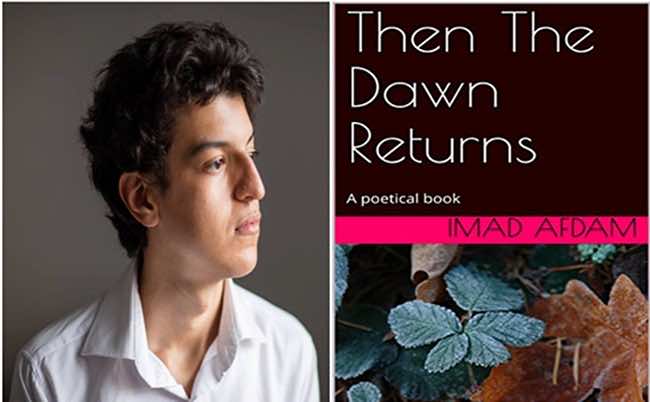
Rabat – Imad Afdam is an ambitious 23-year-old Moroccan writer and poet. Afdam’s most recent achievement is a newly published book of poems entitled “Then the Dawn Returns”—a book of about 92 pages with 63 poems, all written in English.
The poems are sentimental, personal and intra-personal that are composed in both classical and modern verse. Afdam’s book is available on websites including Amazon, Lulu, Smash Words and Create Space, as well as in Europe and the United States.
Afdam holds a master degree of applied foreign languages studies from Cadi Ayyad University in Marrakech, Morocco. Most recently, Afdam majored in anthropology and international Relations as an Erasmus student at University of West Bohemia in the Czech Republic.
Morocco World News recently sat down to interview Mr. Afdam.
How has your experience been as young writer and a poet?
Imad Afdam: I have always wanted to be a writer, and poetry was this refuge that welcomed me with open arms. I accessed the world of poetry through Arabic; the only language I mastered back then, and I have written loads of free verse in Arabic…until I met English. I believe it has introduced me to a diverse range of emotions I had in custody. There is this unmistakable shaky recollection of thoughts, scars of memories and profound feelings only English language could have succeeded to portray, I believe.
What inspires you to write?
Imad Afdam: Anything actually, that’s the thing with poetry, you need to stay alert to your ethereal soul, one should have such light a soul that could dissect the whispers and glimpse the beyond, otherwise the surface won’t get you anywhere on page. For the untrained eyes, a flying bird is uninspiring, for us writers, poets, artists, a whole universe resides there; that’s inspiration for me.
Professional non-fiction and fiction writers need to sit down with or without inspiration to finish their works at a definite deadline around the clock, it’s a different process for poets. Arthur Rimbaud famously wrote his entire poems during his childhood and teenage years and never had touched poetry again…something to ponder about.
What is the relationship between language, your feelings, stories, and lived experiences? What about those of others? Why did you choose to write in English and not Arabic or French? Did you encounter any difficulties expressing your work in English?
Imad Afdam: That’s a very complex question and I can only reflect on it through a deep sense of relationship between desire and design. I wanted to explain my feelings to myself, how the world made sense to me and how I translated people in my own mind, I believe as a multilingual [person], I have [a] freedom to pick different words from different jargons and languages, and as surreal as it can get, English governed and still does in my consciousness.
I wish I could write poetry in French because the musicality and innovation it offers is inspiration in itself. Arabic is my mother tongue and it will always hold a special place in my heart. And to be blunt with you, having to live in Morocco proved to be problematic when considering sharing my own creations with the general public.
I am very hopeful since our generation is extremely exposed to media and to the Lingua-Franca English, but it is still difficult to pull it off in a country where English is a mere second foreign language. I have been told consistently that I would have had better attention or coverage if my anthology had been written in Arabic or French, but again, my [calling] is different.
To whom is your work addressed?
Imad Afdam: Well, my work is addressed tosome very particular people actually; let’s say people who have played a drastic shift in my life, whether intentionally ornot. That may sound cliché because the poems do joggle around a number of themes, but there’s this one special ‘you’ that cements all of the images. I feel religious about protecting those many ‘yous’ in the poetry. Again, it is safe to say that many of these poems have been composed during a very unprecedented yet strange moment during my life.
I withdrew and lived in a closet, and solitude permitted me to access a different dimension within my personality. I have many poems addressing myself, or people I hold as idols, or those who have intrigued me—for example the very last poem of the book is about Princess Diana, entitled as per her death date: 30th August, 1997. Everything there is for a reason, nothing in poetry is random!
Do you feel the work would function as well as if it were translated to Arabic or French or another language? Would it lose some of it essence?
Imad Afdam: I definitely do not think so—recently I had three of my poems translated into Arabic by a talented translator and I strongly think [that] shewonder fully remained faithful to the spirit of the ‘Englishness’ of the poems. There’s a famous myth that poetry is untranslatable—perhaps feelings are translatable but once they are on page, they prove to be, and then they make out of you a poet.
They say you truly speak a language when you dream in that language. Does your work come to you in English or is it an element of bilingual thought?
Imad Afdam: I would like to have dreams in Japanese even though I have a humbly basic level. You know what? I think my dreams resemble a silent movie. Though definitely I happen to dream of conversations, but I think they run about mentally rather than verbally.
I feel more eloquent using English other than any language in my daily life, and I did not rely on school to learn English, that was my very private occupation to do at home and anywhere actually, to master this beautiful language which I had no idea back then that it was important or international, or still that it would be my specialization in university, both in Bachelor and Masters.
Do you think that some languages are more conducive to poetry than others?
Imad Afdam: Yes, I truly believe Arabic is a powerful agent between heart and language, and I do look back warmly to the intensive Arabic courses we used to have about the pre-Islamic poetry, Abbasid poetry and all the ornate elements that have decorated my perception of word usage and the music residing in them.
French, I believe, is simply the most poetic language there is, hands down. But then when you read out loud the Shakespearean sonnets or the Ballads of Chaucer you can’t help but to fall in love with English. I heard Chinese poetry is exquisite though I have never had stumble upon it. Perhaps every language is a poetry on its own.