Rabat – Trial of strength in the Ministry for health: Communication failure, abuse of authority, inefficient governance or loss of trust?
While it is widely believed in Morocco that it is the democratic obligation of the State to provide free of charge education at all levels to all its citizens, it is also believed, at least as strongly, that the State should under no condition expect any sort of compensation for this service. The issue has become critical as newly graduated physicians have been asked to commit to work two years for the Ministry for Health and to accept appointment wherever there is a need for doctors. The arguments supporting the nationwide resistance of the doctors to this decision can be summarized as follows: since the State did not pay for the training of the doctors, why should it make them work for a minimal wage in remote areas in the middle of nowhere, in poorly equipped and under-resourced facilities that may not even have running water and electricity let alone drugs, emergency kits and ambulances? The doctors would be just wasting their time in a make believe scheme of universal health care coverage.
Actually, not only is the training of medical doctors free of charge, but like all students they are entitled to a nominal financial support and social benefits that include very cheap board and lodging options. The argument, therefore, is why single medical doctors out with this policy while graduates of other schools who benefited exactly from the same training conditions would be exempt. Further, they argue, the government will not even insure them against the most frequent communicable diseases nor against other professional hazards and risks.
The structure of the argument is however more complex. The cost of the training is perceived as an impaired fulfillment of the right to universal education. As long as the government does not cover the living expenses and other costs related to the purchase of required materials, education is not really free and the current situation will discriminate against the poor and give unfair advantages to the wealthy. It is interesting, however, to note one pillar of the argument that says that seeing as students are not all from wealthy families (in fact, most are from poor and low middle class families), the average of 3000 dirhams to cover living expenses, the cost of books and other required materials is a real weight on the families that have to pay them for the eight years that the training lasts. No one can agree less.
The problem, however, is that the concept “poor” is relatively tightly defined in economic and political literature and unless this definition is changed no Moroccan poor family can pay 3000 dirhams a month for eight years on the education of one child. Given that the average number of children in “poor” families is more than one, it would be difficult to imagine how the poor can attend school at all, let alone medical school. In fact, a poor family in Morocco often lives on 3000 a month or less. So either the families of the students are not that poor or the government provides some sort of assistance to the poor students which the argument chooses not to integrate in the analysis.
There is no doubt that there is room for improvement in the living conditions of the students as well as in the pedagogical and professional environment in Moroccan universities and their various schools and colleges, including medical schools. Huge gaps are yet to be reduced and constraints to be neutralized. Efforts should be made to listen to the students and to involve them in a credible discussion and resolution of the problems that hinder their performance, their achievement and their professional development. Approaches proven in other countries could be assessed and adjusted to the Moroccan context. Low interest rate loans, contracts with private medical institutions, formal commitments to serve for a certain number of years in the public health system, supporting hospital staff in nursing and paramedical services are but a few suggestions to make the training period more comfortable and beneficial for all.
For many Moroccans who graduated in the seventies and eighties when military service was still mandatory, and who had to work for low pay for two years, often in difficult situations, or who had to serve in the army on the front in the dire conditions of the Sahara for months, the current claims of the medical students are not understandable.
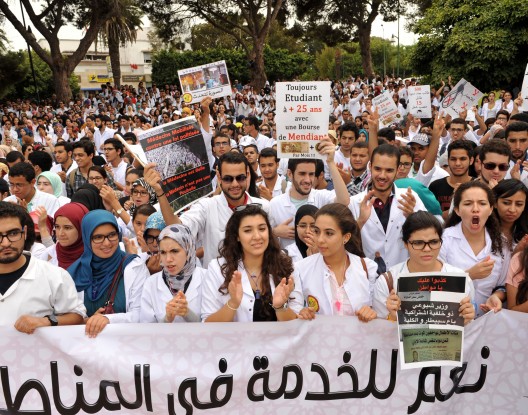
One father whose son, a veterinary doctor, had spent his military service in the Sahara, said of the medical students demonstrating in front of the Parliament in Rabat, “This is a bunch of spoiled kids with no sense of gratitude for their country, they have no sense of patriotism and of what serving the nation means. They refuse to serve those poor people who paid for their education …just look and listen, they are politicizing the issue and they must be led by some Islamist group!”
Another father, whose son has just graduated and is challenging the decision of the Ministry, said, “These guys send their kids to European and American universities on fat scholarships and cone rate them from these schemes they impose on our kids. We have paid every penny of their education, we paid for their food, their clothes, their housing, their transportation, their books from eight to eleven years. Going through medical school is a real ordeal, they make them work for no pay, they do the job of doctors, nurses and janitors for many years before they let them graduate, and now, they want to send them to exile for two additional years in areas with so many hazards to their lives. No, by God, they won’t, we won’t let them. Let them send their own daughters and sons …. “.
I have also heard and read the responses of the Minister to these arguments. He promises that the appointees will be paid in compliance with regulations in force as medical doctors, the two years of the mission will count for four years seniority, they will be insured against professional hazards, an important budget has already been earmarked to equip facilities, and the doctors cansit for all selection examinations for further education.
I heard the arguments of all parties and I still can’t make up my mind. The issue is so complex that it would be a mistake to oversimplify it. The missing link is perhaps an efficient and credible communication system. Trust has been lost in public administration and it will not be recovered without in-depth rehabilitation work, the establishment of integrative and participative communication networks and an innovative approach to good governance of the whole medical education system.
© Morocco World News. All Rights Reserved. This material may not be published, rewritten or redistributed without permission
The views expressed in this article are the author’s own and do not necessarily reflect Morocco World News’ editorial policy