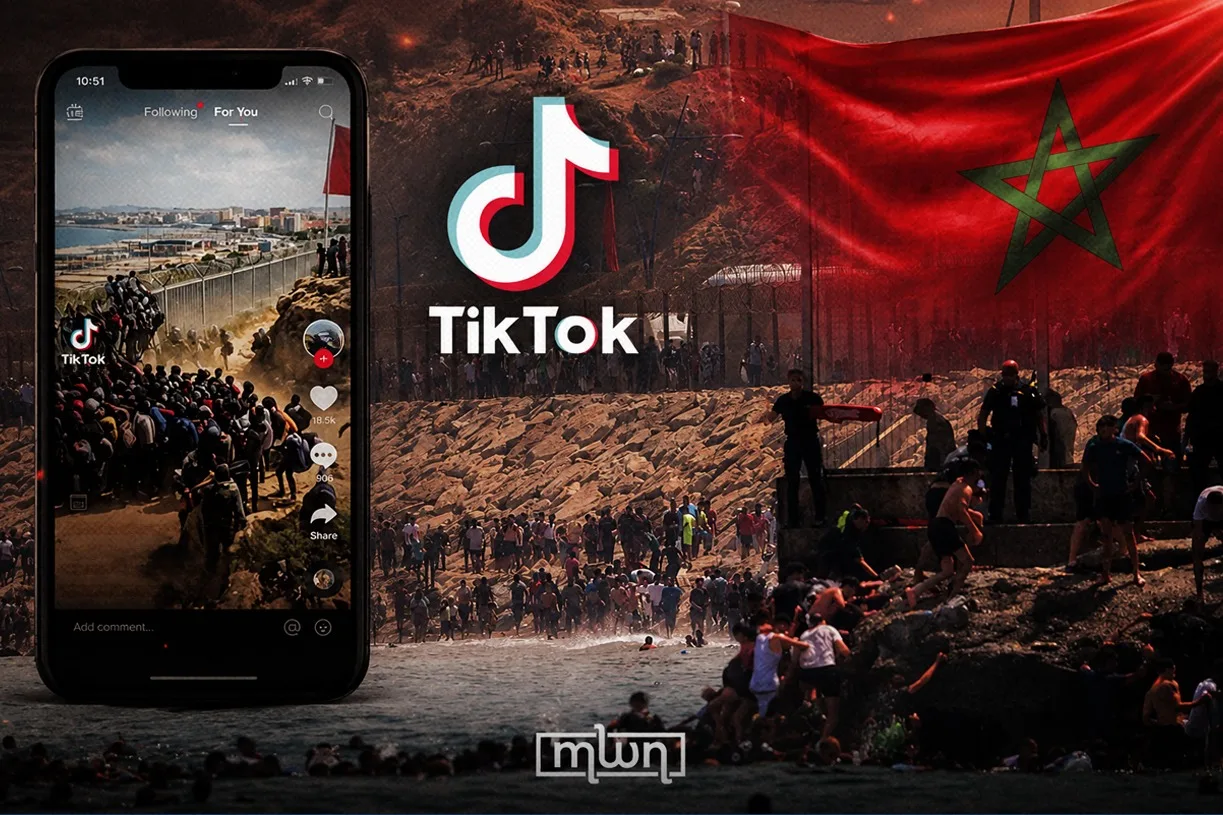
Anonymous social media accounts on TikTok fueled the recent mass migration to the Spanish enclave of Ceuta, encouraging tens of thousands of Moroccans and others to make the risky journey through viral messages that were later deleted.
Spanish newspaper El País said videos circulating on TikTok claimed the Spanish “border is open” and “you can cross without papers,” triggering unprecedented movement toward the enclave.
One widely shared video told viewers: “If you see these stairs, your dream will have come true,” before the content and the accounts behind it disappeared from the platform.
El País said “almost everything had been planned,” emphasizing that social media accounts shared locations selling wetsuits, flippers, diving goggles, and other devices to trigger the wave of migrants.
The report went on to add that some accounts also posted Google Maps screenshots that directed migrants to Tarajal Beach on the Ceuta border.
The algorithm stemmed from keywords that dominated hashtags, including migration and going to Europe.
The situation triggered masses of irregular migrants, with more than 60,000 people reaching the enclave in just one day. Morocco and Spain then intensified efforts and agreed on the return of the migrants. Now, more than 69,500 people have returned, with many coming voluntarily and documenting the violence and mistreatment they endured in the enclave upon their arrival, including from locals.
The situation in Ceuta triggered severe anti-Morocco rhetoric, anti-migrant hatred, and criticism from the far right and those fueling anti-Morocco campaigns.
Many who lack political context and knowledge of the history shared between Spain and Morocco tried to frame the situation as happening at a sensitive time, linking it to Throne Day through conspiracy theories.
However, analysts, including author and publisher Samir Bennis, dismissed similar claims, emphasizing that such allegations overlook both the country’s long-standing migration policy.
He emphasized that Rabat has spent years positioning itself as a key regional and international ally in migration management despite the insufficient funding it receives from the EU.
He argued that it is implausible Morocco would use this card at such a time, referring to Throne Day, one of the country’s most symbolic occasions, celebrated for more than 10 days across the country.
“For politically conscious Moroccans, it is the occasion on which King Mohammed VI takes stock of the government’s performance and the country’s socioeconomic trajectory over the preceding year, and sets the tone for the year ahead,” Bennis argued.
He said that there is no “plausible scenario” in which Moroccan authorities would engineer a diplomatic crisis with Spain in order to dominate headlines during, or overshadow, this particular week, stating that doing so would amount to self-sabotage of Throne Day.
Bennis, who is also the co-founder of Morocco World News (MWN), emphasized that Morocco has also genuinely mobilized and strengthened its forces to tackle the migration crisis, while choosing an approach that does not fuel the rhetoric many parties seek, as the country continues to gain momentum on different dossiers, including the laudable Spain-Morocco cooperation on migration.
The author also argued that social media played a decisive role in amplifying the mass migration crossings, with messages spreading rapidly and reaching thousands of young people.
French journalist and political communications adviser Françoise Degois shared the same perspective as Bennis. The French journalist also questioned who benefits from images prompting reactions from far-right circles around the world, suggesting that it all began with a rumor circulating on social media.
“Who first posted that rumor, particularly on TikTok? Who used algorithms to amplify it and turn it into an accepted narrative? Who stood to gain from that?” she asked.