


 Join on WhatsApp
  Join on Telegram
 By Yassine Makhou
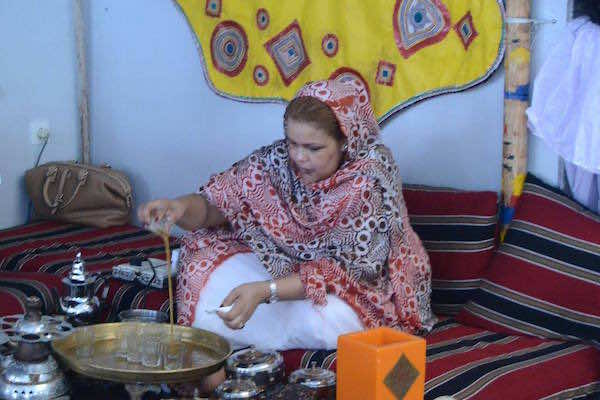
Tangier – In addition to being a traditional drink in the Moroccan Sahara, Sahrawi tea is looked upon as a symbol of generosity, respect, and openness of the Sahrawi people.
Tea is probably the most widespread and popular drinks in the Arab world. The way it is prepared, however, varies from one country to another. In North Africa, more specifically the south of Morocco, we find a distinctive sort of tea called green tea, or as it’s referred to locally as “at-tay.” This tea holds an important place in the culture of the Sahrawi people, for it’s viewed as a symbol of hospitability and generosity .
There are specific occasions and times for preparing Sahrawi tea. Hence, the Sahrawi people drink tea in the afternoon together as a community, while socializing about different issues.
The Sahrawi people are bound to their customs and traditions regarding the preparation of tea. And one of those traditions is what they call ‘djimaat talat” (the three “djiim’s”). The first “djim” stands for “djma3a” (community), or the group of people who are drinking tea. According to the custom, it’s preferable to have a great number of people drinking tea. The larger the group, the more privileged the community is.
The second “djiim” refers to “djer” (prolonging). Thus, the time allocated to prepare tea should be as long as possible, so as to make discussions last for as long as possible.
The third “djiim” is “djamr” (ember), for the Sahrawi always prepare the tea over embers.
While gathered around the tray of tea, some prefer to play some popular, tradition games.
There is also certain criterion taken into account in selecting who is responsible for preparing tea. The tea preparation candidate, called “al-gayam,” must possess specific qualities, among them being proficiency in the Hassani dialect, a good poet, civility, and a well-kept appearance.
While preparing tea, the “djma3a” (community) members take the opportunity to critique some of the mistakes the “gayam” is likely to make. For example, he may not properly use the tea’s utensils, serve a tea that is not well-cooked, or ignore the cleanliness of the tray used for serving tea. Another tradition requires that the person in charge should minimize his physical movements and, therefore, should sit cross-legged during the preparation. In this way, the gayam could be critized for how much he sits and stands.
To comment on high quality tea, the Sahrawi say, “At-tay igla3 dwakh” (This tea is a headache cure). For this reason, the Sahrawi people are presumably addicted to drinking tea, to the extent that going through a day without sipping a cup of tea negatively affects their mood.
Ingredients of Sahrawi tea
Though they are few, the ingredients of the Sahrawi tea play an essential role in giving the it its distinctive flavor.
The ingredients are tea, water, sugar, and mint. The necessary tea equipment include glasses, teapot, serving tray, jars, brazier, and embers.
So, how do we prepare Sahrawi tea?
First, we take tea and throw some of it into the teapot, and then add water. Next, we place the teapot on the ember for few minutes until that water boils. Then, the tea is poured into a glass known as the “kas tshlila.” This process is called “tshlal at-tay.” Next, we add more water to boil, followed by sugar and another ingredient called “al-3elk” (Arabic gum), which is used to give the tea more foam. Finall, we pour the tea into the first glasses, or “al-kas al-awal.” The same strategy is followed for the second and the third glass. This methd of preparation may last up to 2 hours.

Health Benefits of Tea
One of the remarkable benefits of drinking tea is that it helps the stomach digest food. Thus, the Sahrawi people typically drink tea after having fatty, meaty meals. Drinking tea also helps combat diseases like cancer and cures headaches.
Generally speaking, the Sahrawi tea has important historical, cultural, and social elements that are deeply rooted in the history of the Moroccan Sahara as well as its connection to the rest of the world. The first hot cup of tea journeyed from the Buddhist Far East and was imported by Christian Europe, and the became the main drink in the Moroccan Sahara. This historic tour of the tea reflects the personality as well as the environment of the Sahrawi people.
Some may argue that the time allocated to prepare the Sahrawi tea is too long. Others may claim that this tradition is a kind of social sickness. However, these are all false presumptions. The fact of the matter is that the hours spent in preparing and performing the Sahrawi tea ritual is not for its own sake, but rather for people to share in the life of the community, to discuss social issues, and to enjoy the custom itself. Think about some of drawbacks of fast food, or the loss of social intimacy via smart phones and other technologies. In these fast-paced and increasingly virtual times, it’s so important to spend at least two hours around a tray of tea in the real world with real people.
Although it is the Age of Globalization, Sahrawi tea and its associated values remain a strong, lasting tradition of the Sahrawi people since the days of old.
© Morocco World News. All Rights Reserved. This material may not be published, rewritten or redistributed without permission


