 Join on WhatsApp
 Join on Telegram
By Erkia Jarif
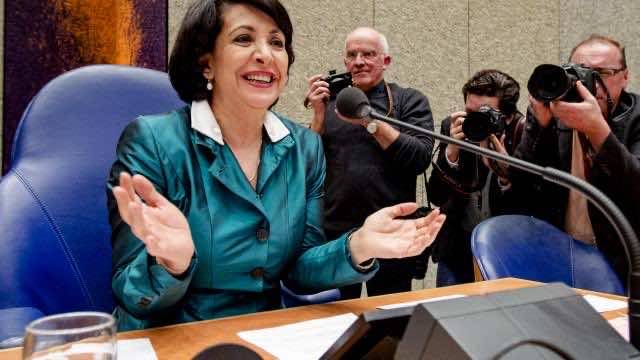
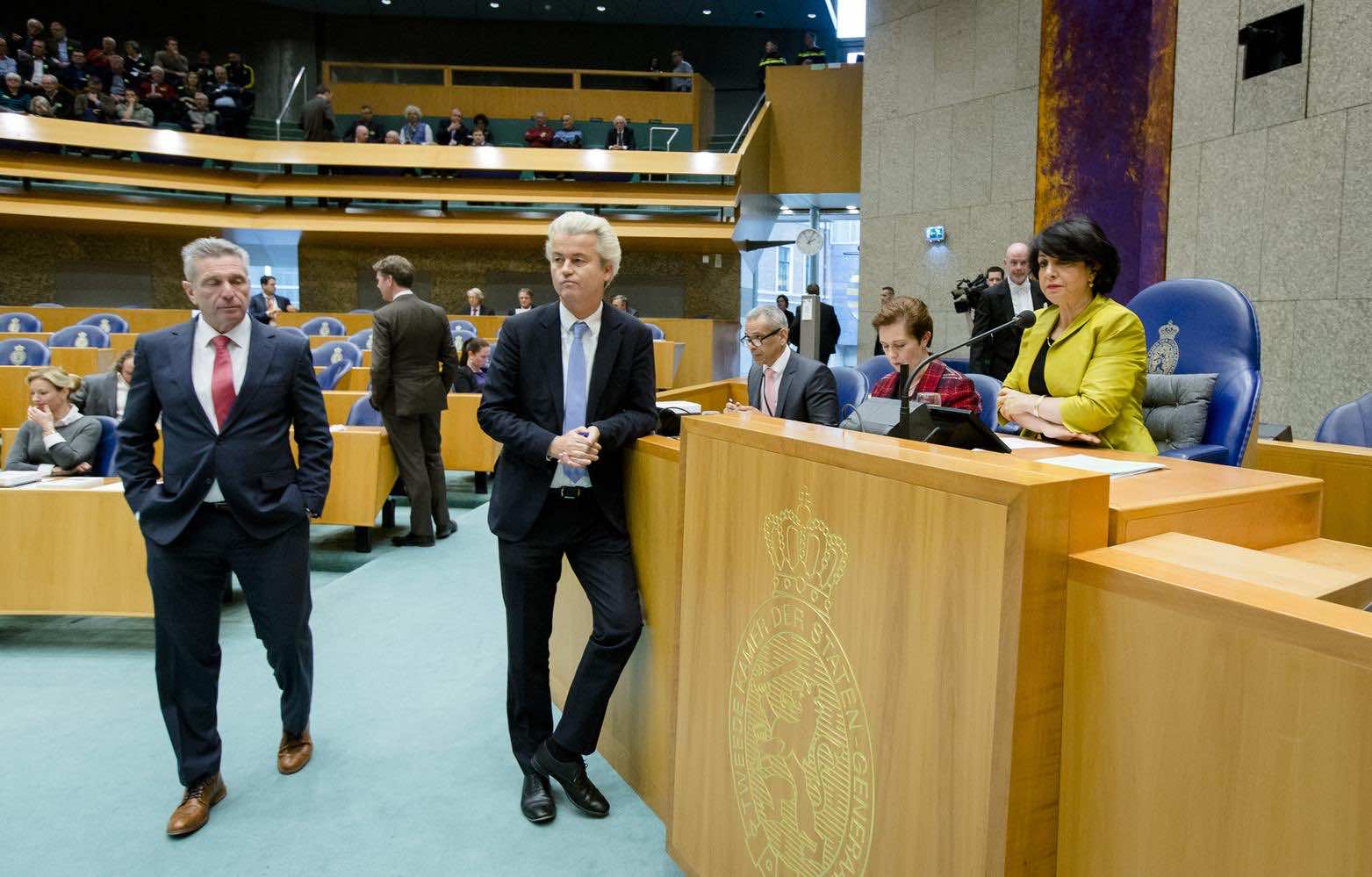
Amsterdam – Khadija Arib, a Dutch Moroccan politician, was elected chairman of the Dutch House of Parliament in January. It is extraordinary, because for the first time in Dutch history a person of non-Dutch descent has been elected to an important Dutch institution of political power.
Unfortunately, her appointment was sensitive because both the far-right Freedom Party of Geert Wilders and the Christian Democratic Party (or CDA) opposed her appointment. The far-right Freedom Party didn’t want her because she is born Moroccan, and they doubt her loyalty. The Christian Democrats didn’t want her because she does not meet the requirements. Before her appointment, she was a subject of discussion in several media and newspapers.
Once she was invited to a political program called Buitenhof. It was an odd interview, and I still don’t know what its purpose was. During this interview she was asked strange questions that implied that she is not able to be loyal because of her dual citizenship and her former work for the Moroccan Advisory Board to the King. Also they stated that she is sometimes difficult to understand, because she still speaks Dutch with an accent. This is simply untrue and an insult, because she speaks Dutch fluently. Also it was asked whether she would be able to objectively carry out the role of chairman and let everyone speak, including Geert Wilders of the far-right Freedom Party, who openly opposes her being chairman, simply due to the fact that she is Moroccan. By the way, Geert Wilders speaks Dutch with a heavy southern accent, and no one is calling that a defect for a party leader.
I am also of Moroccan descent, but with the difference that I was born in a small town in the North East area of the Netherlands on the border with Germany. A positive side effect of growing up near Germany is that I speak fluent German as well. I speak Dutch without any accent and, I dare to say, I speak better Dutch than most natives. I studied and got my bachelor’s degree. I worked mainly with Dutch people; most of my friendships and relationships were and are with Dutch people. Most of my life I was surrounded by tall, blond and blue-eyed people, and that has been my frame of reference. I never felt any different, less than or better than. I still consider myself as Dutch, but I am proud of my Moroccan heritage.
Having said that, I feel times have changed drastically. The generations that followed after me, the third and fourth of non-Dutch descent, seem to feel less at home in the Netherlands. Especially people with a Muslim background, such as Moroccans and Turks, don’t have the same experience that I did and miss that sense of belonging. Also, it appears that they feel that they are not considered full members of society.
A couple of years ago, I would have thought, push yourself and go for it and find your place in society. Now I am asking myself what a person must do to be fully accepted. I even ask myself: Do I fit in and am I accepted? Take a person such as Khadya Arib, who came to the Netherlands as a young girl, studied and holds a master’s degree, is fully integrated and socially involved, worked decades as a political servant and climbed the social ladder all the way to the top. And if she is still being questioned about her loyalty and her dual citizenship and receives insulting questions about her accent, I wonder what it is that one needs to do to fit in. And what does it do to you as a person?
The Dutch society reduces the immigrant to heritage and origin. Dutch media and politicians speak about people of Moroccan or Turkish descent, even if they are born in the Netherlands, as Moroccans or Turks, not as Dutch. They talk about “them” instead of “us.”
If you talk to a native white Dutch person, the first question you get is, “Where do you come from?” What they mean is, what is your origin or heritage? Or, “How come you speak such perfect Dutch?” This question implies that people with my background, even those who are born here, do not speak Dutch as well as white natives. These questions make you feel like a child who did something wrong; it’s confusing. I have heard these questions my whole life. Up until a couple of years ago, I never considered them as weird. Now I just say that I come from the North East of the Netherlands and leave it and instead of profiling myself as Dutch, I turn it around: I am a proud Moroccan who happens to be born in the Netherlands.
 I do believe the Netherlands and Europe have an issue with their own so-called European Christian identity and therefore have issues with people who have a non-white, non-Christian background. Especially now with the influx of Muslim refugees, it is a hot topic and perfect food for extreme far-right parties and conservatives. It seems Europe and the Netherlands are still in an odd kind of denial that European society has in recent decades become much more diverse.
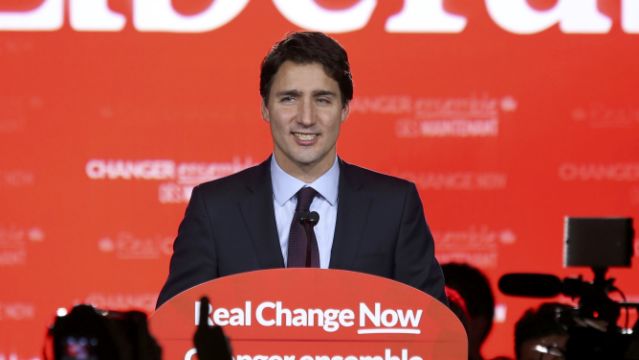
Trudeau, Prime Minister of Canada, is an example of a leader who goes completely against the current stream of rising hatred, nationalism and bigotry. He is taking the first steps to set new paradigms for society, where everyone can have a feeling of belonging and acceptance. I hope his example will be followed by Europe.
© Morocco World News. All Rights Reserved. This material may not be published, rewritten or redistributed without permission
The views expressed in this article are the author’s own and do not necessarily reflect Morocco World News’ editorial policy