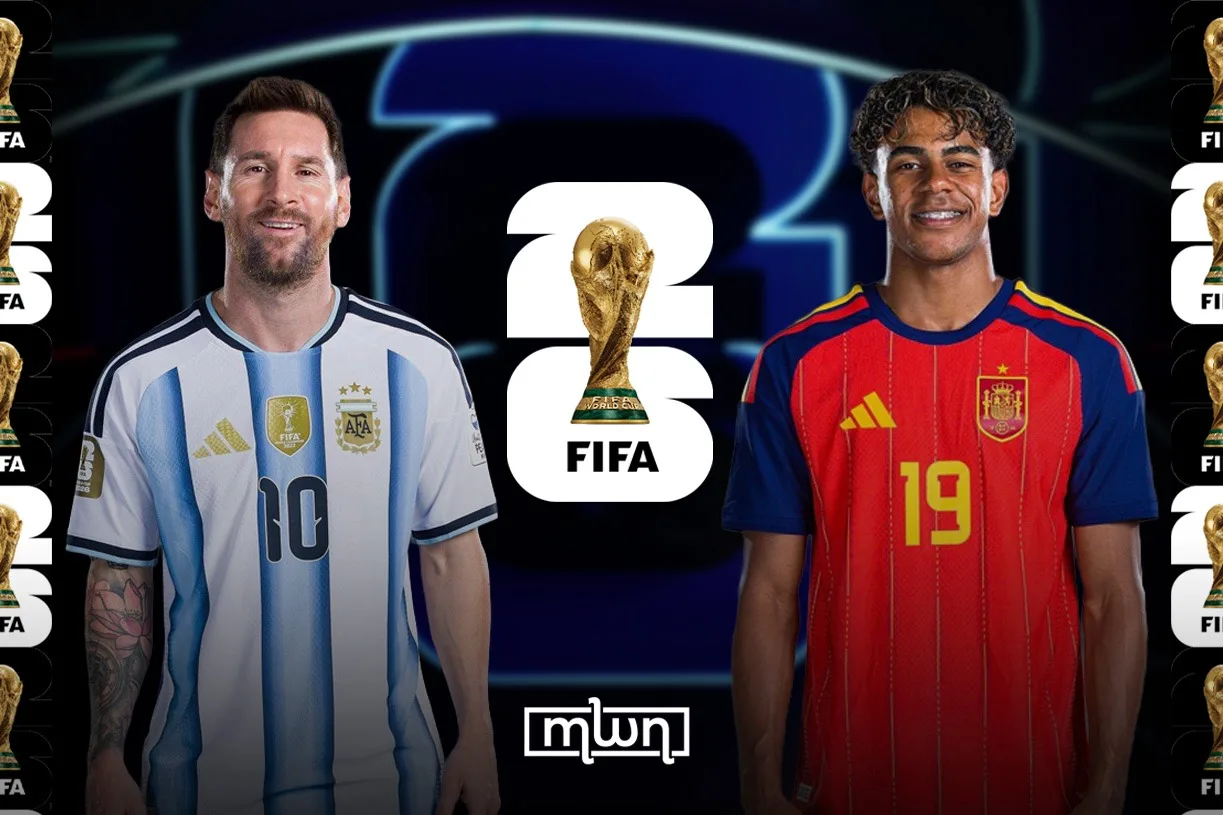
Rabat – The 2026 FIFA World Cup final will be much more than a simple battle for the trophy. Played on Sunday, July 19, at the New York New Jersey Stadium (MetLife Stadium) in East Rutherford, New Jersey, it will pit two of football’s greatest nations.
The two sides are renowned not only for their rich footballing culture and impressive trophy cabinets. Spain arrives as reigning European champions, while Argentina is the reigning world champion and two-time defending Copa América winner.
The two sides also represent contrasting generations, playing styles, and footballing identities. Despite their shared history, this will be only the 15th meeting between Spain and Argentina, and their first clash in a World Cup final.
Fifteen meetings, one historic final
Sixty years after Spain and Argentina last met at a FIFA World Cup, the two nations are set to face each other again, this time in the biggest match of all. Their previous World Cup encounter came during the group stage of the 1966 tournament in England, where Argentina claimed a 2–1 victory. Overall, the head-to-head record is remarkably balanced, with six wins each and two draws.
Beyond football, the fixture also carries historical significance, as Argentina was part of the Spanish Empire from the 16th century until its independence in the early 19th century.
The two teams were initially expected to lock horns in the Finalissima, the one-off game between the reigning European champions and Copa America winners, but the match was cancelled and yet to be rescheduled. Their most recent meeting ended in a stunning 6–1 victory for La Roja in a 2018 friendly, one of Spain’s most dominant performances against the Albiceleste.
From idol to successor
On one side stands Lionel Messi, the 39-year-old Inter Miami star, widely regarded by many as the greatest footballer of all time. Chasing back-to-back World Cup titles and the tournament’s Golden Boot, the Argentine captain could be making what is expected to be his final World Cup appearance.
On the other side is Lamine Yamal, the 19-year-old FC Barcelona prodigy, already seen as the face of football’s next generation and by many as Messi’s rightful heir.
The final therefore symbolizes far more than a battle for the trophy: it is a clash between the past and the future, the master and the apprentice, the legend and the player who could one day inherit his throne.
Widely shared across social media since the matchup was confirmed, the iconic photo of Messi holding baby Yamal has become the perfect illustration of this passing of the torch between two generations, reinforcing what could be the defining narrative of the final.
Control vs. resilience
Spain arrives at the final as the reigning European champions and will play only the second World Cup final in their history. Despite opening their campaign with a goalless draw against Cape Verde, La Roja have dominated every match since without ever looking seriously threatened. Even when they had to wait until the closing minutes to overcome Portugal and Belgium, Luis de la Fuente’s side always looked like a tactically well-oiled machine, controlling the game with remarkable composure, like a train that always arrives on time. That composure carried into the semi-final, where Spain eliminated France, the tournament’s other heavyweight, with a controlled 2–0 win.
Argentina, meanwhile, arrives at the final as the reigning world champions and two-time defending Copa América champions, but their journey has been far more dramatic. Time and again, Lionel Scaloni’s men have relied on resilience and determination to escape difficult situations, often snatching victory in the dying moments.
They came from two goals down to beat Egypt 3–2 and scored twice in the final 15 minutes against England to book their place in the final, inspired on both occasions by a Messi seemingly capable of anything. Trailing 1–0 after Anthony Gordon’s 55th-minute strike, Argentina found a way through Enzo Fernández’s equalizer in the 85th minute and Lautaro Martínez’s winner in stoppage time, both goals set up by Messi. Much like Real Madrid’s unforgettable 2022 Champions League run, La Albiceleste have built their campaign on character, belief, and an ability to survive under pressure.