 Join on WhatsApp
 Join on Telegram
Rabat- In the course of three days, three Moroccan peacekeepers have died in the Central African Republic (CAR) at the hands of the Christian militia known as Anti-Balaka.
The Moroccan soldiers were ambushed on Sunday while returning from a humanitarian mission to escort trucks filled with water to resupply the Mbomou river.
Their death raised the total losses of Moroccan lives in the torn African country to eight. It also brought attention once again to the deadly militia whose crimes have targeted both civilians and military.
Born to Kill
In a continent that has been plagued in by continuous coups, CAR is no exception. In March 2013 the country’s president, François Boizizé, was ousted by the Séléka rebel movement, originating from the northern region where a Muslim majority had been marginalized by the central government.
During its quest for power and short-lived control of the capital Bangui, Séléka was responsible for numerous crimes against their fellow Christian countrymen, which make up 80 percent of the population.
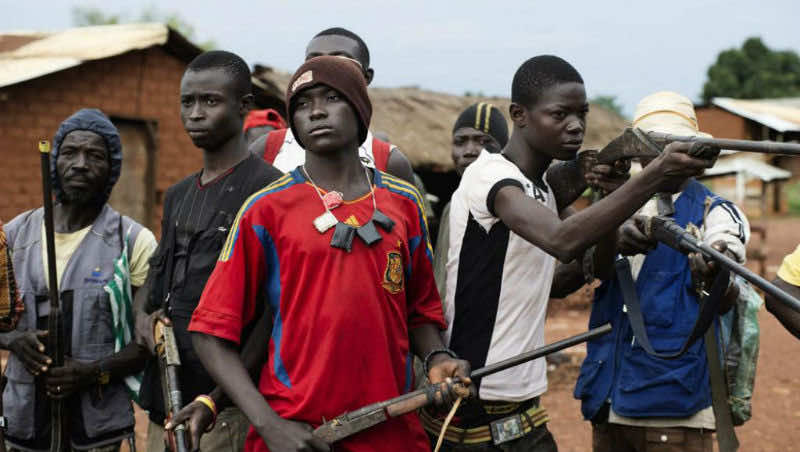
A counter-Christian militia was then formed, composed of militia men and former army members loyal to Bozizé and outlaws, and it began engaging in battles against Séléka. They called themselves Anti-Balaka, a name that reflects their deeply rooted belief in local African superstitions.
The ruthless militiamen believe they are safeguarded against Kalachnikov AK 47 thanks to amulets that they wear around their chests, called “gris-gris.”
Soon after their formation, Anti-Balaka turned “to be even worse than Séléka,” a Christian priest told France24 in April 2014, speaking of the checkpoints set up by the militia to prevent the Muslim population from fleeing to Cameroon.
Several TV reports, especially in 2013 and 2014, on crimes committed by the radical militia show men, armed with guns and machetes, vowing to wipe out Muslims in the country.
“We will kill all Arabs in Central African Republic,” a man shouts at the camera of French TV station BFMTV. “We don’t need any Arabs here.”
In their campaign against Muslims, people have been killed, villages attacked and besieged, mosques destroyed, and women enslaved. According to a Muslim community leader cited by the Integrated Regional Information Networks (IRIN), “more than 300 mosques were destroyed in 2013 and 2014 (26 of them in the capital).”
In April 2015, Human Rights Watch published a report in which Muslim women gave accounts of their captivity for 14 months in Podo, a village in south west of the country.
“The Anti-balaka killed two boys, ages about 6 and 7, and raped three young women and girls, one of whom became ill and died in captivity,” said the report.
“Holding civilians captive, killing children, and sexually enslaving women and girls are shocking tactics by these Anti-balaka and amount to war crimes,” said Lewis Mudge, an Africa researcher at HRW.
While no exact number of their victims has been provided, HRW affirmed that the Anti-Balaka men “have killed and targeted thousands of Muslims since 2013.”
Despite the French military intervention in December 2013 and deployment of the United Nations peacekeeping force, whose number was more than 12 soldiers and policemen, the situation remained fragile.
Targeting Peace and Peacekeepers
In May, 1,500 Muslims in Bengassou were forced to take refuge in a church following an attack by the militia on Tokoyo, a district in the city known for its large Muslim population.
“There are men who walk around town with guns,” the church’s priest, Father Alain Blaise Bissialo, told Al Jazeera. “The situation is not safe enough to leave, and so they cannot move from here.”
The city’s Muslims fled to the church after the mosque where they first took refuge was attacked by the militia, who killed the local imam killed.
Despite the military presence of the United Nations Multidimensional Integrated Stabilization Mission in the Central African Republic (MINSUCA), the country is still struggling to regain the lost peace.
MINUSCA seems to have a hard time ensuring the country does not plunge into violence as the conflict between Anti-Balaka and former members of Séléka continue.
What is even worse, MINUSCA soldiers are targeted by both militias. Recurrent attacks have left several MINUSCA soldiers dead or reported missing.
Bangassou was home to an attack on the UN soldiers in May, in which four peacekeepers died and eight others were injured. In April, three of four MINUSCA members previously reported missing were found dead.
Clashes with Anti-Balaka forces have become frequent in recent months. In May, a group of Moroccan soldiers exchanged fire with members of the militia in Yogofongo, a village 20 kilometers away from Bengassou.
The clashes resulted in the death of eight Anti-Balaka armed men, while nine out of the ten Moroccan soldiers accompanying a Cambodian convoy were injured.
However, on Sunday and Tuesday, things went differently for the three Moroccan soldiers who were part of the contingent that was twice ambushed by the Anti-Balaka militia.