 Join on WhatsApp
 Join on Telegram
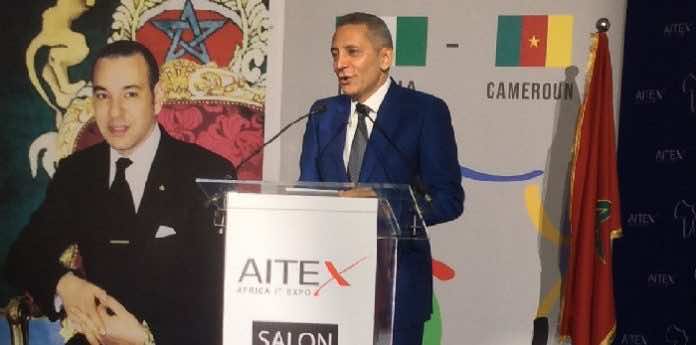
Rabat – Highlighting the advanced trends in technology and their influence on global development, the Africa IT Expo (AITEX) launched its second edition September 27 at the Casablanca International Fair under the title “Digital Innovation in service of organizations.”
Initiated by the Moroccan Federation of Information Technology, Telecommunications and Offshoring (APEBI) in partnership with the Ministry of Industry, Trade, Investment and the Digital Economy, AITEX’s aimed to provide a framework for reflection and sharing of experiences with decision makers.
The second edition, which featured Cameroon and Nigeria as guests of honor, was organized around a showcase of multisectoral expertise, such as publishing, e-commerce, offshoring, big data, infrastructure, solutions, mobility, cloud, and data security.
For Moulay Hafid Alamy, AITEX is a “brilliant chance for the African continent.” The minister said he is determined to seize the opportunities offered by the digital sector to make up for the kingdom’s, and Africa’s, delay compared with developed countries. “It is time to roll up our sleeves and give our youth a propitious ground for development. Let’s get to work, we already lost so much time and ground!”
Saloua Karkri Belkeziz, president of the APEBI, said that the second edition sought to give professionals a unique opportunity to bring together both supply and demand around structuring projects deployed on the African continent.
For Alan Barrett, CEO of the African Network Information Centre (AFRINIC), the Regional Internet Registry (RIR) for Africa, events such the AITEX “are a great opportunity to find new partners and expand our activities.”
“Our aim as a company is to expand internet access all over the continent,” explained Barrett. The Mauritius based company has already conducted two training missions in Morocco since 2012.
“Right now, we’re looking for Moroccan partners to be able to promote internet access in rural areas,” added Barrett, explaining that while the African telecommunications market in Africa is still in its early stages of development, “it is also one of the fastest-growing in the world.”
Strolling between the numerous stalls, giant corporations such as Microsoft, Huawei, Cisco, Disway, SoluTech, and many others covered the heart of the exposition, next to many institutional customers offering mainly “e-gov” solutions, as well as several governmental offices.
However, African and Moroccan SMEs and startups were hard to find.
BioSSL, a British award-winning biometric startup wishing to open a subsidiary in Morocco, was also present at the event. For its Managing Director, Dr. Abdel A. Khan, “the tech sector is not one that has been traditionally favored by Moroccan investors.”
Nevertheless, ”During my stay in Morocco, I met with many Moroccan banks that seemed to be very interested in our products.”
Still, many obstacles stand in the way. “It is very rare when we get a call back,” the director admitted.
But Khan remains optimistic. “The potential that Morocco offers for giant IT corporations is incredible. The Moroccan digital market is still a very fresh one, so there’s big demand on IT services.”
The digital industry stays one of the strongest sectors in terms of creating structuring transformations. It is a major economic challenge for any organization wishing to boost its performance and competitiveness on both a national and regional level. The potential in terms of job creation is considerable for the sector to connect companies to these tools which are in a perpetual state of innovation.
With its Morocco Digital 2020 Plan, the Kingdom is strongly collaborating with the digital future of the continent. The plan is focused on accelerating the digital transformation and strengthening Morocco’s position as an African precursor in the service of partner countries. The road map, therefore, marks a digital revolution offering companies several opportunities for development around structuring projects.