 Join on WhatsApp
 Join on Telegram
Today, artificial intelligence (AI) is becoming increasingly essential. AI refers to computer systems designed to think, learn, and create like humans. Educators use it to enhance lessons, students use it to study, and others harness it for their own variety of purposes.
According to Morocco World News, since 2024, 38% of Moroccan consumers actively use ChatGPT, placing Morocco among the top countries globally in AI adoption, especially for conversational AI tools. This roughly translates to 13 million users, considering Morocco’s population of about 36 million.
However, higher authorities often perceive AI as a threat rather than a tool, particularly in education. This belief contrasts sharply with policies encouraging teachers to use AI to improve their efficiency while discouraging and even forbidding students from using it in their studies.
The issue of overdependence
It is no surprise that this technology is having difficulty emerging within societies and institutions – especially in developing countries such as Morocco. The same hesitation surrounded the Internet in the 1990s. Many thinkers and educators warned against using online sources out of fear of overdependency and lack of thinking critically. Nevertheless, the Internet today is an essential learning tool and a cornerstone of modern education. AI seems to be following the same path—first feared, then gradually understood, and finally integrated. Resistance to innovation is not new; what matters is how societies adapt and learn to use new tools responsibly.
As AI use among young learners has increased rapidly, both the Moroccan Ministry of National Education and the Ministry of Higher Education have implemented measures to prevent potential misuse affecting student performance. One of the key pillars of Moroccan university education used to be the The Final Year Project (Projet de Fin d’Études or PFE as written in the French curriculum), in which students applied all their skills and knowledge by the end of their bachelor’s program to complete a final research or development project. In 2024, the Ministry of Higher Education canceled this program, citing concerns that students might rely on ChatGPT to generate their projects. Ironically, the ministry launched programs like DigiSchool, which trains teachers and students in AI and coding, emphasizing the need to keep up with technological advancements in today’s world.
AI in universities today
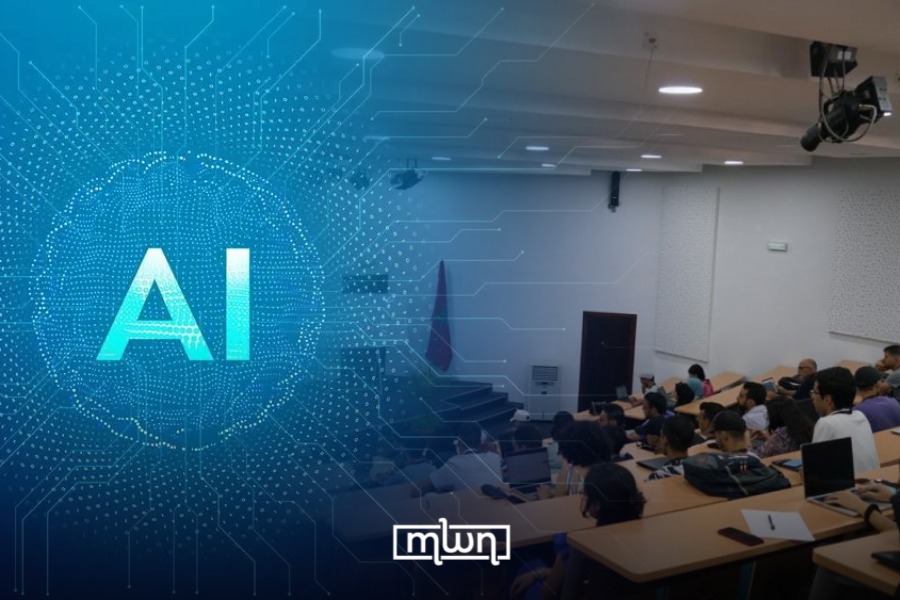
In Moroccan universities, students now face strict rules regarding AI use. Some institutions, like UM6P, have formalized policies stating that students may only use generative AI tools if explicitly permitted by their professor; otherwise, doing so may be considered academic misconduct or even plagiarism. Thus, this intense restriction disadvantages Moroccan graduates globally by not equipping them to fit the job market needs.
When to balance with the benefits
Yet, AI tools can greatly support learning by helping students brainstorm ideas, correct grammatical errors, provide feedback, and expand their knowledge independently. An assistant should not necessarily be a human as long as it is used in the right way. Instead of restricting the use of AI, why not embrace it through engaging students and forming them properly?
While students are restricted, instructors are strongly encouraged to adopt AI. Many educators now use AI daily to plan lessons, organize data, create personalized materials, and evaluate assignments. This not only saves time and effort but also improves efficiency. Programs such as the literacy-teacher training initiative, launched by UNESCO with support from the The National Agency for the Fight Against Literacy (ANLCA) and technology partner Huawei, provide teachers with training to integrate AI effectively into classrooms. The growing reliance on technology highlights a clear double standard: tools considered a threat in students’ hands are seen as innovation in teachers’.
In conclusion, the Moroccan educational system is at a crossroads. While AI tools, like ChatGPT, are restricted for students in the name of academic integrity and cognitive independence, they are highly recommended for educators to save time, enhance knowledge, and improve lessons. This paradox underscores the need to rethink how AI is integrated into education, ensuring it benefits both learning and teaching equally. Otherwise, the consequences might be greatly damaging for the new-market emerging categories and new graduates.