 Join on WhatsApp
 Join on Telegram
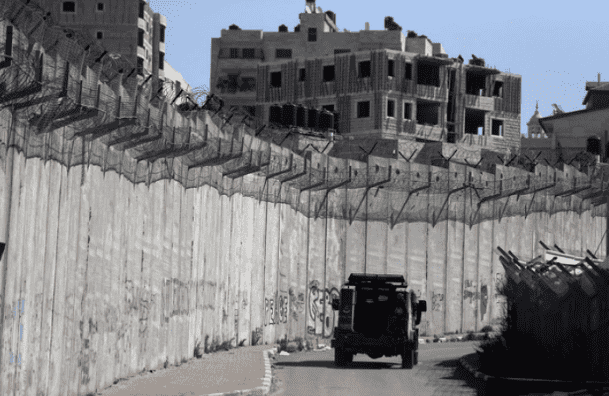
Rabat – In the occupied West Bank, the long separation wall, imposingly ripples the horizon of a region ferociously split in two. Slicing through Palestinian communities, ravaging their everyday lives in a steady manner, the giant concrete barrier- twice the height of the Berlin Wall- bears the words: “The hands that build can also tear down.”
Tuesday, July 9th, 2019 marks the 15thanniversary since the International Court of Justice (ICJ), the United Nations’ (UN) judiciary organ, issued an advisory ruling that deemed Israel‘s separation wall illegal under international law and called for it to be dismantled.
The court issued its non-binding advisory opinion in 2004, stating that the wall’s construction must stop, and that Israel should pay reparations for any damage caused.
The wall, which Israel began constructing in 2002, the threshold year of the second intifada, has been described by Israeli officials as a necessary security precaution against terrorism and the Palestinian community’s raids.
Although the ICJ acknowledged that Israel faced acts of violence against its civilians, it said that the Israeli government violated the global legal framework and should take down the wall.
Yet 15 years on, the wall continues to cut through Palestinian communities, taking over natural resources in the occupied West Bank, and annexing Palestinian land.
Palestinians have decried the wall as an Israeli mechanism to gain control over Palestinian territory, as it is constructed deep within the West Bank, violating the 1967 boarders and the Green Line plan.
Read Also: Moroccan Activists Rally in Solidarity with Palestine
“Israel has continued to build and expand the separation wall and has acted as though the ICJ decision did not happen,” Ghassan Daghlas, a Palestinian official who monitors settlement activities in the northern West Bank, told Al Jazeera.
“This has resulted in the strangulation of the West Bank, and has affected the course of life for Palestinians,” he added.
The estimated cost of the wall upon completion is $2.1 billion. The eight-meter high wall is toppled by barbed wires and electronic motion sensors. Buffer zones stretch between 30 to 100 meters wide.
Daghlas said that Israel utterly disregarding the ICJ ruling shows that the country “considers itself above international law” and does not hesitate to show its “racist, apartheid” face globally.
Critiques on the wall and the Israeli attitude towards Palestine
At least 85% of the wall’s planned 712km-long route, which is twice as long as the Green Line, is built within Palestinian territory, severely impacting the Palestinians’ everyday ability to access services, such as schools, hospitals, their own land, as well as the rest of the Palestinian population.
The majority of Palestinians have their villages and homes surrounded by the wall, settlements and settler-only roads, further worsening seclusion issues on the region.
The Human Rights Watch director for Israel and Palestine, Omar Shakir told Al Jazeera that the separation wall has significantly affected the Palestinian daily life by separating thousands of Palestinians from each other and from crucial infrastructure and services.
“The wall itself is part of the matrix of control and rights abuses that are part of the daily Palestinian experience,” Shakir said.
Stop the Wall, a Palestinian grassroots advocacy campaign said that upon the wall’s completion, more than 78 Palestinian villages and communities would be isolated, translated to a total of 266,442 Palestinians.
At least 11,000 Palestinians live in designated “seam zones” which lie between the Green Line and the wall, completely isolated from the rest of the population.
The life for these residents highly relies on obtaining residency permits from the Israeli civil administration.
“Permits must be constantly renewed before they expire so the permit-holders can keep living in their own homes,” said the Israeli rights group Btselem, highlighting that the permits’ validity can range from a single day to a couple of years.
The wall, along with hundreds of other Israeli checkpoints dispersed throughout the occupied West Bank, has not only burdened the Palestinian mobilization and everyday living, but also the Palestinian economy.
“The World Bank has estimated in 2013 that restrictions of movement have cost the Palestinian economy $3.4 billion a year,” Shakir said.
“Ultimately, more concrete action is needed by the international community in response to the serious violations of international human rights laws that are part of the daily reality for Palestinians under occupation,” he added.
Protests against the wall
The construction of the separation barrier caused several villages to react in the early 2000s, as they used unarmed popular demonstrations to protest against the Israeli annexation of their land.
Budrus, Bilin and Nilin were among the villages which notoriously fought against the Israeli’s brutal response to their protests, including the firing of tear gas and rubber-coated steel bullets to demonstrators.
Yet, in recent years, the protests have abated, and lost much of their previous momentum.
The level of repression by both the Israelis and the Palestinian Authority hinders Palestinians from engaging in activism organisations and protests concerning the separation wall.
Today, the focus of the Palestinian vigor to protect their nation’s identity shifts elsewhere. In 2018, protests broke out following US President Donald Trump’s decision to recognize Jerusalem as Israel’s capital and relocate the US embassy there.
“Every day we witness and live under crimes of colonization, not just with the separation wall but also with the incessant building of Israeli settlements,” Daghlas said.
“We are defending our dignity, our homeland and the international law which we hope will be implemented soon,” he added.