 Join on WhatsApp
 Join on Telegram
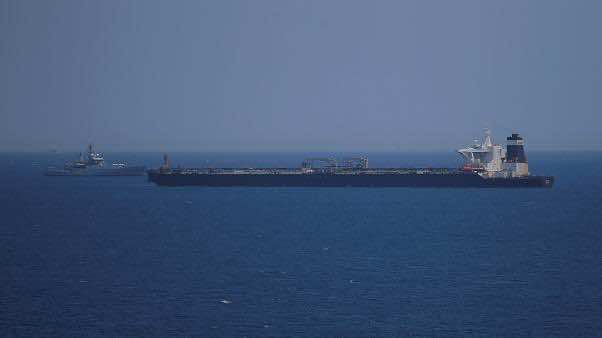
Rabat – On Thursday, July 4, while en route through the Strait of Gibraltar, the Iranian supertanker Grace 1 was set upon by a joint force of British marines and Gibraltarian authorities.
Reportedly attempting to conceal its identity by flying a Panamanian flag, the Iranian ship was suspected to have been traveling to Syria, with a shipment of crude oil, when it was captured.
During its voyage, the Iranian ship took several other measures to camouflage itself, such as turning off tracking signals and sailing along a much longer route around the Cape of Good Hope, instead of sailing directly through the Suez Canal.
Despite these extensive measures to remain hidden, the British operation to seize the ship was successful. Iran was forced to admit to ownership of the vessel in order to condemn the ship’s seizure.
Triggered by intelligence received from the US, the operation was launched by British authorities under the guise of enforcing European Union sanctions against importing crude oil into Syria.
The operation comes in the midst of escalating tensions between Iran and the West — primarily, the US — adding coals to the fire of tensions already near boiling point.
Since the Trump administration decided to pull out of the international agreement on Tehran’s nuclear development, the diplomatic gap between the US and Iran has severely widened.
This has only been further exacerbated following recent attacks on oil tankers near the Strait of Hormuz, which the US has accused Iran of perpetrating.
Iran has retaliated by shooting down an American Unmanned Aerial Vehicle (UAV), which invoked a heated response from the US President, who threatened to “obliterate” Iran.
With conflict between the two countries growing ever-closer by the day, the seizure of the Iranian vessel has only contributed to growing hostilities between Tehran and the West.
Protection or piracy?
Although Europe has had sanctions on oil shipments to Syria since 2011, it had never acted upon these sanctions by seizing an oil tanker until Thursday. Furthermore, although the US has implemented sanctions against Iran, the European Union has not followed suit.
However, authorities in Gibraltar have defended their actions by claiming that they were justified in their suspicions, as well as in their subsequent seizure of the vessel.
“We have reason to believe that the Grace 1 was carrying its shipment of crude oil to the Banyas Refinery in Syria,” Gibraltar’s chief minister Fabian Picardo said in a statement. “That refinery is the property of an entity that is subject to European Union sanctions against Syria.”
While the EU sanctions were intended as a means of weakening the Syrian regime to prevent the further “repression of [the] civilian population,” the UK’s enforcement of these sanctions has been seen by critics as a form of pandering to the US government.
Critics have also pointed to the UK’s relaxed attitude on a number of other sanctions against Syria, especially when it comes to the arms trade.
Since the outbreak of the Syrian Civil War, the UK has granted a substantial number of arms export licenses to Syria, with the number sharply increasing in 2017 from 10 licenses to 114 licenses.
As a result, critics have been wary of the UK’s intentions in seizing the Iranian ship, questioning whether the operation was launched to protect the Syrian people, or to support the US as it ups the ante with Iran.
Iran threatens retaliation
Iran has condemned the seizure as “illegal,” with Iranian foreign ministry spokesman, Abbas Mousavi, labeling the act as “a form of piracy.”
Mousavi, argued that “the move indicated that the UK follows the hostile policies of the US, which is unacceptable for the Iranian nation and government.”
Iran has since summoned the British ambassador to voice “its very strong objection to the illegal and unacceptable seizure” of the ship. It has also reportedly threatened to retaliate and seize a British oil tanker unless the Iranian ship is released.
A day after the Iranian ship was captured, a senior commander in Iran’s Revolutionary Guard allegedly stressed that it was Iran’s “duty” to retaliate and seize a British oil tanker.
The commander, Mohsen Rezai, reportedly wrote on Twitter: “If Britain does not release the Iranian oil tanker, it is the [Iranian] authorities duty to seize a British oil tanker.”
“Islamic Iran in its 40-year history has never initiated hostilities in any battles but has also never hesitated in responding to bullies,” he added.
Though no retaliatory actions have taken place as yet, the UK’s refusal to release the ship and its crew have severely damaged relations between the UK and Iran, amidst the ongoing escalation between the latter and the US.
Sovereignty in the strait
With the ship being seized off the coast of Gibraltar, Spanish officials have argued that British forces overextended their authority in a territory claimed by Spain.
The waters off the coasts of Gibraltar have been a point of contention since the United Nations Convention on the Law of the Sea in 1982, with both the UK and Spain claiming authority of the disputed zone.
The law established that territorial waters reach up to 12 nautical miles from a nation’s coasts. As such, the treaty established, in theory, if not in practice, that the waters off of the coast of Gibraltar are under the authority of the United Kingdom.
Despite this, Spain has refused to recognize any Gibraltarian sovereignty in these waters, citing the 1713 Treaty of Utrecht, which ceded the territory from Spain to the UK following the War of Spanish Succession.
As a result, Spain has accused the UK of potentially violating its sovereignty during the course of the raid.
“We are analyzing the circumstances and seeing how they affect our sovereignty,” said Josep Borrell, the acting Spanish foreign minister
Prior to the operation which seized the ship, London reportedly informed Madrid that the supertanker would be detained “in the port of Gibraltar.” However, in reality, the seizure took place in the waters outside of the port, which is considered by Spain to be its own sovereign territory.
Regardless, Spanish forces made no attempt to prevent the operation, which has been received by British sources as a symbol of support for the seizure of the supertanker.
“Spain did not want to interfere because this was about upholding EU sanctions,” said a source from the Spanish Ministry of Foreign Affairs.
Meanwhile, Spain’s argument with the UK over its sovereignty in Gibraltar could reopen old wounds between Spain and Morocco over sovereignty in the Spanish enclaves of Ceuta and Melilla on the northern coast of Morocco.
While Spain continues to decry the British occupation of Gibraltar, it maintains its firm hand over the enclaves of Ceuta and Melilla, refusing to acknowledge any Moroccan legitimacy over the cities.
The most prominent debate over the two cities in recent memory took place in 2007, after Spanish King Juan Carlos decided to visit Melilla in a move to show Madrid’s commitment towards maintaining its presence in the exclaves.
In response, the then-Moroccan prime minister Abbas El Fassi reasserted the Moroccan claim over the territories.
“We would like to remind everyone that the two cities form an integral part of Moroccan soil and their return to their homeland will be sought through direct negotiations with our neighbor Spain,” said El Fassi.
Morocco’s King Mohammad VI also joined in the dispute, temporarily recalling the kingdom’s ambassador to Madrid in protest over the Spanish monarch’s visit to the “occupied territories.”
Though relations between the two countries have since stabilized, debate over the territories still persists, with both Spain and Morocco claiming legitimate and rightful ownership over Ceuta and Melilla.