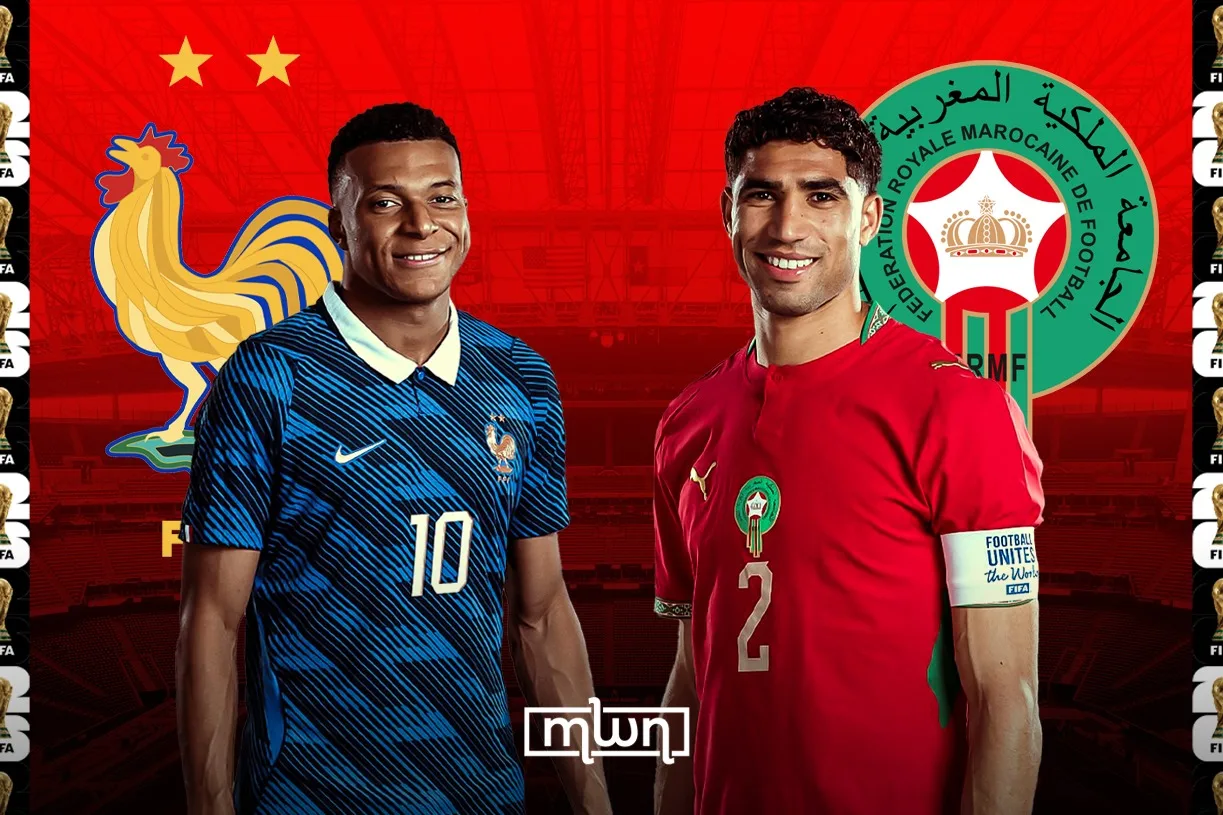
Only hours after Morocco secured a place in the FIFA World Cup quarter-finals with a 3-0 victory over Canada, social media filled with images and videos recalling the two penalty appeals denied to Morocco against France in the semi-final of the 2022 World Cup. The posts came with a relevant, pertinent tale of caution against a repeat of what happened in Qatar four years ago.
The fixture carries weight beyond nostalgia. France and Morocco meet again on July 9 at Boston Stadium in Foxborough, in front of an expected sellout crowd of nearly 66,000 – a repeat of the 2022 semi-final that Les Bleus won 2-0 on their way to the final. Currently ranked sixth in the world, Morocco arrives as the first African nation to reach back-to-back World Cup quarter-finals. While France, ranked third, has looked less commanding than its reputation suggests, needing a controversial penalty to see off Paraguay in the round of 16.
For Moroccan fans, the parallels with 2022 are impossible to ignore. This is not simply a rematch of a lost semi-final. For Atlas Lions fans and football enthusiasts in the Global South, this is, above all, a chance to test whether football’s refereeing culture has changed at all in the years since.
The Ghost of Cesar Ramos
Moroccan supporters appeared confident in their team’s ability to continue its run, but many voiced clear unease about the officiating awaiting them. That unease sharpened after France was awarded a penalty against Paraguay, scoring the only goal in a 1-0 victory that secured its place in the quarter-finals. The point here is not to cast doubt on a rightfully given penalty. Rather, it is to point out, as several observers have already done, that the action that led to Les Bleus’ winning penalty against the Paraguayan team resembled the very penalty appeal denied to Moroccan winger Sofiane Boufal four years earlier, when referee Cesar Ramos booked Boufal instead of awarding Morocco a spot-kick against French defender Theo Hernandez.
The Royal Moroccan Football Federation (FRMF) formally protested the decision to FIFA at the time, and pundits, including former English defender Rio Ferdinand, argued publicly that Morocco had been outrageously wronged. Yet that grievance never really faded; it simply went dormant until the draw paired the two sides again.
As the two sides now prepare for their quarter-final showdown, deepening suspicion now also extends to French media outlets. Some believe most of the heavily influential French media are once again applying the kind of pressure they exerted in 2022 to shape the narrative around the match. In previews of the salivating matchup, they have notably cast Morocco’s physicality as gamesmanship rather than legitimate defensive organization. For both Atlas Lions fans and Moroccan sports commentators, such coverage conveniently precedes any contentious refereeing decision that might follow.
The debate has widened further as African, Asian, and Latin American broadcasters have weighed in on the officiating in both the France-Paraguay and Morocco-Canada games. Particular attention fell on the four yellow cards shown to Moroccan players in the Canada match, despite far more physical challenges from Canadian players going unpunished. This revived the discussion of the disputed calls from the Morocco-France semi-final in Qatar. As that old footage recirculated, the message that has been widely spreading among Moroccan fans is that, among other questionable calls in that horribly refereed semifinal game, Morocco was denied two clear penalties in 2022. Moroccan supporters have insisted they will not accept a repeat.
Yet, as politics and favoritism of the Global North poison football, will their legitimate concerns be heeded; will their grievances be taken into account by a FIFA leadership that is unabashedly blurring the line between politics and sports?
A familiar complaint across the Global South
We will discover soon enough whether FIFA will grow a conscience this time around. Meanwhile, it bears reminding that this expectation of unfairness against the Global South is not a new feature in the politics of world football. Those of us who are old enough to remember refereeing scandals from decades back are hardly surprised or shocked by the fact that refereeing on the world stage has historically favored established football powers – particularly European sides – when they face African or former “underdogs” now labelled as “emerging” national teams.
Indeed, Global South commentators have long pointed to how fouls are called and how quickly yellow cards are issued, compared with what they see as greater leniency shown to traditional powers. Even when such decisions aren’t individually decisive, they tend to accumulate quietly and thus narrow the margin by which emerging teams are allowed to compete.
So, it is no surprise that a significant share of Moroccan fans believes the four yellow cards shown within the opening 25 minutes against Canada were themselves excessive, including the card given to Achraf Hakimi after he absorbed a hard challenge from a Canadian opponent without reacting in a way that would typically warrant a booking.
Let’s face it, Moroccan fans’ concern ahead of their team’s game against France, arguably the most anticipated clash of the quarterfinals, is hardly symbolic. Several Moroccan players are now one caution away from suspension in the tournament’s later stages, meaning the accumulation of yellow cards in earlier rounds could shape who is even available for the France match and beyond.
VAR’s troubling legacy
And the legitimate criticism documented throughout this article has, in recent years, gone far beyond the on-field officials. The Video Assistant Referee – whose job is to correct clear and obvious errors – has drawn its own share of doubt both in Qatar four years ago and during this current tournament. And, to be clear, this concern over VAR bias or questionability has not only come from Moroccan fans. Following Ghana’s draw with England, head coach Carlos Queiroz captured that frustration with a sarcastic remark: “Once again, VAR went for a coffee.”
Queiroz was reacting to a missed penalty call against England. But his pertinent line traveled far beyond that single match, becoming shorthand for a wider frustration that VAR intervenes selectively. While the technology and the biased officials charged with directing it rigorously scrutinize marginal calls in some matches, they frustratingly wave away unmistakable fouls in others.
That Queiroz’s joke resonated so broadly across fanbases with no direct stake in Morocco’s grievance suggests the frustration isn’t just a Moroccan complaint. It points to something closer to a historical pattern. In other words, there is a sense, shared among fans of several “emerging” footballing nations at this tournament, that officiating consistency has not kept pace with the scrutiny VAR was supposed to bring.
And the timing is rather unfortunate for FIFA. This is the first 48-team World Cup, and it was expressly built to widen the sport’s global footprint and give “emerging” footballing nations a bigger stage. If that expansion is accompanied by a persistent perception that officiating still favors traditional powers when it matters most, the tournament’s credibility will take a hit that no amount of commercial success can fully offset.
Ultimately, whether or not Thursday’s match at Boston Stadium is officiated cleanly, the conversation it has already generated suggests that refereeing consistency and the transparent application of VAR have become as central to the World Cup’s legitimacy as the football on the pitch. For many observers, that broader reckoning is the real story here. Their hope is that FIFA and its referees will eventually grow a conscience or be principled enough to let football rules fairly decide football match results.