
 Join on WhatsApp
 Join on Telegram
Marrakech – Turkish Airlines carried 92.6 million passengers in 2025 and posted $24.1 billion in total revenue. The airline’s chairman told Morocco World News (MWN) that the North African country remains a high-priority market as the carrier eyes further expansion on the continent.
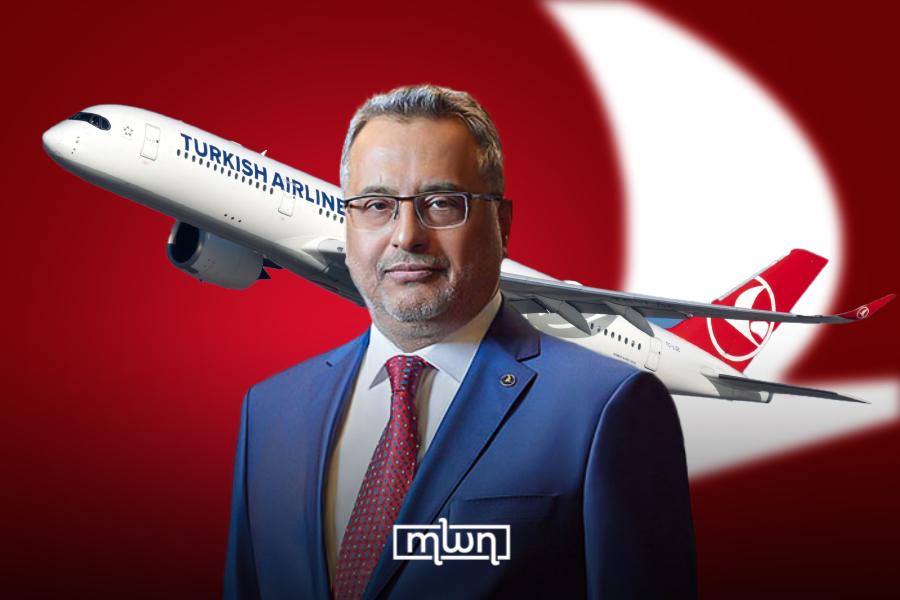
In an exclusive interview with MWN, Prof. Ahmet Bolat, Chairman of the Board and the Executive Committee at Turkish Airlines, laid out the airline’s latest performance figures, its fleet strategy, and its plans for Morocco ahead of major sporting events set to reshape the country’s aviation landscape.
“In 2025, we increased our Available Seat Kilometers by 7.5% to 273.2 billion, while our passenger traffic increased by 8.8% to 227.3 billion,” Bolat said. Total passenger numbers rose 8.8% to reach 92.6 million. The passenger load factor climbed to 83.2%, a sign that the airline is managing its growth without sacrificing efficiency.
The carrier’s financial results tell a similar story. Turkish Airlines posted $2.2 billion in operating profit for 2025 on total revenues of $24.1 billion, a 6.3% increase year-over-year. Passenger revenues drove much of the growth, rising 7.4% on the back of strong international and premium-segment demand. Fourth-quarter revenues alone surged 12% to $6.3 billion.
Cargo operations also contributed. Turkish Cargo transported 2.2 million tons of freight in 2025, an 8.4% increase, and generated $3.4 billion in revenue. The freight arm secured its third-place position globally with a 6.1% market share. “While global air cargo traffic grew by 3.4% in 2025, Turkish Cargo solidified its third-place position globally with a 10.7% growth,” Bolat noted.
Turkish Airlines now flies to over 340 destinations across more than 130 countries, making it the carrier that serves the most nations in the world. It is also the network airline operating the highest number of daily flights in Europe.
The airline is betting big on fleet renewal and growth
Fleet modernization is central to the airline’s medium-term strategy. Turkish Airlines closed 2025 with 516 aircraft. It took delivery of 57 new planes during the year while retiring 33 older models. The current fleet stands at 531 aircraft, including 14 wide-body, 359 narrow-body, and 28 cargo planes. The average fleet age is 9.8 years. New-generation aircraft now account for 41% of the total.
“Our fleet is planned to grow from 516 aircraft in 2025 to well over 560 aircraft in 2026,” Bolat said, with around 90 deliveries expected this year. The airline aims to push the share of new-generation aircraft from 40% to 100% by 2035.
Human capital has kept pace. The workforce at the main brand exceeded 36,000 employees. Including 19 subsidiaries, total headcount reached 100,000 – a 5.3% increase compared to 2024.
The airline also swept the awards season. Skytrax named it Europe’s Best Airline for a tenth time. It collected eight total awards, including Best Business Class Catering, Europe’s Best Business Class, and Europe’s Best Economy Class. APEX gave it the World Class Airline title alongside awards for Europe’s best in-flight entertainment and Wi-Fi.
Yet managing costs has been a persistent challenge for the Turkish giant. Fuel remains the single largest expense, and prices have been volatile due to geopolitical developments. “Our main motivation is not just to take precautions against price increases, but to minimize the negative impact of fuel prices on our cash flow and profitability,” Bolat explained. The airline uses hedging transactions and econometric modeling to manage this risk.
Beyond fuel, global inflation has squeezed margins across the industry. Bolat pointed to the economies of scale at Istanbul Airport, digital transformation, and fleet modernization as tools for keeping unit costs competitive. The airline invested $6 billion in 2025 alone. Over the past five years, total investment reached approximately $20 billion.
Competition with Gulf carriers has entered a new phase
Gulf disruptions caused by the ongoing conflict in the Middle East have redirected traffic through Istanbul. Turkish Airlines has suspended most Middle East flights except those to Saudi Arabia and Oman, which accounted for 6% of its capacity and revenue. The airline said it is adjusting capacity dynamically to offset the impact.
For 2026, Bolat outlined plans for new destinations including Yerevan, Timișoara, Monrovia, Bissau, and two Chinese cities – Urumqi and Chengdu. “These additions will allow us better presence in China in line with our growth goals there,” he said. The airline’s geographically diversified network across six continents reduces dependency on any single region.
In 2025, Turkish Airlines launched new routes to Ohrid, Seville, Port Sudan, and Phnom Penh, while resuming flights to Benghazi, Damascus, Aleppo, Misrata, and Sulaymaniyah as part of its strategy to connect underserved markets to its global network.
Morocco occupies a specific place in this expansion. Bolat described the country as “a strategically significant market within our growth vision in Africa.” The airline carried more than 87,000 passengers on Moroccan routes in 2025, a 12% year-over-year increase. Revenue on the Casablanca-Istanbul route grew by around 10%.
“Through our Istanbul hub, one of the most connected hubs in the world, we provide Moroccan guests with seamless access to more international destinations than any other airline,” Bolat said. The airline currently operates flights to both Casablanca and Marrakech.
Looking ahead, the chairman confirmed that additional frequency increases and broader network development are under evaluation. “Morocco remains a priority and high-potential market within our global growth strategy,” he said.
Morocco’s aviation infrastructure is undergoing a massive overhaul
The timing aligns with Morocco’s own aviation ambitions. The country is investing MAD 38 billion (approximately $3.8 billion) in airport infrastructure between 2025 and 2030 as part of its “Airports 2030” plan. The goal is to raise national airport capacity from 38 million passengers per year to 80 million by the end of the decade.
A new terminal at Casablanca’s Mohammed V International Airport is expected to add 20 million passengers in annual capacity. Major upgrades are also underway at airports in Marrakech, Agadir, Tangier, and Fez. The African Development Bank has approved a €270 million loan to support the effort.
Morocco welcomed nearly 20 million tourists in 2025, surpassing its original 2026 target two years early. Tourism revenues hit MAD 138 billion ($13.8 billion), a 21% jump from the previous year. The government is now targeting 26 million annual visitors by 2030. Royal Air Maroc, the national carrier, is also expanding its fleet and adding at least 10 new routes in 2026 to strengthen Casablanca’s role as a regional hub.
These developments create a favorable environment for Turkish Airlines’ growth in the Moroccan market. Morocco’s co-hosting of the 2030 FIFA World Cup with Spain and Portugal, combined with the successful hosting of AFCON 2025, has put the country on the radar of global airlines.
Bolat acknowledged this directly. “We see these milestones not only as short-term demand drivers, but as structural catalysts for sustained aviation and tourism growth for Morocco,” he said. The airline views its role as that of a “long-term strategic partner supporting Morocco’s development as a key regional aviation hub.”
A cautiously optimistic 2026 outlook
Founded in 1933, Turkish Airlines began direct flights to Casablanca in March 2005 with four weekly routes. Twenty years later, the carrier now connects Morocco to Istanbul through 7 weekly flights to Casablanca and 9 to Marrakech.
Strong performance in January and February 2026 supports expectations that profitability margins will hold steady this year. Turkish Airlines is guiding for an EBITDAR margin within the 22-24% range. Despite the Middle East disruptions and global trade uncertainties, the carrier says its diversified model gives it the flexibility to adapt.
For Morocco, this means the door to expanded service remains open – and the airline’s chairman has made clear that Rabat, Casablanca, and Marrakech are firmly on the map. “In an increasingly dynamic global environment, we have maintained operational efficiency through agile decision-making and disciplined resource planning,” Bolat pledged.