 Join on WhatsApp
 Join on Telegram
Rabat – Morocco is hosting this year’s Solar Decathlon Africa, a global competition that the Ministry of Energy, Mines, Water, and the Environment and the Moroccan Research Institute in Solar Energy and New Energies (IRSEN) is organizing. Over 1,200 participants from over 20 countries compete to fully design and construct operational solar homes.
Ben Guerir in Morocco’s central Rehamna Province is hosting the decathlon from September 13 through 27. Throughout these weeks, a team of jurors will evaluate the participants based upon ten events. Each event accumulates up to 100 points. Whichever team scores the most points will be the winner.
Passionate students and professors of the future of solar powered houses compete under the auspices of universities from around the world.
The contest aims to conceptualize low-energy consuming buildings that reach the bid of net-zero energy and to increase reliance on renewable energies, as outlined in the competition’s mission statement. Morocco World News travelled to Ben Guerir for a first-hand impression of Solar Decathlon Africa 2019.
Weaving native hemp into design
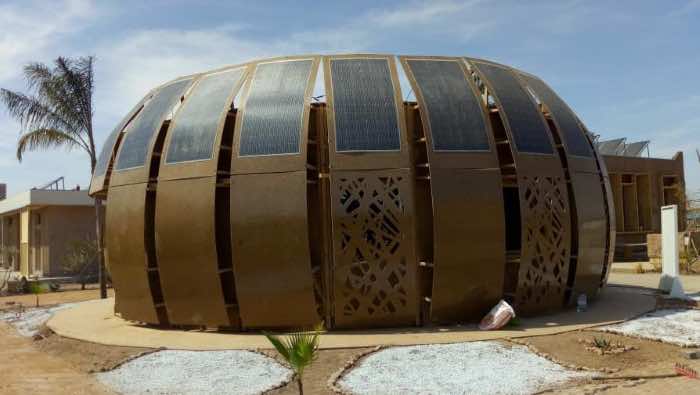
Introduced to Morocco via the Silk Road, the hut-shaped Sunimplant is constructed largely of hemp. Throughout her career as a Germany-based architect, Monika Bruemmer regards hemp as a formidable building material apt for the Moroccan climate.
“We have constructed tamped hemp concrete walls. Not only is hemp well suited for the day-night cycle and subsequent differences of temperature, but because of its organic nature, we’re able to completely reconstruct the house after it has reached its durability limit. Right now this house can last up to several decades, but can be completely rebuilt out of the same materials,” as told by Bruemmer.
Throughout the Central Rif region, the origin of Moroccan hemp, there is more than meets the eye. Sunimplant’s interior is based on Riffian decoration, as the particular layout of the house indicates.
Though the interior may be reminiscent of the Rif, the exterior calls to mind the design of archaic African architecture, such as that in ancient Somalia.
“The exterior design of the house is taken after the huts that were constructed in archaic times, but since we are striving for a sustainable future and modern requirements, the outer layers of the hut have been equipped with solar panels that provide the house with energy.”
Read also: Mohammed VI University Launches ‘Solar Decathlon Africa’ in Benguerir
Appeal and comfort
Per competition parameters, teams must construct the houses not only in a sustainable fashion but to appeal to inhabitants as well. Petra, the ancient southwestern city located in Jordan, inspires Neopetra design, though it caters to modern audiences.
“Since we are hoping that one day people will actually live in houses such as these, we realized we had to make them appealing and comfortable at the same time,” said Mohamed Amine El Marraki, project manager of Moroccan team Neopetra.
Appealing to modern audiences who are in search of something fresh and new does not mean abandoning Moroccan heritage. “As you can see we have decorated the entire ceiling with wood, in line with the Moroccan style referred to as atawa,” added Marraki.

The house’s design pays respect both to Moroccan architecture and to achieving a sustainable, solar-driven future. “The solar panels on the roof are facing an east-to-west position, to ensure the panels are exposed to the sun throughout the entire day,” Marraki explained.
“But a house is a place to socialize as well. This is why we have designed a place in the middle of the house, referred to as forstdar where people can meet, laugh, and make music.”
Recycle, reuse, and reinterpret
Team Bosphorus represents Turkey with their villa-like house titled Reyard. “Reyard is a play on words by which we convey the strength of our house, namely: Recycle, reuse and reinterpret,” according to project manager Esra Kiygin.
“While doing research we learned that Moroccan houses usually have an inner-yard. This is something we incorporated by connecting every individual room to the courtyard. Hence the name Reyard.”

“We have strived to go above and beyond with our design, not only incorporating solar energy but ensuring a self-sufficient, sustainable house that can be used for many years. Crucial for this approach was the use of our microalgae pond, that makes it possible for streams of waste water to be reconverted into reusable energy,” she said.
“In this way the house can operate as an independent ecosystem, not reliant on any other power source,” explained Kiygin.
Read also: Moroccan FM: ‘ Africa Is Disproportionately Affected by Climate Change’
Interhouse engages its inhabitants
Each house brings something new to the table. The team that built Interhouse wanted to ensure interaction between the inhabitant and the house.
“As you can see we have equipped each room with a smart device that can be operated by both the main computer and an app we have designed for your smartphone. By sliding my finger in a downwards position over the screen of my phone I can lower the sunscreens of the house, or with a simple tap turn on the lights,” explained team member Michael Blonsky.

“Being an American-Moroccan team, we designed the house in both styles. Our front porch is a great example of American architecture, and as you can see, we have constructed black tinted, see-through solar panels above the porch.”
The team also worked to create something that was both Moroccan and unique. “We anticipated that other teams would go for a typical Moroccan riyad as well, so we approached it with an ‘interactive’ angle. Depending on the weather you can adjust the rotating beams that serve as the roof to heart’s content, by the mere flick of your finger,” explained Blonsky.
The future of Morocco’s solar homes
Many team members feel confident that solar homes will be part and parcel of Moroccan society within the coming decades, but Romani Zaid, a professor at Tetouan’s National School of Architecture (ENA), expresses doubts.
“Though these houses are built with extraordinary passion and dedication by all the team members, we must not forget that there remains a big gap between the government and the industry in Morocco.”
It may be some time before solar homes will enrich Moroccan society, but trying to close the gap is part of the solar decathlon’s mission. While the solar village features the houses built by teams from all across the world, the congress hall provides team researchers with a platform to explain the progress they have made during the two-year design period.

Though solar homes may still be part of a utopian future, Zaid thinks solar energy in general has a viable chance for success.
“Naturally the enormous solar plant that was built by the government near Ouarzazate remains a formidable example, but there are other bottom-up projects throughout the country as well. Due to the rising levels of air pollution, Marrakech initiated a solar bike project to encourage people to leave their polluting scooters at home and take the solar bike as a sustainable alternative.”
“But,” he concluded, “whether Morocco will embrace solar homes indefinitely is up to the Moroccan people, industry, and government.”
Read also: Morocco’s Everyday Sustainability