 Join on WhatsApp
 Join on Telegram
Rabat – The 12th annual Fez Festival of Sufi Culture took place from October 19 to 26, 2019. The festival’s program rolled out to locations throughout the ancient city of Fez, Morocco’s spiritual capital.
Every year, the festival’s director Faouzi Skali approaches the event with the hopes of spreading a positive image of Islam through Sufism.

Skali sees the festival as a way to “consolidate the positioning of Morocco in the intercultural dialogue by throwing a bridge between East and West.”
With the theme “Sufi culture, a spiritual humanism for our time,” Skali’s goal for this year’s festival was to create a space in which people can come to understand the significance of Sufi culture and revive the legacy of Sufism in Moroccan civilization.
“Somehow people lost this connection, this spirit of Sufism,” Skali told Morocco World News. “Fez is really a city of Sufism, but people are not always aware of that.”
While Skali has also directed the popular annual Fez Festival of World Sacred Music, which began in 1994, he decided to take his work a step further and explore the legacy of Sufism in the spirit of Fez. In 2007, the Fez Festival of Sufi Culture was born.
Skali believes that Sufism is a necessary part of a much-needed spiritual revival in Morocco, and that Sufi culture has the capacity for innovation and creativity.
“I want people to share, discover, and understand what the Sufi culture could give us in our time.”
Read also: Fez Festival of Sufi Culture in October to Honor All Things Sufi
The core values of Sufism: Love, unity, and inclusivity
Sufism is the mystical branch of Islam. Like all Muslims, Sufis strive to emulate the Prophet Muhammad and believe that God is the source of all knowledge.
Unlike certain branches of Islam and other religions, however, Sufism does not prioritize doctrine or a system of beliefs.
Rather, Sufism is a way of life in which a deeper identity is discovered and lived, according to Kabir Helminski, author of “Living Presence: A Sufi Way to Mindfulness & the Essential Self.”
Sufis aim to discover a deeper identity beyond that of the superficial personality. This deeper identity has superior abilities of awareness, action, creativity, and love.

Because Sufis focus on looking into one’s inner self, they are compelled to respect the dignity and integrity of others. Based on this principle, Sufis tend to be liberal and open-minded.
Sufism is perhaps the most inclusive of all religions, as Sufis believe that everyone can find God regardless of their religion, class, or ethnic identity. God is not confined to one religion or place; rather, God lives in the heart of everyone.
“If Sufism recognizes one central truth, it is the unity of being, that we are not separate from the Divine,” says Helminski, a leader of the Mevlevi Order of Sufis.
“Sufism is about realizing the current of love that runs through human life, the unity behind forms.”
Read also: Islam in Morocco is Couched in Sufism
Open to the public, but restricted to the privileged
While Sufism appeals to the masses and strives for inclusivity, the Fez Festival of Sufi Culture ultimately fell short of upholding the core values of Sufism.
The festival, while marketed as open to the public, in effect, hand picked its attendees with an exclusive access system. Only those who had enough time, money, and resources—or a personal invite—could attend the events.
An all-access pass to every event of the weeklong festival was MAD 1000, a steep cost for the average Moroccan who earns between MAD 3000 and 4000 a month.
Those interested in attending certain intellectual roundtables or musical performances could have purchased individual event tickets rather than the full package.
A ticket to the opening ceremony cost MAD 300, and the closing ceremony was the same price. The rest of the musical performances were free to the public.
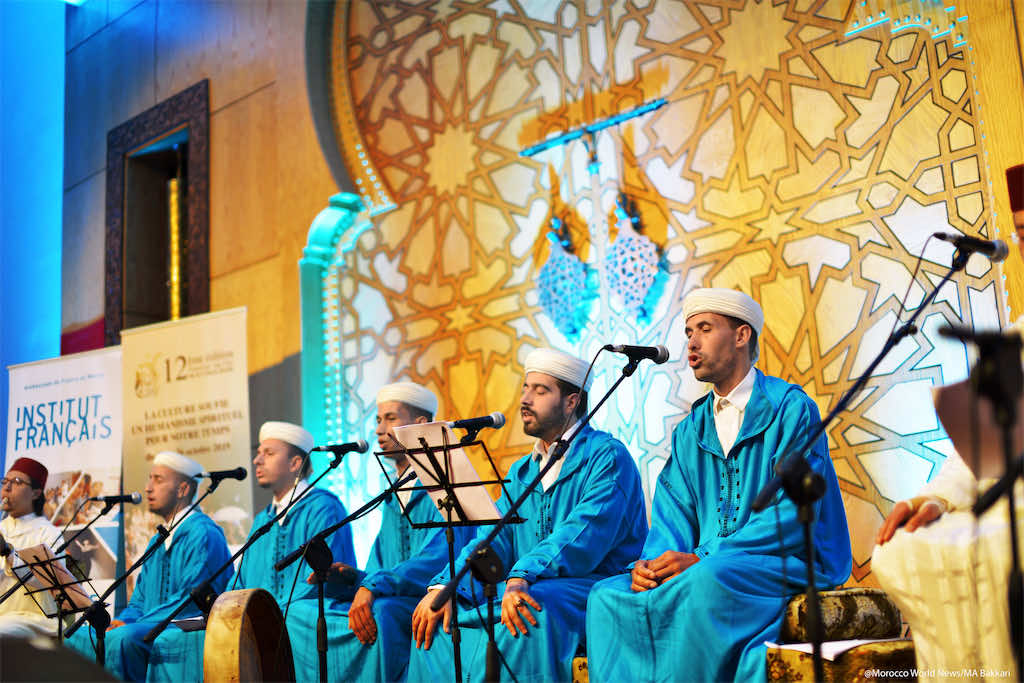
Attending the poetic and musical recitals cost MAD 100 per performance.
Entry to the roundtable discussions cost MAD 50 per conference, and a full access pass to all of the conferences was set at MAD 300.
In addition, the roundtables and recitals were held in the morning and afternoon, during regular working hours. This effectively limited attendance to retirees or the financially sound and excluded the average Moroccan.
The annual festival is conducted under the patronage of King Mohammed VI and in partnership with the Ministry of Culture. With sponsors like BMCE Bank of Africa and phosphate giant OCP, attendees might expect subsidized tickets to promote local participation.
Read also: Report: 9 Million Moroccans Poor or at Risk of Poverty
Location matters
Due to poor weather conditions, the festival’s organizers relocated the musical performances to the Jemat al Fez municipal building. The building is in the middle of a quiet, developing neighborhood far from the Fez medina. Attendees who were not staying in one of the festival’s upscale hotel partners had to arrange their own transportation.
The events in this building were therefore less accessible to the public than they would have been in the more central location of Jnan Sbil Park, a short walk from the medina. As one of Fez’s most popular gathering spots, the park setting also offers a backdrop of Moroccan culture.
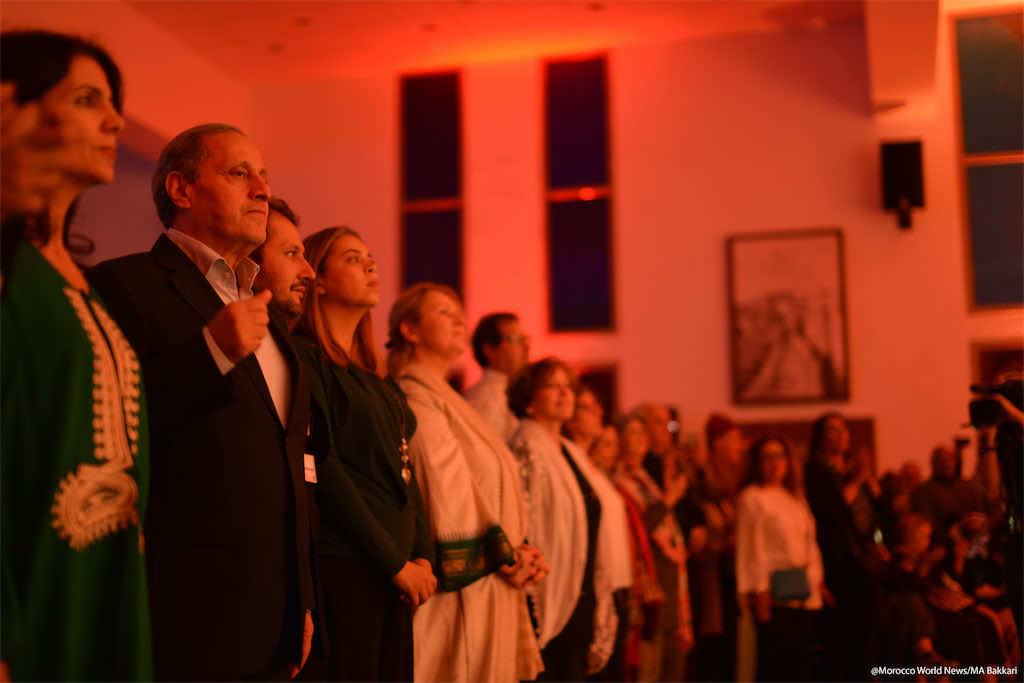
Despite the less than desirable location, each of the musical performances still attracted a formidable audience—but a privileged audience, nonetheless.
The intellectually stimulating roundtable discussions also relocated.
The roundtables were originally scheduled at the Bou Inania Madrasa, one of Morocco’s most important Islamic historical sites. However, due to rainy weather, the roundtables took place at Riad Dar Batha, owned by the French Institute in Fez.

This change in location may have served to shift the perception of some conference attendees.
The Bou Inania Madrasa would have reminded the roundables’ participants of the achievements of Islamic culture. The intellectual talks, however, were marked by a prevalence of French culture, despite being part of a Moroccan festival celebrating Sufi culture.
The panel members discussed Sufism exclusively in French, in front of a Francophone audience, in a traditional Moroccan building owned by the French Institute. The French Institute in Morocco is an organization established by France’s Ministry of Foreign Affairs to promote French culture in the Kingdom.
The French-owned Moroccan riad was the site of an argument over the hijab between a Moroccan Muslim woman and a French woman, just two days into the festival. The Francophone woman told the hijabi Moroccan to remove her headscarf before posing a question to the panel.
Had the roundtable been held at the world-renowned Islamic architectural feat of Bou Inania Madrasa, a building that still functions as a prayer space for Muslims, the hijab debate would have been even more ironic.
Read also: Francophone Woman Attacks Hijabi Moroccan at Sufi Festival in Fez
A rational but ironic system of exclusion
Although Skali intended to spread the values of Sufism with the annual Fez Festival of Sufi Culture, the festival fell short.
The steep entry fees and linguistic limitations ultimately excluded all but an elite class of invitees, contradicting the principles of inclusivity, unity, and cohesion within Sufi traditions.
Perhaps this system of exclusion was intentional, given Skali’s goals of promoting a positive image of Islam and “throwing a bridge between East and West.”
The local population of Fez, which has a rich history of Sufism, already appears to have a positive image of Islam.
Westerners, on the other hand, perhaps need added exposure to Sufism.
Sufism represents a more liberal and open-minded branch of Islam, which has been branded a religion of violence and intolerance by right-wing political parties and media sources throughout Europe and North America.
In this sense, it is completely reasonable for the festival organizers to prioritize the attendance of Europeans and North Americans, along with upper-class and highly-educated Moroccans—particularly those residing abroad.
If Skali’s ultimate goal was to encourage the re-integration of Sufism into Fez culture, the festival would be branded a failure, given the absence of local participation.
However, while he did mention wanting to make the legacy of Sufism in Fez more known, his intended audience for this knowledge may very well have been elites.
Furthermore, space was limited at Riad Dar Batha where the roundtables were held, and would have been just as restricted at Bou Inania Madrasa.
Without entry fees, those who were personally invited to the festival may not have found seats.

The concerts, in contrast, were free of charge and would have been open to regular passersby in Jnan Sbil Park, had it not been for the rain prompting a location change. Perhaps the festival’s organizers could have decided on a larger, more public location for the intellectual roundtables, as well.
Read also: In Photos: Mystical Music at the 12th Fez Festival of Sufi Culture
While it is easy to rationalize the festival’s exclusivity as a strategic decision, one key issue still remains: Exclusion of this nature directly opposes the principles of Sufism.
The sheer irony of restricting a celebration of Sufi culture in Morocco’s spiritual capital to a class of well-resourced, Francophone elites is irrefutable—whether it was done intentionally or not.