 Join on WhatsApp
 Join on Telegram
The “Moroccan Supermarkets tackling Single-Use Plastics” (MOSSUP) project has been partnering with Moroccan supermarket chains since early Spring 2021, helping the country to take important steps to address plastic pollution.
“The project’s end goal is to increase collection of post-consumer plastic waste and improve the recycling rate of PET plastic” according to Searious Business, the environmental consultancy company behind the innovative scheme.
The MOSSUP project was piloted in supermarket chains Marjane and Carrefour (which operates as Label Vie). By simply introducing plastic bottle collection points in participating stores and integrating reusable packaging at deli counters, MOSSUP has already helped avoid the accumulation of masses of plastic waste.
The project has potential to be upscaled in the near future, achieving an even greater positive impact on both the environment and on consumer mindsets.
The MOSSUP project
There were two main tenets to the project at its conception in March 2021.
“Pilot A” involved the installation of bottle collection points in participating stores. This enables a closed loop for bottle-to-bottle recycling, according to the environmental experts at Searious Business. Customers are incentivized to take part in the scheme because they receive a voucher or loyalty card points to spend in the store for each bottle returned.
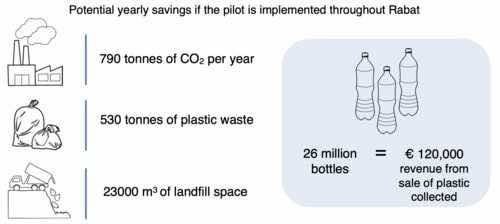
Image courtesy of Searious Business, the impact-driven environmental consultant company running the MOSSUP project
As the above Searious Business graphic shows, it is estimated that 26 million bottles could be collected every year in Rabat alone if the project operated across the entire city. Such a colossal disruption of the typical “end of life” path of plastic bottles would equate to saving 790 tonnes of carbon dioxide per year.
This is not only good for the environment, but also a sustainable corporate practise: supermarkets can generate a sizable amount of annual revenue by selling the plastic collected to be recycled and re-enter production.
“Pilot B” is a reusable food container scheme, whereby deli counters in participating supermarkets are encouraged to become zero-waste. Prior to the implementation of this pilot scheme, single-use plastic containers would have been thrown away by consumers immediately after use. Now, consumers can pay a small deposit on a reusable container, return the container to the store and receive their deposit back — the container is washed and reused by the store, not contributing to the masses of single-use plastic currently discarded into nature.
If widely implemented in the city of Rabat alone, the reusable container scheme could avoid a huge 5000 tonnes of plastic waste. Not only this, but the reusable containers are less costly for supermarkets per year than single-use counterparts.
Both schemes work hand in hand to financially support the supermarkets and protect natural spaces from the scarring effects of inadequate plastic disposal.
The MOSSUP project has been successful in Morocco thanks to the partnership between Searious Business and Moroccan Association for the Protection of the Environment and Climate (ASMAPEC) who provide on-the-ground knowledge and assistance in Morocco. This joint effort to improve the collection and recycling of plastics is also supported by the Moroccan Ministry of Industry, Trade and Investment.
Plastic waste: A global threat
The challenges posed by plastic debris being inadequately managed is not unique to Morocco. The accumulation of plastic waste is adversely affecting the earth’s environment by horrifically harming biodiversity and wildlife. Despite this, it is estimated that half of all plastic produced is designed to be used only once — and then disposed of.

(Credits to Our World in Data)
The above image shows that by 2015 global plastic production had reached more than 7.8 billion tonnes. This is equivalent to more than one tonne of plastic for every person alive today. More to the point, the image shows that we are coexisting with almost an inconceivable amount of plastic waste because of both overconsumption of plastics and poor management practices.
It has become absolutely essential that we decentralize single-use plastics in our daily consumption habits.
Even though Morocco produces 1 million tonnes of plastic waste per year, only 7% of this is recycled. The rest ends up in landfills or in the environment.
To add further insult to injury, a 2010 study showed that 66% of plastic waste in Morocco was inadequately managed, meaning that plastic waste coming from Morocco has a higher risk of polluting rivers and oceans.
The improvement of waste management systems across the world is absolutely critical to reducing plastic pollution. The MOSSUP project is taking admirable first steps in what must be an international endeavor to be more conscious about disposal techniques and ethical consumption.
Not only that, but the MOSSUP project is tackling the sector from which the most single-use plastic waste emerges: around the world it is packaging which takes the greatest environmental toll. This is shown in the following graphic from Our World in Data:
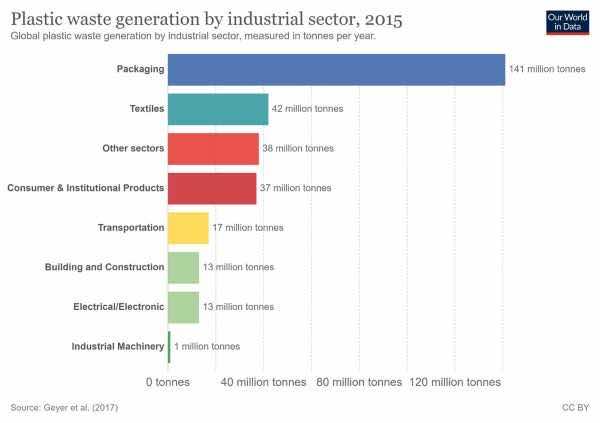
(Credits: Our World In Data)
Simply put, the climate crisis demands innovation from consumers, retailers, and policy makers alike. The MOSSUP project is a promising glimmer of hope that consumers are willing to play their part and that green new ideas can be beneficial to businesses, rather than a hindrance to profits.
Next Steps For MOSSUP
The MOSSUP project presents excellent potential for upscaling, and is setting a precedent for other supermarket chains and even other countries. The project puts sustainable plastic consumption within tangible reach, at a time when this has never been more urgent.
It seems that one of the most innovative aspects of the project is intentional closing of the gap between waste management processes and individual consumers. Many of us tend to lose all awareness of our plastic waste the second it leaves our hand and falls unceremoniously into the nearest rubbish bin. The “end of life” path of a water bottle or plastic container is understandably not always at the forefront of consumers’ minds. However, the MOSSUP project seems to have cultivated a common awareness among thousands of people of the negative impacts of plastic waste.
The threats of climate change can so often appear distant, and MOSSUP ultimately gives every Moroccan who uses the supermarket a chance to engage with and protect nature. Shifting the way consumers view their environmental responsibility is no small feat, reminiscent of the rallying cry of many conservationists: we are a part of nature, not apart from it.
In fact, if the MOSSUP project is supported in mass upscaling, it can in turn support a circular economy in Morocco. Financial growth is so often associated with the depletion of finite resources and the misuse of resources — a lack of sustainability seen as a necessary evil central to development. Instead, the MOSSUP project envisions a scheme that benefits businesses, society, and the environment: regenerative by nature rather than wasteful and greedy.
Searious Business appears determined to propel the project forward in the coming months. The group’s latest statements express hopes for a “fully integrated national container deposit scheme” modelled on the success of pilots A and B. It is expected that the mass recovery of plastic bottles will boost the economy and help to develop a more efficient system of recycling in Morocco.
The MOSSUP project is leaving a mark on the waste management industry in Morocco: Not the uncaring mark of a carbon footprint but instead an eco-conscious mark forged by policy-makers, investors, retailers and each and every consumer contributing to plastic waste reduction.