 Join on WhatsApp
 Join on Telegram
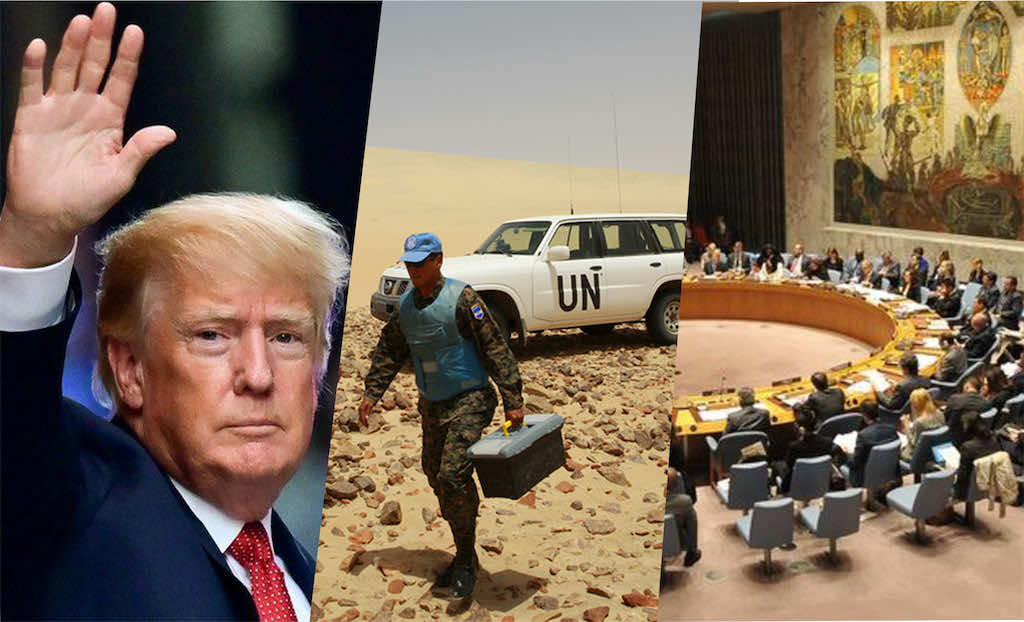
Rabat – One year ago today, self-determination spin doctors in the Western Sahara conflict suffered an epoch-defining jolt when former US President Donald Trump proclaimed Washington’s unambiguous recognition of Morocco’s sovereignty over the territory.
With the Polisario Front’s “Sahrawi self-determination” cause already in limbo following the Guerguerat incidents in October and November 2020, Trump’s announcement was the sharpest expression of a reality that many diplomats and analysts had long suspected or pointed to for the past decade at least.
A wake-up call
It was not just a monstrous blow to the morale of Polisario leadership; it was a brutal wake-up call to the excruciating reality that clinging to self-determination in the Western Sahara question essentially amounted to chasing shadows.
And so, if the past two years had felt like a diplomatic procession for Morocco — UN Resolution 2414 and the African Union’s pro-Morocco turn in July 2018 come to mind — December 10 was a critical watershed moment in the continued consecration of the triumph of political realism and compromise.
For Morocco, it felt like the end of a cycle, the harbinger of new, pro-Rabat beginnings to come. Having consigned Polisario to diplomatic irrelevance for much of the past decade, Moroccan diplomacy secured its grip on the driving seat a year ago today and has since made it clear that it does not intend to let go.
But recent, growing tensions between Morocco and Polisario-backing Algeria have raised the specter of armed confrontation and revived debates about the viability of the UN-led political process. It appears the repeated diplomatic trouncing of Polisario’s self-determination case is only the beginning, rather than the end, of a long and arduous walk toward a sustainable political settlement of the decades-long dispute.
The question now facing the ongoing but fragile UN peace process is: What can possibly convince a profoundly vindicated Morocco and an increasingly cornered but intermittently hostile Polisario Front to resume the long-stalled peace talks? Is there still hope for a mutually acceptable political settlement after the particularly hectic past few months?
Asking a similar question in a recent analysis, MENA experts Haizam Amirah-Fernandez and Isabelle Werenfels reached the conclusion that the international community should increase the pressure on conflicting parties to broker a “sustainable solution” consistent with Morocco’s Autonomy Plan. Because Trump’s December 10 proclamation has irreversibly altered the dynamics over Western Sahara, they suggested, it can and should be the new basis on which to conduct a diplomatic conversation.
Whose ‘international law’?
Of course, the two authors’ analysis and interpretations often complicate an already blurry picture. Even, for instance, as they strive to come across as neutral or objective, there are minor invocations of the mainstream discourse waylaid by sympathy for Polisario’s supposedly more morally defensible position.
Key in such a reeading is the contention that Trump’s Western Sahara proclamation was in contravention of international law and conventions. But proponents of such a critical take on Morocco’s position do not generally specify what consistency or inconsistency with customary international law means in practical terms.
Or, for that matter, what international law amounts to when talking about Western Sahara. Without dwelling on the history of international law or a detailed listing of the elements of public international law, it helps to at least stress that the UN Security Council is, by definition, the ultimate enforcer and embodiment of international law in the case of Western Sahara. For one thing, the UN Secretary General’s annual reports and — most critically — the Security Council’s resolutions are the ultimate codifier and arbiter of the behaviors and regulations by which each of the conflicting parties is required to abide.
As Samir Bennis has instructively argued, “by virtue of the principle of consistency of practice in customary international law,” the UN’s Security Council’s ditching of a self-determination referendum in the past fifteen years has “created legal consequences for the conflict.”
In this sense, Trump’s December 10 proclamation was merely a Trumpian — bold, self-assured, and unnecessarily combative — way of putting something that the UN Security Council has consistently but hesitantly said for the past 15 years. That while negotiations for an optimal, “compromise-based” settlement are up for debate, the independence dream is fundamentally off the table.
Read also: Western Sahara: Guerguerat and the End of Dreams
Trump, not known for his diplomatic temperament, had no qualms about crudely embracing the gist of an idea that the UN Security Council has been gesticulating at for the past decade. The resounding takeaway from the Trump proclamation can be expressed as such, in less offensive Trumpian parlance: Just get over your impractical statehood dreams and come back to the table to negotiate something that is actually feasible and tremendously benefits everybody.
That Trump’s language shocked and offended many is comprehensible. Still, the undiplomatic, convention-shattering tone should not distract from the political essence: The prevailing — and increasingly inexorable — consensus in UN quarters is that a self-determination referendum is now misguided and untenable.
Biden’s juggling act
The latest dispatches from the Biden White House suggest that Washington is very unlikely to revert Trump’s decision. However, Biden’s balancing act — neither fully embracing nor rejecting the December 10 proclamation — may give a new lease of life to pro-Polisario interpretations.
It would not be surprising to hear or read in the next few days or months that Congress’ recent conditioning of US-Morocco security cooperation is a solid indication that the US can still decide to give in to pro-Polisario entreaties and annul the Trump White House’s proclamation on Western Sahara.
But that would be a wild overinterpretation. More diplomatically inclined than Trump, Biden surely understands that his administration needs to make the Trump proclamation more palatable to have a real shot at convincing the Polisario leadership to commit to the peace process.
As this requires creatively working within the confines of Trump’s decision by finding a way to make the grieved Polisario Front accept the unmistakable political reality while assuaging some of their concerns, the question remains how long such a juggling act will take. How long, or what, will it take for the UN-led process to persuade the separatist front to resign itself to political reality and diplomatic pragmatism?
Read also: Western Sahara and the Clash of Pan-Africanisms
To be clear, the flurry of diplomatic setback Polisario has experienced in recent months — Morocco’s assertive prominence in Africa; the opening of consulates in Dakhla and Laayoune; the Trump proclamation; and the emerging feeling that the EU may end up following in the US’ footsteps — makes it abundantly clear that Polisario’s independence option is unworkable.
But Morocco is not out of the woods yet. As evidenced in the rejection of the latest UN resolution by both Polisario and Algeria, confidence-building remains the primary task of Staffan de Mistura, the newly appointed UN envoy for Western Sahara.
Even so, there is so much more to the rejection of Resolution 2602 by the Algerian regime and Polisario’s leadership. It comes from an adamant willingness to torpedo the UN-led process as long as it does not rehabilitate the self-determination thesis.
It is a feeble attempt at sustaining the forlorn surface-level optimism that, for all Morocco’s diplomatic victories in recent years, there is still some faint hope of reframing or reclaiming the narrative by dramatically amplifying Polisario’s sense of grievance and presenting Morocco as an occupier.
As such, the torrent of vindictiveness and outrage that both Polisario and the Algerian regime recently threw at the UN Security Council constitute both an excuse to hide behind and a desperate reaction to the inescapable reality that compromise and pragmatism have won the day.
Lingering challenges and enduring myths
At the current juncture, even with unmistakable evidence that a referendum-based solution is anachronistic and unbefitting to the development of the conflict, getting a frustrated pro-Polisario camp to come to terms with that fact remains a Sisyphean task. The old holding patterns are still fully operational in a regional conflict that, then as now, is an ideological minefield.
Read also: Strategic Paranoia: The Banality of Algeria’s Moroccan Obsession
For Morocco, one essential ingredient in the Sahara story is Algeria’s historical and continued role in the dispute. That there would be no Polisario Front without Algeria’s logistical, ideological, and financial support flies in the face of anyone who takes time to read a few pages about the history of the conflict.
And yet, when Moroccan diplomats often bring this up, some observers are quick to dismiss it as a ploy to delegitimize Polisario’s supposedly noble and more sympathetic decolonization struggle.
Heavy on affective narrative but light on historical evidence, this perspective — a revolutionary Algeria only supporting the uptight struggle of an oppressed people — is the continuation of the well-trodden third-worldist tropes with which Algiers has long suffused its diplomatic activism.
As they argue from a position of ideological fervor, zealous certainty, the ardent proponents of this thesis claim to offer a strident “deconstruction” of Morocco’s “expansionism” — only to end up gaslighting diplomatic history and facts.
Morocco should not rest on its laurels
But there is a reason for the survival and continued appeal of such tenacious myths: Narratives of suffering, even if false or fabricated, have always been more electrifying and seductive than sober, historically grounded analysis.
In his slim but devastatingly insightful book, L’Algérie et le Sahara Marocain (Algeria and the Moroccan Sahara), historian Abdallah Laroui writes that the success of “Algerian propaganda” with most left-leaning politicians and commentators in the West stems from its dexterous mobilization of “revolutionary utopia.”
Laroui cites the “bewildering ignorance of historical facts” and the superior galvanizing potential of “ideological zeal” and “revolutionary imposture” as the drivers of an effective narrative. As perceptions trump reality and moralism triumphs over analysis, he writes, Morocco is eternally judged on “its actions or inaction” while Algeria is given sympathetic nods for its noble intentions.
The Moroccan historian wrote this in the 1970s, and while much has changed since then — Morocco has made unprecedented diplomatic gains and the UN now acknowledges Algeria’s front-seat role in the Sahara conflict – much remains the same, narrative-wise at least.
Scrolling through most international coverage of Western Sahara, it is extremely commonplace to come across expressions and phrases like “Morocco invaded after Spain left” or “the last colony in Africa.” Hence, one fundamental point that has not changed in the past four decades is that, for all its diplomatic strides in the past five years, Morocco should not be lulled into complacency.
Instead, the time has never been this ripe for Morocco to sharpen its diplomatic firepower, redouble its public diplomacy outreach to counter Algeria’s relentless outpouring of pro-Polisario verbal onslaughts. This entails occupying the cultural, political, and academic sphere (research scholarships and grants, for example), with the aim of eventually, efficiently catapulting Rabat’s side of the Sahara story into the mainstream consciousness.