 Join on WhatsApp
 Join on Telegram
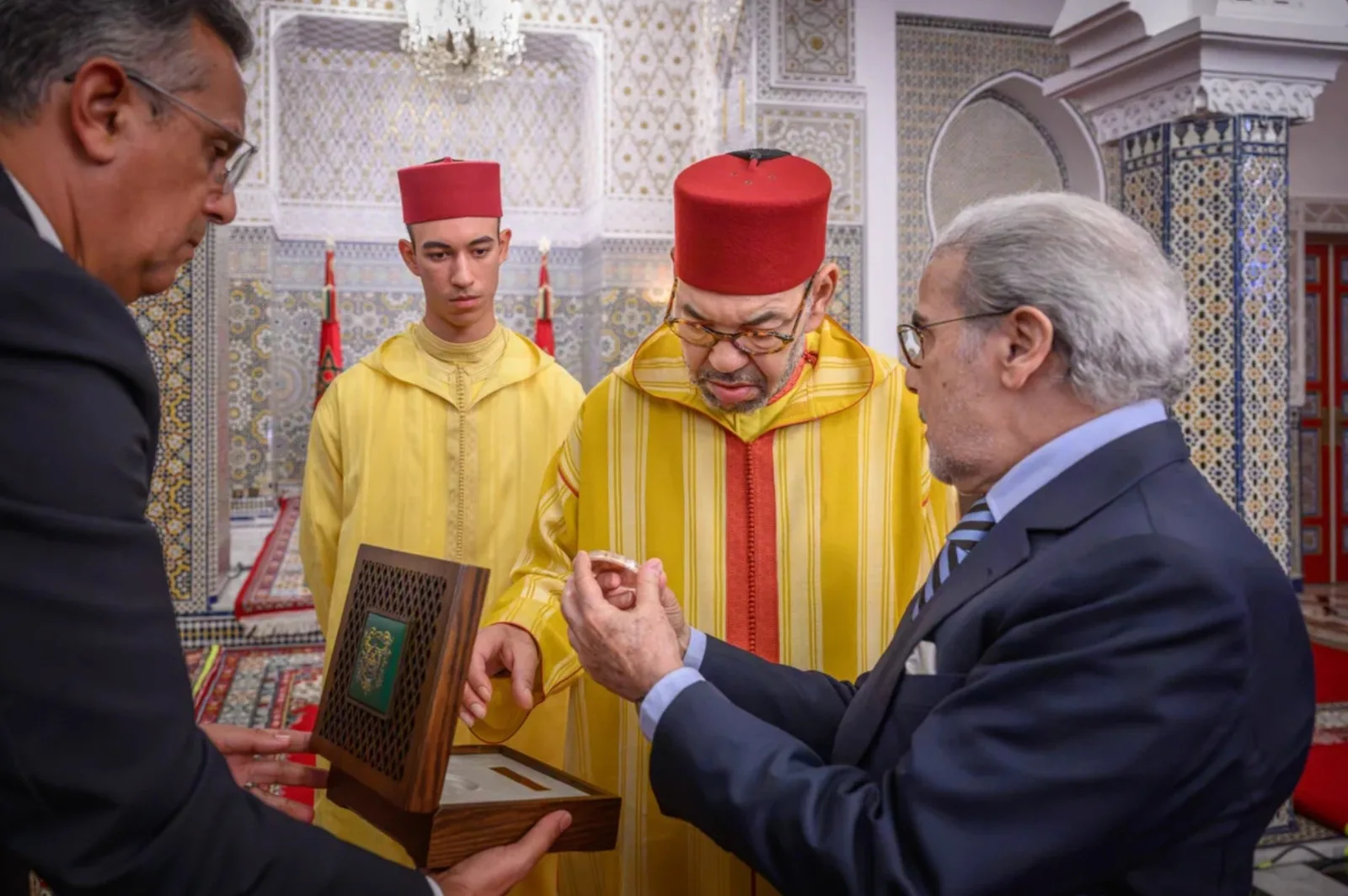
Agadir – King Mohammed VI received Bank Al-Maghrib Governor Abdellatif Jouahri at the Royal Palace in Tetouan today, where the central bank chief presented the institution’s Annual Report on Morocco’s economic, monetary, and financial situation for the 2025 fiscal year.
Jouahri said Morocco maintained solid economic momentum despite a challenging global environment marked by successive shocks and persistent uncertainty.
According to the governor, the Moroccan economy expanded by 4.9% in 2025. This positive trend was primarily due to strong investment, stressed the report, noting that inflation remained subdued at an average of 0.8% despite the acceleration in economic activity.
“Despite an international environment marked by successive shocks and persistent uncertainty, Morocco’s economy continued to improve in 2025,” Jouahri said, explaining that the country’s economic resilience continued throughout the year.
On the monetary front, Jouahri said Bank Al-Maghrib maintained an accommodative policy by lowering its benchmark interest rate to 2.25%, while continuing to fully meet banks’ liquidity needs and intensifying efforts to facilitate financing for very small enterprises.
Unemployment remains a challenge
The governor also pointed to improvements in the labor market, saying stronger economic growth contributed to job creation. However, he acknowledged that the gains were insufficient to significantly reduce unemployment, which stood at 13%.
Regarding public finances, Jouahri said Morocco continued to improve its fiscal position, with the budget deficit narrowing to 3.5% of GDP, supported by robust tax revenues and proceeds from innovative financing mechanisms.
He added that the country’s external accounts remained resilient, with the current account deficit contained thanks to strong tourism revenues, remittances from Moroccans living abroad, and exports of phosphates, phosphate derivatives, and aerospace products.
Official foreign exchange reserves rose to MAD 443 billion, equivalent to nearly five and a half months of imports, further strengthening Morocco’s external buffers.
Jouahri calls for more inclusive growth
While these indicators reflect sustained economic momentum, Jouahri stressed that future progress depends both on maintaining higher growth and on ensuring its benefits are shared more broadly across society.
A gap has emerged between economic performance and public perception, he noted, largely attributing it to the labor market’s limited ability to generate the expected improvements in employment.
To address this challenge, the governor called for continued reforms to education and vocational training, stronger spillover effects from investment, and greater private-sector participation to support sustainable and inclusive growth.
Jouahri also linked public perceptions to persistent social inequalities, recalling King Mohammed VI’s 2025 Throne Day Speech, in which the Sovereign warned that “there is no place, today or tomorrow, for a Morocco advancing at two speeds.”
He said that although significant resources have been allocated to social support, the country should improve the targeting of assistance toward the most vulnerable segments of the population.
Public spending reform among key priorities
The governor further emphasized the need to rationalize public spending to create additional fiscal space, particularly in light of unavoidable expenditures and the expected impact of pension reform.
He called for regular reviews of public spending and urged faster implementation of reforms to Morocco’s Organic Finance Law.
Addressing strategic priorities, Jouahri said recurring disruptions to global supply chains underscore the importance of implementing the High Royal Instructions issued in the October 2021 Royal Speech on establishing strategic reserves of essential products.
Such reserves, he argued, would enable Morocco to move “from a reactive to a preventive approach.”
Sustaining Morocco’s development momentum
He also stressed the importance of accelerating the country’s energy transition to reduce dependence on imported energy while helping Moroccan exporters comply with increasingly stringent climate-related standards in international markets.
On climate issues, Jouahri identified water governance as a key public policy priority, emphasizing the need for more efficient management and better use of water resources amid growing climate pressures.
The governor also welcomed the momentum generated by Morocco’s advanced regionalization process following the King’s 2024 speech, calling for greater mobilization of expertise to accelerate implementation, foster regional economic hubs, and reduce territorial disparities.
Concluding his presentation, Jouahri said sustaining Morocco’s progress requires the continued commitment of all stakeholders within a framework that ensures coherent and effective public action under the leadership of the Monarchy, which he described as the country’s principal driver of development.