
 Join on WhatsApp
 Join on Telegram
Rabat – In the lead-up to World Cancer Day on February 4, the Swedish Institute for Health Economics (IHE) in collaboration with Pharmaceutical Research and Manufacturers of America (PhRMA) held an online webinar to stimulate debate and discussion over cancer care.
Organized by the Union for International Cancer Control (UICC), World Cancer Day aims to raise awareness of cancer, and stimulate public debate over the best practices to adopt to prevent, detect, and treat cancer worldwide.
With over 100 attendees, the webinar panelists included high-profile cancer activists across the spectrum building on their personal experience to bring to light the factors behind the gap in cancer care.
Read Also: In Morocco, Cancer Is More Than an Illness, It’s a Crippling Fear
Discussing the theme “Realizing the Problem,” panelists all seemed to agree that the most dangerous aspect of the cancer gap is the fact that it remains in the shadows.
Drawing on her experience as a mother of a cancer patient and President of the Union for International Cancer Control, an NGO dedicated to reducing the global cancer burden, Princess Dina Mired of Jordan explained that the cancer gap hits low- and middle-income countries the hardest with 70% of global cancer deaths occurring in those countries.
In low- and middle-income countries, patients often discontinue cancer treatment because they can’t afford daily transit fees to health centers, explained the president of the union for international cancer control.
The financial burden of cancer treatment, or “disease burden,” can potentially drive families to the brink of poverty, argued panelist Fadia Saadah, director of the World Bank’s human development branch.
Patients discontinuing treatment because of financial constraints is a major loss of resources and of precious lives, the issue should be at the forefront of policy-making, argued the director of the World Bank.
Speaking on the global reach of the issue, Thomas Hofmarcher, a health economist at the Swedish Institute for Health Economics (IHE), shared alarming data indicating that population dynamics, coupled with a multitude of other factors, are projected to drive a rise in the number of cancer patients over the coming 10 years.
Decision-makers face the need to develop efficient policies to deal with the projected surge in the number of cancer patients and maintain a high survival rate.
With strong political will, countries around the world can reach a high survival rate for cancer patients, explained Ahmed Hassan Abdelaziz, Associate Prof of Clinical Oncology at Ain Shams University, Cairo.
Hepatitis claimed thousands of lives in Egypt, but once the government stepped in with a science-backed plan, the survival rate jumped to 90%, the health professional recounted.
While cancer care is more costly and more complex than that of hepatitis, the example serves to illustrate just how far countries can get in saving lives with the right political will, the professor added.
Policymakers need to reorder priorities, improve popular awareness, and make cancer care accessible especially in remote areas, Abdelaziz noted, concluding: “We need to see some action.”
While data indicate that they are many constraints facing equitable access to cancer, there is a silver lining. The UN adopted non-communicable diseases in 2011, a milestone for cancer activists worldwide, according to princess Mired.
Cancer care in Morocco
While presenting the major findings of an IHE report on cancer care in the Middle East and Africa, Hofmarcher pointed out that Morocco is a bright spot in the fight against cancer.
A dedicated public fund and good collaboration between different stakeholders stimulated significant progress in many different areas of cancer care.
The success of the first 2010-2019 cancer care plan, led to a second 2020-2029 plan. The plan includes well-defined objectives in all cancer care-related aspects, according to the IHE report.
Morocco recorded 144 cancer cases for every 100,000 individuals in 2018. The number will rise to 192 in 2030, and 226 in 2040, IHE projects.

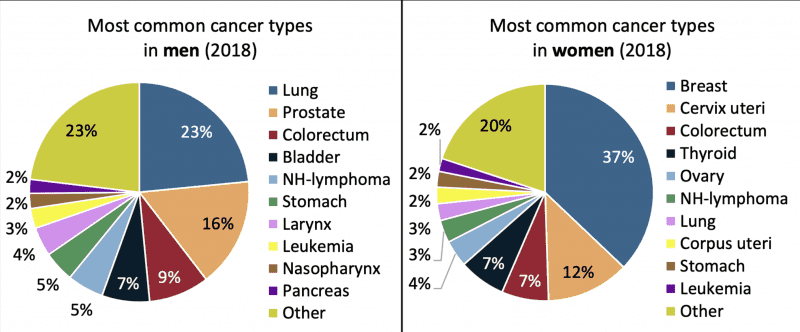
Breast cancer is the leading type of cancer affecting Moroccan women, with 37% of recorded cases in 2018, while lung cancer and leukemia top the list of cancer types affecting men the most with 23% each.
Read Also: Swedish Institute: Morocco Has Highest Cancer Mortality Rate in 9 MENA Countries