 Join on WhatsApp
 Join on Telegram
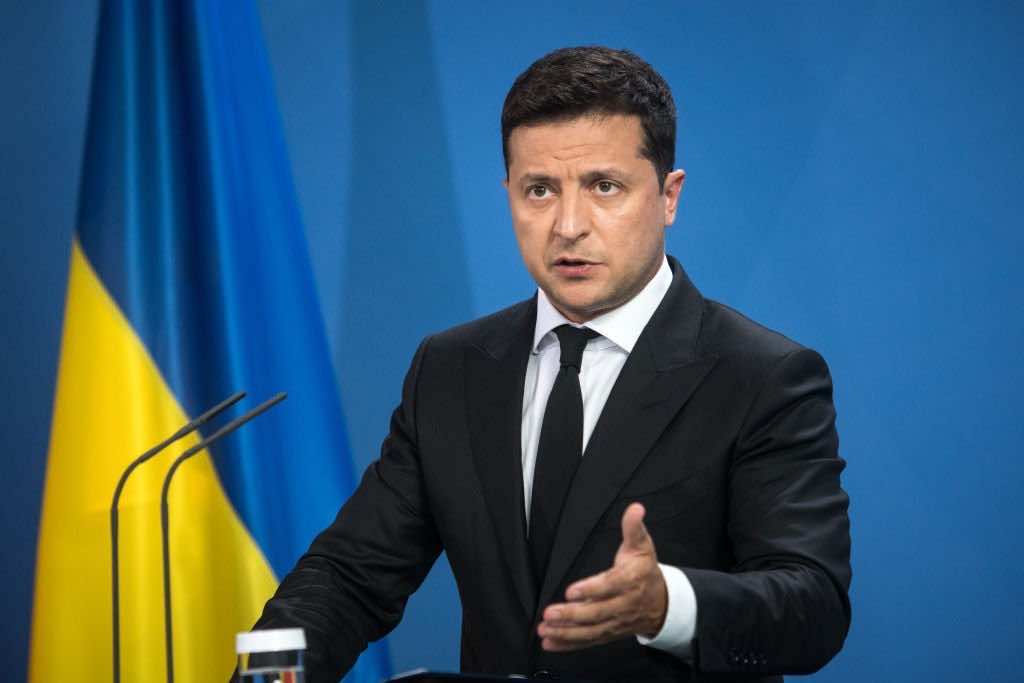
Ukrainian President Volodymyr Zelensky has recalled Ukraine’s ambassadors to Morocco and Georgia.
The Ukrainian president claimed that his ambassadors in the two countries have failed to “convince” Morocco and Georgia to “punish Russia for its invasion.”
“With all due respect, if there won’t be weapons, won’t be sanctions, won’t be restrictions for Russian business, then please look for other work,” he said during a video on Wednesday night.
The move appears to be an attempt to push Ukraine’s ambassadors across the world to push harder for military and sanctions support for Ukraine. The president said that he is waiting for “concrete results in the coming days from the work of our representatives in Latin America, the Middle East, Southeast Asia and Africa.
The move is part of Zelensky’s approach to secure more support for Ukraine’s position in the conflict between Kyiv and Moscow.
Last week, Zelensky called on the US and its allies to send more weapons, criticizing the West.
He claimed that some countries have refused to send more offensive weapons to Ukraine “because they are afraid of Russia. And that’s it. And those who say it first are the first to be afraid.”
The Ukrainian president argued that Western nations, who implemented heavy sanctions against Russia, did not show more efforts to weaken Russia’s economy because “they have not completed the sanctions on disconnecting the banking system from SWIFT.”
Morocco’s principled non-interference approach
The move by Ukraine’s president to recall and fire his ambassador to Morocco came after the Northern African country emphasized its principled non-interference in other countries’ domestic affairs.
Last week, Morocco emphasized its non-interference principle during a UN General Assembly vote, which called for an immediate end to the Russia military offensive in Ukraine.
During the vote, Morocco was among the countries that abstained from voting. The North African country adopted the same approach in a March 2nd vote, when the country abstained from voting.
Morocco clarified its decision following criticism, emphasizing its non-interference position. Like many African, Middle-Eastern and Asian countries, Morocco has avoided picking a side in the conflict, in order to push for genuine conflict resolution efforts, instead of further escalation.
Read also: Who Are the Current Winners and Losers of the Ukraine Crisis?
The Ministry of Foreign Affairs said on March 2 that its non-participation in the UN General Assembly’s resolution should not be “subjected to any interpretation.”
The ministry emphasized that Morocco, which follows the evolution of the situation between Ukraine and Russia, is regretting seeing a military escalation that resulted in deaths and thousands of injuries.
Morocco also renewed its commitment to respect for the territorial integrity, sovereignty and national unity of all Member States of the UN.
“The Kingdom of Morocco recalls that, in accordance with the Charter of the United Nations, the Members of the Organization must settle their disputes by peaceful means and according to the principles of international law, in order to preserve world peace and security,” the ministry said.
The North African country also called on Ukraine and Russia to intensify ongoing dialogue to put an end to the escalation.
Bourita recalled Morocco’s neutral position during a joint press conference with US Secretary of State Anthony Blinken on March 29.
“Moroccan position is very clear and it has been expressed many times. We are in favor of territorial integrity and national unity of Ukraine, as of all the member states of the United Nations,” Bourita said.
He emphasized that the country is also “against the use or the recourse to force in settling disputes. We are in favor of constructive neighborhood relations, and we are in favor of dialogue and negotiation to solve issues.”
Morocco adopted the same approach in different conflicts, including in Libya in which the country maintained its principled approach of non-interference and respect to its territorial integrity.
The Moroccan government, however, contributed to the UN-led political process, convening the parties to the Libyan conflict in different roundtables of talks to discuss an agreed-upon and mutually acceptable solution to end the conflict.
Morocco hosted several dialogue meetings, convening fractions of the Libyan conflict to pave the way for negotiations aimed at resolving the conflict.
Throughout the Libyan conflict, Morocco denounced foreign military interference, emphasizing that only Libyans are able to find a solution to the dispute.