Rabat – The “petrodollar” has received renewed attention amid the Russian military offensive in Ukraine and the resulting Russian threats to undermine the dollar’s status.
Russia is countering US control over global financial systems by demanding hydrocarbon-payments to be made in Russian rubles instead.
The Russian invasion of Ukraine, and the power struggle that both preceded and followed military action in Eastern Europe, has brought attention to Europe’s reliance on Russian energy exports, while inadvertently showcasing the financial power structures that govern our world.
Russia’s attempts to collect payments for energy exports in rubles might not sound too controversial to the casual observer, yet it demonstrates one of the largest threats the Russians could present to the US.
For Russia, the conflict in Ukraine is very much considered to be a proxy war between Russia and NATO, with the US seen as the key driver of tensions and escalation. While this ignores Russia’s own agency in invading a sovereign neighbor, the overarching policy responses coming from the Kremlin very much target Washington, instead of Kyiv.
Russian attempts to collect payments for energy transfers in the country’s native currency very much attempt to overturn a post-World War 2 status quo that has governed the economic fortunes of countries across the world.
What is the petrodollar?
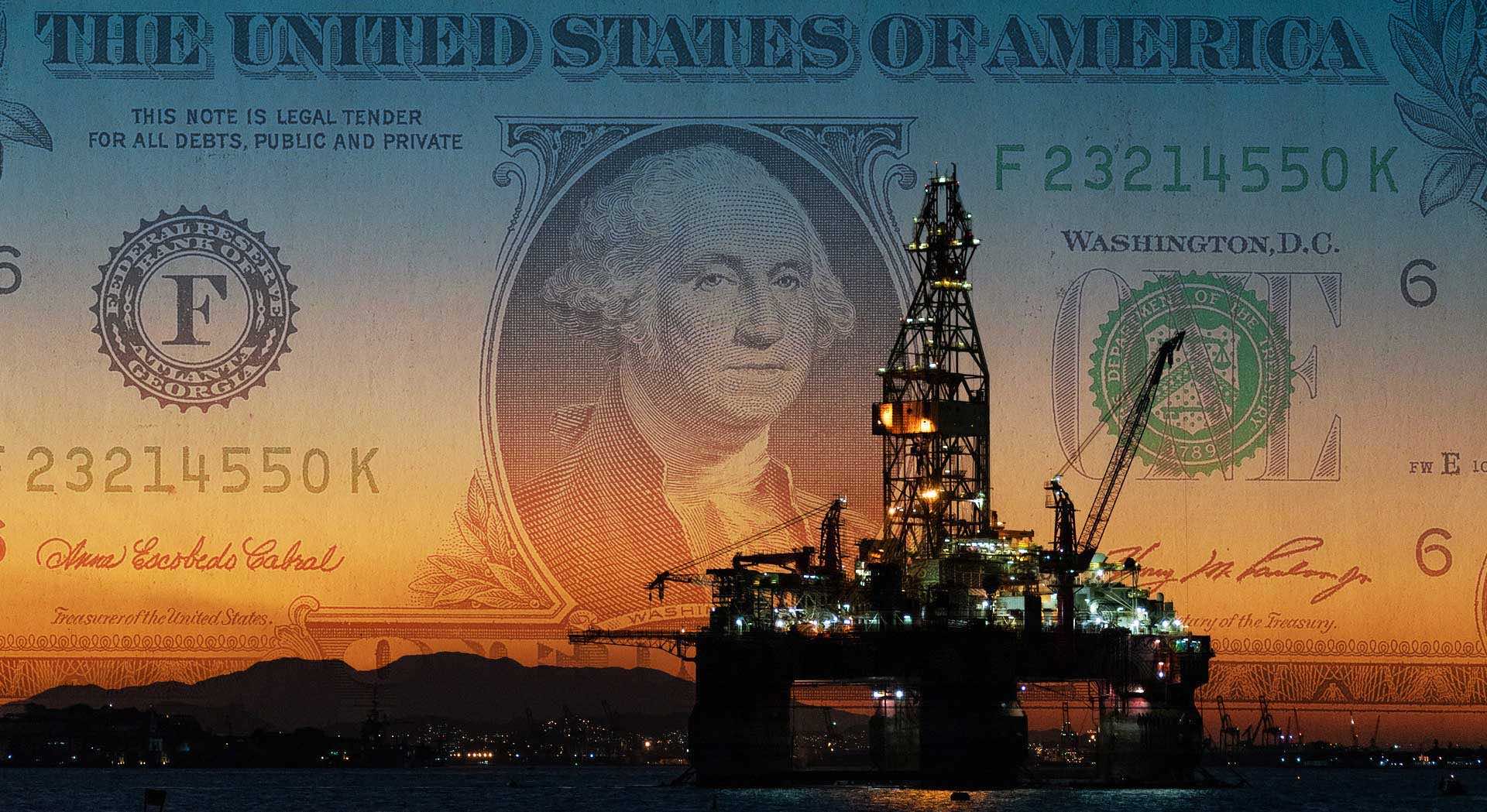
The concept of the “petrodollar” commonly refers to the US dollar, and its status as the preferred currency for most crude oil sales, as well as many other vital commodities. In 2019, 88% of all global transactions involved the highly-liquid dollar, including in transactions for oil, gold and coffee. These commodities are all priced in dollars, despite often not being produced in the US.
The path towards the establishment of the dollar as the world’s preferred exchange currency started at the Bretton Woods conference in 1944. Long before many developing countries were independent, the allied nations during the Second World War expressed their support for having dollars, pegged to gold, as the preferred currency for international transactions.
Decades before the independence of key oil-producing states like Bahrain, the United Arab Emirates, and Qatar, the currency in which they would receive their oil revenues was being determined by their former colonial masters, in a conference in New Hampshire.
The dollar’s status then was fully cemented in the seventies, when the US and Saudi-Arabia signed a military agreement that secured US military support for the Arab kingdom, with the Saudis committing to the dollar as the currency in which it would sell its vast oil reserves.
This agreement set in motion our current system in which most oil transactions pass through US “correspondent banks,” through the use of the dollar. This system means the US dollar, despite it no longer being backed by gold, would underpin global transactions around the world.
This system means that when two businesses from two countries outside the US decide to exchange goods and services, they would perform the transaction in dollars, despite the US having nothing to do with either countries, or the goods or services traded.
The effects of this system cemented the US’ position as the world’s sole economic superpower. Even though the US only accounts for roughly 20% of global GDP, its currency is used for nearly 90% of all international transactions, nearly 40% of all foreign debt, and 60% of all foreign exchange reserves held by other countries.
The importance of the petrodollar
Because most international trade occurs in dollars, there is always demand for US treasury bills and its currency, protecting the US from the threat of inflation, and keeping the dollar stable. This power and stability further reinforces its status as the key currency for international transactions.
The focus on the US dollar has given the US immense control over global commerce. Because almost every trade occurs in dollars, the US considers that it has jurisdiction over most global trade, as it passes through US correspondent banks
The global dependence on one nation’s currency has given the US certain domestic economic “superpowers” that no other nation has.
The US dollar’s current position as the “world’s reserve currency” means the US is the only country in the world where the laws of our current neoliberal economic order regarding inflation or indebtedness don’t count, as demand for dollar assets and US debt is always high.
For most countries in the world; growing debt can cripple their access to international capital. The US however, has been able to rack up $30 trillion in debt, while it was able to “print” $13 trillion to address COVID-19 induced shocks to its financial markets with little consequence.
The petrodollar means the US can be indebted like no other country, a key advantage which former French President and then-Finance Minister Valéry Giscard d’Estaing described as an “exorbitant privilege.”
Because acces to dollars means access to key resources such as energy, the US has the power to block any company, entity or country from vital global trade through unilateral sanctions. It has leveraged this power against its perceived foes in Cuba, Iran, Venezuela and North Korea, devastating those countries’ economies, in particular those who are dependent on oil exports.
While the petrodollar allows the US to uniquely withstand global economic shocks, it simultaneously intertwines other countries with US economic slumps. The devastation wrought by US financial crises in the late nineties and 2008 sent shockwaves through national economies worldwide.
Outside economic control, the petrodollar additionally allows the US influence on other countries’ internal decision-making.
Whenever Iraqi politicians debate the withdrawal of US forces from their country, the US lauds its ability to withdraw Iraqi access to dollars, potentially crippling their oil industry. Some have even analyzed that the US 2004 invasion of Iraq itself came in response to Iraqi and OPEC efforts to price their oil in Euros instead of the almighty dollar.
The petrodollar also feeds the US military-industrial complex. This occurs when dollars move through the US, where they are exchanged for US goods such as tanks, missiles and jets.
Maintaining the petrodollar’s dominance is also seen as a threat to the fight against climate-change, as falling oil sales, once we reach “peak oil,” would reduce petrodollar recycling (the spending of dollar-denominated oil revenues) and diminish the amount of dollars needed in other countries’ foreign currency reserves.
Dollars, Rubles or Yuan?
US allies and rivals have attempted to leverage their current dependency on dollars as a way to push the US, by threatening to develop alternatives by pricing certain trade goods in other currencies. The Saudis, for example, have recently threatened to sell their oil to China in the Chinese Renminbi, instead of the US dollar.
Questionable US foreign policy decisions have led others to develop alternatives to the dollar-dominated trade paradigm.
A key example can be found in the US withdrawal from the Iran Nuclear Deal and the reintroduction of unilateral US sanctions on Iran. This pushed the EU to develop a Euro-based alternative for trade with Iran. Without the dollar involved in the transaction, the US has little control over these exchanges.
The Kremlin’s recent push to conclude energy sales in rubles is a similar workaround, specifically aimed at dislodging the US dollar’s dominance. Yet, the ruble can never overtake the dollar, as its home-country simply has too small an economy to support all global trade, which could lead to what economists call the “Dutch disease.”
Currently, only the Euro and Chinese renminbi have the volume to be able to potentially replace the US as the world favored exchange currency. This however hasn’t stopped other rising powers from trying. India, the world’s third largest consumer of oil, is increasingly paying for its hydrocarbon needs in rupees.
Few foreign policy makers will consider it realistic to replace the US dollar, yet the process of gradually chipping away at its dominance is definitely underway. Signs of countries preparing for an eventual decline of the petrodollar can be seen when countries like Russia and China sell off their dollar reserves, and buy gold instead.
Transactions in non-dollar currencies are already increasing, and strikingly, the lion-share of preferred currencies are not other traditional exchange currencies such as the British Pound or Japanese Yen, but instead favor the Chinese renminbi and the currencies of smaller countries.
Since its inception, the petrodollar has had a noticeable impact on the Middle East and North Africa, and its relationship with the United States.
Any change in this dynamic has far-reaching implications, especially in the Middle East and North Africa, where oil revenues and the arms and power purchased with recycled petrodollars have fueled regional power struggles.
As the US has signaled its military focus is “pivoting” to Asia, key regional allies such as the Saudis and Emiratis have shown an increasing belligerence towards the superpower which has underwritten the two countries’ regional power for decades.
Examples of this can be seen in the recent moves by OPEC that blatantly ignored US pressure, the Saudi considerations to sell oil in Chinese currency, and Riyadh’s “threat” to end mostly artificial Sunni-Shia tensions with Israel’s regional foe, Iran.
What about the Moroccan Dirham?
The supply of money is crucial to the autonomy of a nation, with a famous quote attributed to the Rothschild family saying “let us control the money of a nation, and we care not who makes its laws.”
The French understood this adage well, when they introduced the CFA Franc, a currency that has kept monetary control, and African reserves, firmly within Paris’ grasp. Still today, at least 40 African nations rely on the UK, France and Germany to print their money
Morocco’s currency similarly has French links, with first the Moroccan Franc and then the Moroccan Dirham in 1960, which was valued at 1 dirham per 100 francs. Until 2016, the Moroccan dirham was pegged to a two-currency basket of US dollars and euros, before the country started the process to move toward a more flexible foreign exchange system.
Africa’s dependency on foreign currencies is in many ways a left-over of colonial economic structures on the continent. Still, the ebbs and flows of global finance, now mostly driven by the petrodollar and financial speculation, has a very tangible effect on the people of Africa.
For Morocco, petrodollar-driven financial booms and busts have undermined its primary foreign policy orientation, focused on ending the colonial partition of the country by gaining recognition for its southern borders in the Western Sahara region.
The OPEC oil boom in the 1970s, provided its rival Algeria with the resources and misplaced confidence that it could meddle in its neighbor’s affairs by spending vast amounts of its oil wealth on supporting the Polisario armed resistance force opposing Moroccan reunification.
Algerian self-confidence, boosted by new-found foreign currency inflows in the 1970s, likely gave it the confidence that it could financially support Polisario separatists, and undermine Moroccan development by keeping it mired in an internal conflict.
Waning oil revenues in recent years have had the converse effect, tying Algeria to an expensive and futile military expenditure from which its regime cannot back down without losing face.
The petrodollar has far-reaching effects on oil exporters, such as Algeria, the Gulf states or Russia, yet also severely impacts living conditions in oil-importing countries such as Morocco.
The IMF highlights that when “oil exporters save their revenue, it may in a first round drain financial resources away from investment or consumption in the oil-importing world, reducing their growth and employment prospects.”
Caught in the storm?
Between 2010 and 2012, Morocco saw its foreign currency reserves plummet by 27% as a result of the aftermath of the 2008 financial crisis. Morocco was left with only enough reserves to fund four months-worth of foreign goods and services, revealing its dependency on foreign currency in order to afford the most basic of commodities.
Morocco has since attempted to change this dynamic, with its foreign currency reserves breaking records in recent months and its currency less tied to the euro and dollar, yet fluctuations in currency exchange markets could still cripple the Moroccan economy through no fault of its own.
Maintaining sufficient foreign currency reserves, in order to absorb global economic shocks, comes at a price as well. The cost of maintaining these reserves is higher for low-income countries like Morocco, and can become politically controversial amid economic hardships.
Debt is also paid in foreign currency, and the depreciation of Morocco’s foreign currency debt is seen as a possible driver of growing national debt, according to the IMF’s latest Regional Economic Outlook report. Growing debt can in turn undermine effective monetary policy, creating a potential vicious economic cycle.
Given Morocco’s new-found gas resources,it is possible that Rabat can reduce its dependency on foreign energy imports. Yet, it is key where newly incoming petrodollars are spent. The example of Chad, where oil-riches were spent on state security instead of development, shows that oil-wealth can easily keep the population poor and undermine democratic processes.
The Moroccan think tank The Policy Center for the New South estimates that the petrodollar will remain the world’s reserve currency, and Morocco itself has little power to change this trend.
Still, the diversification of foreign currencies in international transactions could provide Morocco with more leverage vis-a-vis powerful trade partners like the US and China. It is also seen as a key trend that could chip away at our current unipolar geopolitical and economic structures, open debate on new economic models, and empower smaller nations.
With major global challenges such as climate change and renewed militarism in our not-so-distant future, understanding and leveraging the global economic forces at play, could provide a key advantage to Morocco and its growing role as a regional trading nation and promoter of regional stability.