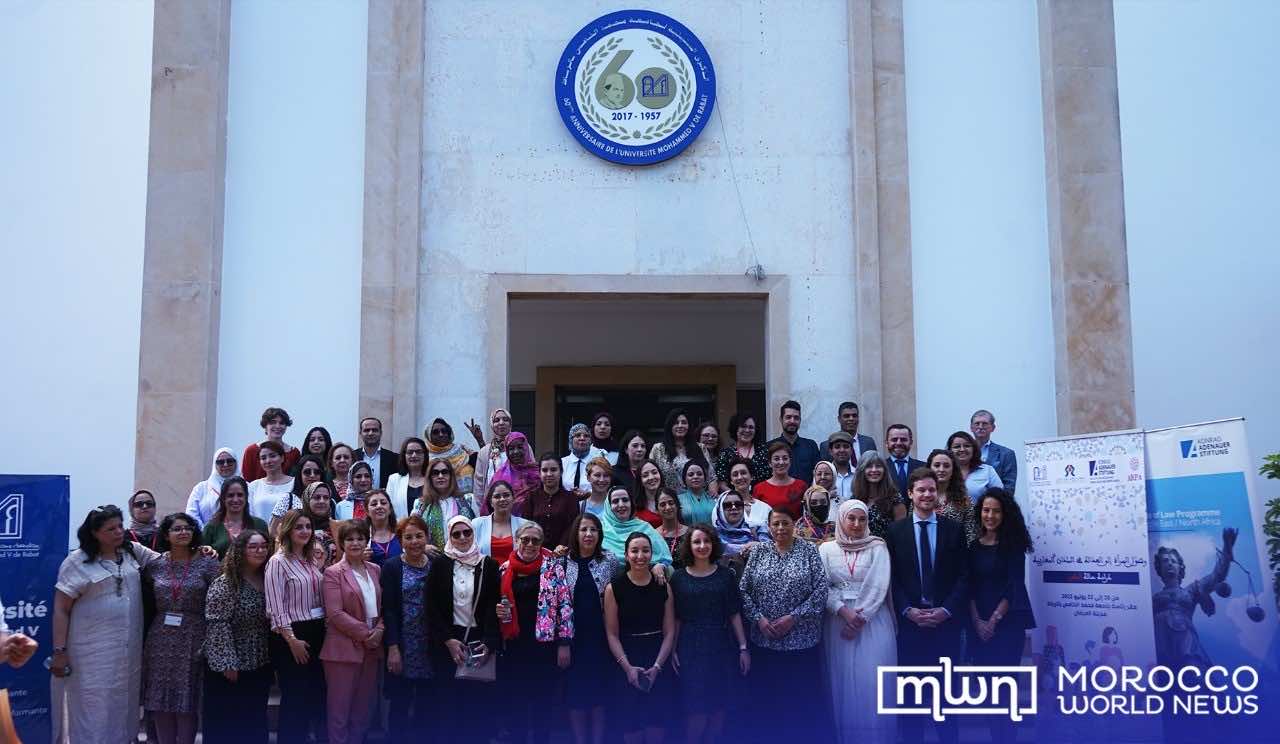
Rabat – From June 20th to June 22nd, Mohammed V University, the National Human Rights Council (CNDH), Konrad Foundation’s Middle East and North Africa Rule of Law Programme, and ARPA International Law Group hosted the inaugural forum on strengthening Women’s Access to Justice: Maghreb Countries post-COVID.
The Forum cultivated connections between female North African leaders from Mauritania, Algeria, Tunisia, Egypt, and Morocco and sought to unite women from the legal, judicial, civil, academic, and policy circles to develop action plans to enhance gender justice in the sub-region.
Presentations from the Ministry of Justice Fatima Berkane and the Moroccan Parliament’s Vice-President MP Zaina Idhali highlighted Morocco’s advancements in the equitable administration of justice, as the Kingdom marks the 11th anniversary of the Constitution and its access to justice articles.

The Forum also celebrated the launch of the Maghreb Women’s Access to Justice Community of Practice to further the exchange of experiences and re-examine the proposed recommendations relating to the availability of legal education, legal aid, and the administration of justice.
As noted Moroccan legendary judicial figure, Zhor Al-Horr, the legal system must be enhanced to provide remedies that are preventative, timely, and non-discriminatory.
Legal Pluralism in Morocco & Women’s Access to Justice
There are at least two segments of legal and judicial life that coexist in Morocco: codified laws and regulations coupled with an informal justice system of dispute resolution based on customs.
Moroccan participants highlighted that judicial independence, efficiency, and accessibility serve as the fundamental foundations of a healthy and legitimate judicial system under both domestic and international law.
Through these three criteria, one can measure the judicial sector’s adherence to the standards of law.
Former Moroccan Minister Hassan El Maaouni and President of Forum des Initiatives de Développement et Consolidation de la Primauté du Droit reiterated the relevance of the event, as Morocco is currently soliciting suggestions on its national consultative framework regarding women’s access to justice.
“It is important to examine the common obstacles to women’s access to justice in the broader sub-region to present a holistic view of the intersectionality of legal, political, and socio-economic trends and their effects on women’s access to justice,” said Dr. Leila Hanafi, ARPA International Law President and co-organizer of the Forum.
Under the current legal structure, women, along with rural and displaced individuals, are often placed at a distinct disadvantage when pursuing access to justice.
Access to Justice in the Maghreb: What’s Next?
Across Maghreb countries, access to justice is a growing concern that has been further exacerbated further during the COVID crisis, with reduced freedom of movement for women, an increased justice gap due to the digitalization of the justice system, lagging legal aid, long delays of court cases, and a steep resurgence of violence against women.
In many Maghreb nations, women’s access to justice is constrained when compared with men, as they possess relatively less control of the economic assets needed to navigate justice sector services and often encounter restrictive social norms that discourage them from filing cases and complaints.
Even when women successfully access services, they remain subject to the discriminatory practices within the judicial system.
Using the forum as a launching pad, the Forum organizers will leverage the multi-country partnerships developed to support emerging practices to deliver user-friendly justice through the Network inaugurated at the Forum: Maghreb Women Legal Network.
The network will seek to create an enabling environment for women’s access to justice through reforming formal and informal legal norms that discriminate against women, such as the absence of gender-responsive norms. The network will also legally empower women through supporting legal education tools for women to understand, claim, and exercise their rights and by extending knowledge of women’s rights to men, youth, and community power structures.
This latter point was extensively emphasized by Maghreb participants such as Judge Monia Ammar, Tunisian Judge at the Cassation Court and head of the Arab Center for International law.