 Join on WhatsApp
 Join on Telegram
Marrakech – This study focuses on Moroccan Amazigh textiles and sheds light on the presence of a different artform in the Arab-Islamic world. The discourse stems from the idea that there is one singular form of art produced in this region.
The art is generally categorized as ‘Islamic art,’ however, this definition marginalizes the other artforms from this region, therefore, this article challenges the Western art historical discourse and its view on Arab-Islamic artworks.
Moreover, the analysis challenges the observation that most art in this area is well-known for its typical floral and arabesque decorations. The study on Amazigh textiles and the focus on the importance of Amazigh artifacts in Moroccan society show the strong presence of multiculturalism in the region.
Furthermore, Amazigh textiles portray an art style that differs from the ‘artifacts from the Arab-Islamic world’ as categorized in the Western art historical discourse. As a result, this article explores the different art developments in the Arab-Islamic world through a focus on Morocco, as part of the Maghreb, to contribute to the expanding research field in the West on Arab-Islamic art.
This article focuses on the concept of Islamic art as it is categorized by the art historical discourse in the West, through a case analysis of Moroccan Amazigh textiles. This study on the production and importance of Amazigh textiles illustrates the presence of a specific art style in the Arab-Islamic world.
Amazigh artifacts originate from the pre-Islamic period and differ from the Western idea about art from this region because this discourse focuses on the idea that there is one art style throughout the whole Arab-Islamic world. Moreover, the common idea is that these artworks are always connected to the divine, therefore called ‘Islamic art.’
The Western concept of “Islamic art”
Over the past centuries, various research has been done by Western art historians on the development of Islamic art and its influence on Western art history. Mostly, the existing research either gives an overview of Islamic art history, like the works of Robert Hillenbrand and Wendy M.K Shaw, or discusses the relationship between Islamic art and Western art, such as authors Rosamond Mack and Katarzyna Pieprzak. The latter especially focuses on the relationship between Islamic art and the Italian Renaissance because of the importance of this historical period within Western art history and because, during the Renaissance, the West opened up to the Arab-Islamic world.
As for Mack, she focuses on the connection between Islamic art and Italian art history in her work Bazaar to Piazza: Islamic Trade and Italian Art, 1300-1600. She sheds light on the fact that various Italian Renaissance artists refer to Islamic art by portraying objects from the Islamic world, such as textiles and handicrafts. Moreover, Mack elaborates on the presence of Islamic calligraphy in the famous Italian Renaissance paintings through a study on Italian painters Giotto di Bondone and Gentile da Fabriano.
Another author researching the relationship between Islamic art and Western art is Katarzyna Pieprzak. In her book Imagined Museums: Art and Modernity in Postcolonial Morocco, she focuses on the relationship between Islamic and Western art. In the chapter “Imaginary Museums and Their Real Phantoms: Exorcising Monumental Discourse,” she challenges the idea that abstract art is established in Europe. Pieprzak questions this idea by shedding light on the idea that European abstract art is actually influenced by Islamic (and especially Moroccan) art.
Mack and Pieprzak present two examples of research done on the relationship between Islamic and Western art. However, first and foremost, I want to state that increasing research has been done in the West on the topic of Islamic art and its relationship with the West, which is a positive phenomenon.
Nevertheless, in my opinion, there are a few misconceptions and generalizations that exist in the Western art discourse regarding the concept of Islamic art, which should be addressed. First, I believe existing research in the West is sometimes built on generalizations about the concept of Islamic art. Professor Wendy M.K. Shaw points out in her work What is Islamic art? – Between Religion and Perception, that art categorized as Western art can be described as Christian art, and Western art history never included Islamic aspects or concepts in Western art history.
Shaw’s theory explains that we should be aware of the Western concepts, ideas, and views that are being implied while researching art from the Arab-Islamic world. This is supported by Shaw stating in the article “The Islam an Islamic Art History: Secularism and Public Discourse:”
“Nonetheless, historical objects from the Islamic world continue to be called upon regularly to reduce intercultural tensions in the contemporary world in a manner that often elides differences between past and present, religion and culture, geography and religion.”
Shaw’s statement emphasizes how, within art history in general, the Arab-Islamic world is often presented as one big region that produces one form of art ignoring differences caused by religion, culture, and geography. This leads to the Western concept of Islamic art, which is, in other words, art from the whole Arab-Islamic world. Shaw’s idea offers a starting point for this article, because, through discussing Moroccan Amazigh art, it will become clear that not all art from Arab-Islamic art fit into the Western framework of art from this region. But before that, the following question must be addressed: how does the West characterize Islamic art?
Islamic art as it is presented in the Western art historical discourse is described as non-figurative, religious, and often decorated with arabesques and floral designs. Moreover, calligraphy is an important artform for Islam because it functions as a medium to present the world of Allah. In my view, and as theorized by Shaw, these discussed aspects of Islamic art are truth-telling, but it is important to realize that terms such as ‘arabesque’ or ‘ornament’ are terms created in Western art history.
Islamic art history
However, I would like to focus on something else, because, until the 18th century, the prominent idea in the West regarding Islamic art was the idea that Islamic art always excluded contemporary painting, sculptures, and photography, and that it was only focused on themes related to the divine. Herein lies the problem, because, by Islamic art, the Western art discourse refers to art from the whole Arab-Islamic world, without taking into consideration other religions or communities present in the area.
Failing to take other groups into account presents the idea that the whole region produced one form of art: art serving a religious purpose (architecture and design of mosques, textiles used for prayers, the Qur’an, etc). Because of this narrow definition, Arab-Islamic art became misconstrued as one, monothetic artform in the whole Arab-Islamic region. Fortunately, the definition of Arab-Islamic art began to further develop in the West. This happened as a consequence of Western art historians recognizing that the concept of Arab-Islamic art was born in Europe and influenced by Orientalist views.
One of the many other artforms present in this region are Amazigh textiles in Morocco. Amazigh art is an example of an art style that developed in the Arab-Islamic world without being Islamic art.
Moroccan Amazigh textiles
The form of Islamic art as it is known in the West was established under the rule of the Umayyad Dynasty (661-750). Its capital was located in Syria and the rise of the dynasty is connected to the emergence of Islam as a world power. According to Robert Hillenbrand in his work Islamic Art and Architecture, the first form of Islamic art under the Umayyads is known for its eclectic, experimental, and propagandistic characteristics. The Umayyad period created a basis for the developments in Islamic art history that followed. This period of Islamic art history is followed by the following dynasties: Abbasid, the Fatimids, Seljuqs, Atabegs, and Mamluks.
However, Islamic art developed differently in the Maghreb because of its location at the western end of the Arab world. This area experienced different empires (for example, the Almoravids and Almohads), but the rulers did not reign for a long period of time, and they did not focus on religious art, partly because the region was ruled by Amazigh dynasties. Consequently, the Islamic art produced in this area was limited.
During the later Middle Ages, the Maghreb area was ruled by different dynasties. Morocco was ruled by the Marinids (mid 13th-15th centuries), who mainly focused on architecture. Therefore, other artforms, such as pottery and metalwork, did not significantly develop during the period.
The developments in the Maghreb, including Morocco, illustrate how there is not one singular artform in the Arab-Islamic world because of the different dynasties that ruled and focused on different aspects of art history. In particular, studying Moroccan Amazigh art buttresses the idea that Arab-Islamic art does not always serve a religious purpose.
The Moroccan Amazigh people are among the indigenous inhabitants of North Africa. Nowadays, different Amazigh communities live in areas from Egypt to Morocco, but also in Mauritania, Niger, Mali, and Burkina Faso. However, the largest Amazigh community lives in Morocco.
According to Cynthia Becker, the author of Amazigh Art in Morocco, the term “Berber,” which is commonly used in the West, is derived from the Greek word for “barbarian.” For this reason, indigenous Maghrebi people prefer to be referred to by their self-described name Amazigh, which means “free people.”
In her research, Becker illustrates how Amazigh women are the prominent artists in these Moroccan communities. This differs from various other Arab communities, where men often dominate the art scene. Amazigh women are responsible for the production of textiles, crafts, and jewelry, and the women are well-known for their tattooing and henna. The beautifully dressed and decorated women became the symbol of Amazigh communities. It is remarkable that Amazigh men do not participate in tattooing nor wear special jewelry.
Becker’s research on the Amazigh people offers good insight into the culture, including art. It uses Amazigh art to offer an example of an artform from the Arab-Islamic world that breaks with the concept as it is presented in the Western art historical discourse.
The production of Amazigh textiles is the most important artform for this community. The textiles require a lot of handwork, and, therefore, offer a certain societal status to the Amazigh women who work on them.
The textiles are decorated with repeated designs and patterns, mainly with triangular shapes. These authentic Moroccan textiles and other objects produced by the Amazigh women are often sold or influence other products being sold in the Moroccan souks (Moroccan markets).
The presence of Amazigh products and influences in Moroccan markets illustrates how the Amazigh people influence, unintentionally or intentionally, the Moroccan art scene. This is caused by the importance of Morocco’s old cities or medinas, for they are the places where artifacts are exhibited and sold. In other words, medinas in fact function as Moroccan museums.

Figure 1: Zemmour Tribe (Middle Atlas), Old large fine Amazigh pillow, mid-twentieth century, Source Amazigh Website.
Figures 1-3 illustrate how the decorations and patterns of Amazigh products inspire and influence the products sold with the medinas. Figure 1 presents an Amazigh pillow from the Middle Atlas Mountains, on which one can clearly observe the typical triangular Amazigh patterns.
Figure 2 demonstrates the detail of an Amazigh pillow from the Atlas Mountains as well. Again, there is the signature triangular pattern. Figure 3 is a good example of the Amazigh presence in Moroccan souks.
While walking through the streets of the old medina of Marrakech, for example, one will encounter an abundance of textiles influenced by Amazigh products or made by Amazigh people. All of these observe the same colors and triangular patterns (Fig. 1 and 2) that are typical for products of the Imazighen. Examples like this demonstrate how Amazigh textiles influence the Moroccan art scene, which is indicative of the pride the Moroccan people feel and express regarding this ancient cultural heritage.
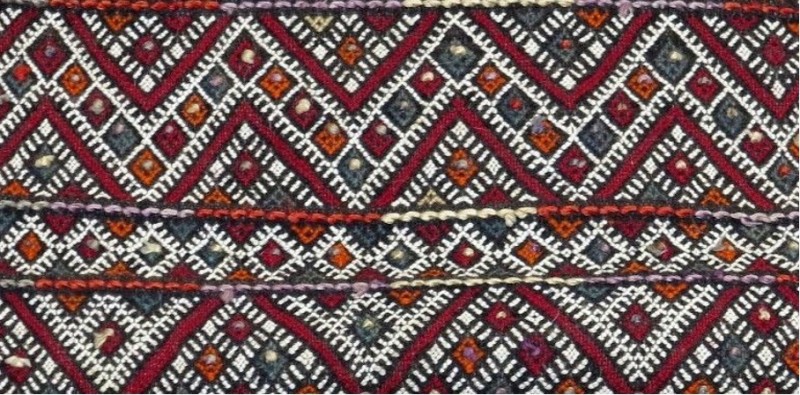
Figure 2: Zemmour Tribe, Middle Atlas, detail of the patterns on a pillow of Amazigh design, mid-twentieth century. Source Amazigh Website.
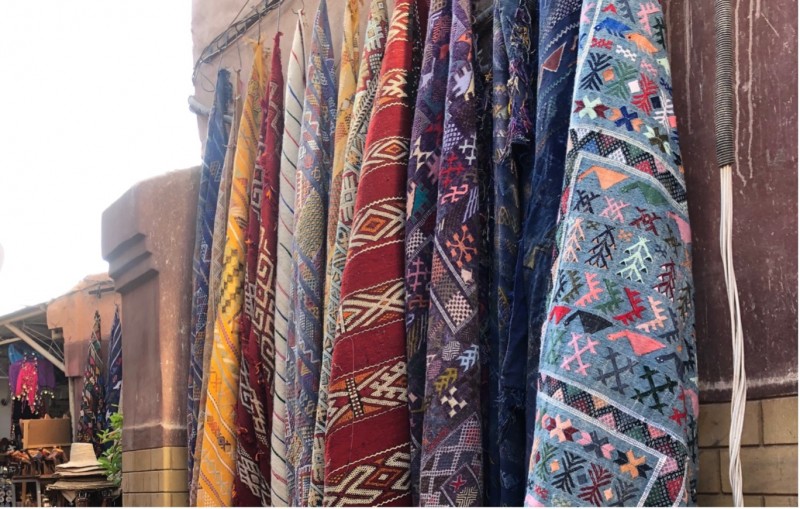
Figure 3: Amazigh textiles in the medina of Marrakech. Source: Yvette Broex.
To further explore whether Amazigh textiles serve religious purposes and refer to religious themes, I visited the medina of Marrakech to talk to Amazigh carpet salesmen.
Ihssan, one of the salesmen in the medina, studied culture and spoke English very well; I engaged in an interesting conversation with him about Amazigh textiles. He reiterated how the Amazigh people have their own culture which differs from other cultures in the region, with their own language, food, and traditions.
The Amazigh carpets originate from the pre-Islamic period in North Africa when the people followed polytheistic religions. The textiles were meant to create more comfortable circumstances for the people to live in; for example, to protect themselves and their houses against the cold.

Figure 4: Detail of Amazigh textiles in the medina of Marrakech. Source: Yvette Broex.
Furthermore, we discussed the symbols that are present in Amazigh textiles. The salesman explained how the symbols are very difficult to understand, even for Amazigh people themselves.
It is certain that the carpets contain a message, but it is almost impossible nowadays to interpret it. According to him, if you want to study the Amazigh culture in detail, including the textiles, “you should go back to the period before Islam because, after the arrival of Islam, some traditions and aspects of the Amazigh culture changed.”
Thus, the Amazigh patterns and designs on the carpets originate from the pre-Islamic period, as the salesman stated: “the symbols are pre-Islamic; this is for sure.” He concluded the interview with the following statement: “The Berber culture is very deep, very mysterious, and it is very rich.”
Figure 4 displays the detail of one of the Amazigh carpets sold at the salesman’s store. After doing some more research on the symbols of the Amazigh, I was able to find a description of a few of the symbols from research conducted at the University of Arizona.
One of the symbols I found in almost all Amazigh textiles is the triangular pattern, which is called the arrow, according to the university’s research (Figure 5). This pattern is observed in the textiles in Figures 1, 2, and 3. This so-called arrow refers to cosmic projection, and it refers to male energy and fertility. However, this is one of the few symbols with a known meaning, unfortunately, as the salesmen in the medina of Marrakech explained.
As discussed in a previous section, in her work “The Islam in Islamic Art History,” Shaw points out how existing research on Islamic art often lacks a focus on cultural differences. Morocco is especially known for its multicultural society, wherein the Amazigh are native inhabitants of the region. The textiles originate from a pre-Islamic period, and, therefore, are from a pre-Islamic historical art period, which should be included in research about art from this region.
This is supported by Imagined Museums by Pieprzak, in which she also remarks that other communities present in the Arab-Islamic world are often not taken into consideration in research on Arab-Islamic art. From my observations, analysis, interview, and literature study, I conclude that the Amazigh carpets indeed differ from other art styles from the Arab-Islamic region, and are pre-Islamic, and, therefore, should not be categorized within the Western concept of Islamic art.

Figure 5: Amazighi arrow pattern. Source: My Tiny Blogs
Amazigh textiles are an example of diverse artforms found in the Middle East and North Africa, particularly Morocco, that are not of Islamic origin or meaning. They, therefore, challenge the Western assumption that all art from this part of the world is Islamic or theistic. Still, the beauty of different artforms produced in the Arab-Islamic world invites more research on this topic.