Optimal energy control and management for a Fuzzy Wind Turbine System (FWTS) involves the use of advanced control strategies to optimize wind turbine performance while managing the generated energy efficiently.
One approach to achieve this is to use Fuzzy Logic Control (FLC). FLC is a type of control strategy that uses fuzzy logic –a form of reasoning that mimics human decision-making– to determine the optimal control actions for the wind turbine. Using FLC, the control system can adapt to changing wind conditions and adjust the turbine blades accordingly to maximize power output.
Another approach is to use Model Predictive Control (MPC), which is a control strategy that uses a mathematical model of the system to predict future behavior and determine optimal control actions. This approach is particularly useful for FWTS because it allows the controller to take into account the nonlinear and time-varying nature of wind systems.
Managing the generated energy
In addition, the management of the energy generated by the wind turbine is also important. This can be achieved through the use of advanced power management techniques such as Optimal Power Flow (OPF) and Demand Response Management (DSM). OPF is all about finding the optimal combination of generation and transmission that minimizes costs while meeting electricity demand. DSM, on the other hand, involves the management of system power consumption to reduce overall energy demand and costs.
In summary, optimal energy control and management for a fuzzy wind turbine system can be achieved through the use of advanced control strategies such as FLC and MPC, as well as advanced energy management techniques such as OPF and DSM.
Optimizing control and energy management
A fuzzy wind system uses renewable energy that converts wind turbine energy into electricity. In such a process, optimizing control and energy management are critical tasks to ensure efficient and reliable operations. Here are some steps to optimize control and energy management in a TS fuzzy wind system:
1. Define the objectives: The first step in optimizing control and energy management in a TS fuzzy wind system is to define the objectives. These may include maximizing the power output, minimizing the operational cost, improving the system efficiency, or reducing the environmental impact.
2. Develop a fuzzy logic controller: A fuzzy logic controller is a control system that uses fuzzy logic to make decisions based on input variables. In a TS fuzzy wind system, a fuzzy logic controller can be developed to optimize control and energy management. The controller should take into account variables such as wind speed, turbine speed, power output, and energy storage levels.
3. Implement predictive control: Predictive control is a control strategy that uses mathematical models to predict the system’s behavior and optimize the control actions. In a TS fuzzy wind system, predictive control can be used to predict the wind speed and optimize the turbine speed to maximize the power output.
4. Use energy storage: Energy storage can be used to store excess energy generated by the wind turbine during periods of low demand. The stored energy can then be used during periods of high demand which reduces reliance on the grid and improves system efficiency.
5. Monitor and optimize performance: Monitoring the performance of the TS fuzzy wind system is critical to optimizing control and energy management. This can be achieved by installing sensors and monitoring systems that provide real-time data on variables such as wind speed, turbine speed, and power output. The data can then be used to optimize the control and energy management strategies.
By implementing these strategies, the system can be operated efficiently and reliably, maximizing the power output and minimizing the operational cost.
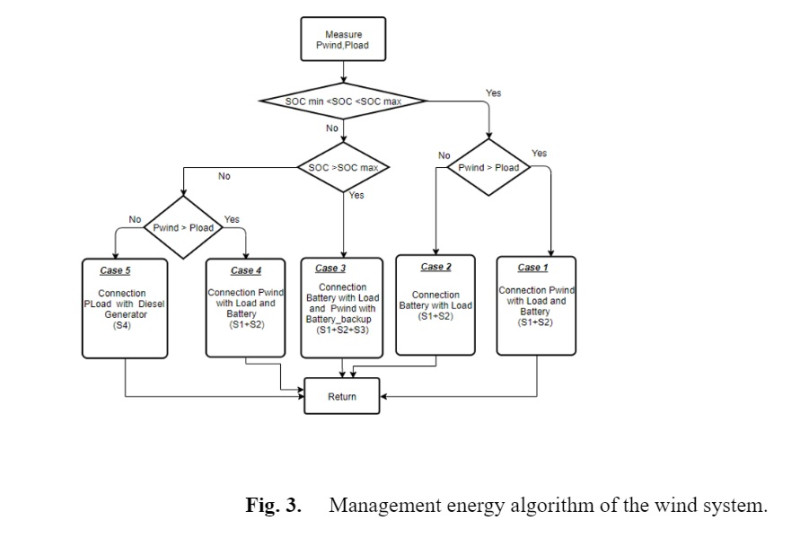
Figure 1 shows the energy management of the wind system. It includes wind power, battery, loads, battery backup, diesel generator and switches S1, S2, S3, and S4 which are used to control the interconnections between the energy source and the other units like batteries and loads. These components are linked with an energy management system. The objective of this system is to develop a management algorithm by using the state-flow approach which makes it possible to manage this type of constraint.

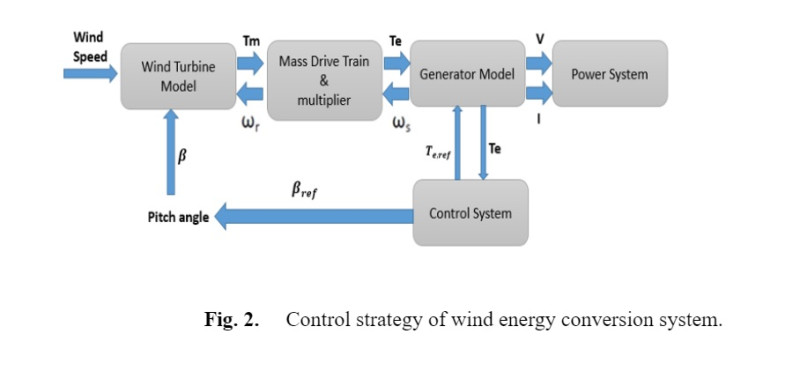
The wind energy conversion system model used in this study is formed by a wind turbine coupled with a generator and mass train drive. Wind speed varies with climate change, it is insufficient to ensure rotational speeds, so, it is important to insert a multiplier between the generator and the wind turbine, this multiplier is modeled by a gain G allows the machine to have a speed close to speed optimum In order that it operates at the point of maximum power, it is necessary to add a controller illustrated in Figure 2. Therefore, to ensure that the rotational speeds of the wind turbine and generator remain consistent, a multiplier is inserted between them. This multiplier is modeled using a gain G, which helps the machine maintain a speed that is close to the optimal speed for generating the maximum amount of power.
In this article, we propose a robust control of TS fuzzy conversion wind power system for extracting maximum power. Then we propose a method of managing the whole system (wind, battery, loads, diesel generator, back-up battery) by using the state flow approach in Matlab/Simulink. This control method has proven to be effective for the management of the energy produced. The result of the simulation obtained by the matlab linear matrix inequalities (LMI) toolbox shows that the performance of stability and robustness are guaranteed as well as the efficiency of the sliding mode observer. Also, the simulation obtained by Matlab/Simulink shows that the proposed strategy allows good management of the elements of the wind system, according to the operating mode (deficit or surplus of wind energy) and the state of each element (charge/discharge of the battery).