In the days leading up to Ramadan 2023, nervousness bubbled in my stomach whenever I pondered the idea of fasting. As a non-Muslim American living in Morocco, this would be my first ever Ramadan and the idea of going without food or water from around 4 a.m. to 6 p.m. each day terrified me as much as the fabled atmosphere of Ramadan excited me.
I know I’m not at all obligated to fast, but a plethora of factors led me to the decision. The majority of my study-abroad program classmates vowed to fast when our teachers explained how fasting — and breaking the fast through the iftar meal — brings us closer to Moroccans as we experience the deprivation and fulfillment, fully immersed in the local culture.
Further, I live with a Moroccan host family and I’d rather not inconvenience them with my need to eat breakfast and lunch. I could eat out at foreign-owned restaurants like McDonald’s, but fast food never entices me as much as a hearty Moroccan meal.
When I told my host mom of my decision to fast, she announced it to the entire extended family and painted me as a glowing example to her young nieces who are starting to fast. She then promised to dress me up in a caftan and pose for wedding-like photos on Laylat al-Qadr, or the 27th of Ramadan, as is customary for little girls fasting for the first time.
I’m beyond excited at the prospect, but trepidation also lingers, knowing that unlike little kids who phase into fasting, I’m going from zero to a hundred.

Waking up for suhoor. Photo by Selina Chen.
When my alarm went off at 4:30 a.m. on March 23, I was disoriented for a moment before remembering that it’s time for suhoor, the pre-dawn meal. I had no appetite whatsoever at this early hour, but I swallowed some food and chugged a liter of water in preparation for the long day ahead, all the while keeping an ear out for the adhan, or call to prayer, that signifies the end to suhoor.
When echoes of “Allahu akbar” began spreading through the city, I went back to my slumber.
Come morning, I got up once again and headed to school. I barely left the house when I began feeling thirsty. Time and time again, I reached into my backpack for my water bottle only to remember that it’s not there. By the time I finished my school and internship, I was hungry and thirsty, asleep on my feet with a growing headache, so I headed home to nap.
I woke up groggily near time for iftar. My host family had truly outdone themselves with the food: harira and dates and sweet briwats and homemade pizza and — I dry-swallowed at the sweet sight — water.
The first sip of water, whose constant availability I’d always taken for granted until this day, was the most satisfying in my life; so was the meal that followed.

An iftar with my host family. Photo by Selina Chen.
Perhaps I initially decided to fast partly out of peer pressure, but once I got into the rhythm of Ramadan, I do not regret it at all. In choosing to fast when it’s non-obligatory for me, I choose to understand the preciousness of sustenance and to sharpen my willpower in a voluntary challenge to temporarily forgo that sustenance.
I think the underlying reason for fasting — learning to appreciate what we have — is true across all religions. So once I’ve made the promise, I resist the temptation to eat or drink out of personal principle — as an Arabic saying goes, “karamati la tasmaH.”
Read also: Ramadan: Your Guide to Weight Loss by Consuming the Right Food
Fasting gets easier each day. I no longer experience any headache and now have the energy to trek all around the city before iftar. But the most beautiful moments are after iftar when the entire city comes alive, with people filling up the mosques and surrounding streets for the taraweeh prayer.
And I will never forget the visceral happiness of Moroccans when they hear that I’m fasting. They exclaim in excitement and tell me “may Allah accept your fast” and even offer me free dates for iftar.
I write this as I’m waiting to break my fast in a collective iftar at Morocco World News’s office. It’s been one week since Ramadan began and by now I have no doubt that I will fast for the rest of the holy month.
At the end of each day, my Muslim-American friend sends out a poll in our study-abroad group chat: Did you fast today? With pride, I click “yes” and “wallah.
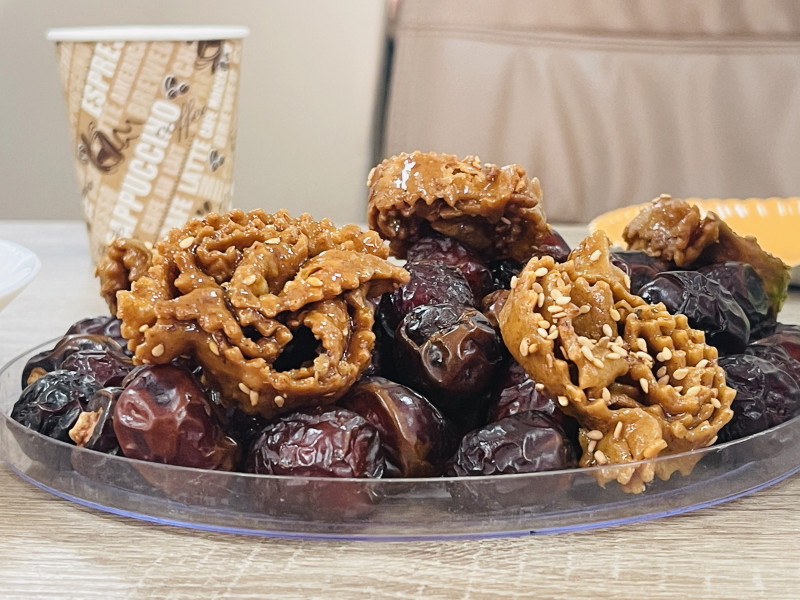
Close-up of dates and chebakia. Photo by Selina Chen.