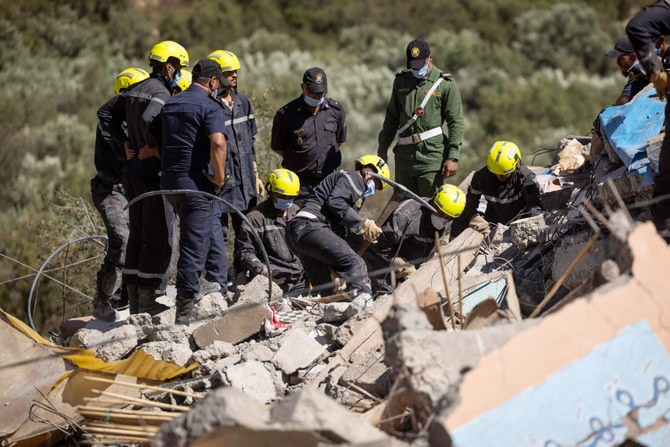
Rabat- The prestigious British daily The Guardian has commended Morocco’s response to the devastating earthquake that struck the North African country last Friday, describing the country as a “functioning modern” state that tackled the earthquake’s tragic aftermath in a “reasonably effective” way.
Peter Beaumont, one of the co-authors of the article, spoke in admiring terms of Morocco’s relief efforts as the country mobilized to come to terms with the earthquake’s heartbreaking aftermath. A veteran natural disaster reporter, Beaumont appeared to have been impressed by the determination and efficiency with which Moroccan authorities mobilized to address the September 8 tragedy.
“In the space of around 48 hours, Morocco partially reopened one of the main roads leading to the heart of the earthquake zone, opening up a corridor for the delivery of aid to those most affected,” he said, detailing how the Royal Armed Forces’ military helicopters have been making non-stop rotations for days, while a huge surge of solidarity has gripped the entire country.
Although the relief efforts have encountered some difficulties, Beaumont argued, such issues are normal when dealing with a crisis of the magnitude of the disastrous quake that hit central Morocco. The disaster’s very nature afflicted a population that was widely distributed in hundreds of villages spread over exceedingly challenging mountainous terrain.
Read also: Launch of New Courses to Provide Psychological Support for Earthquake-Affected Students
The Guardian’s article comes amid controversy over French media’s paternalistic and smearing coverage of Morocco’s earthquake relief efforts. In particular, French media accused Morocco of rejecting France’s offer of humanitarian aid on political grounds, casting doubt over the genuineness of the Moroccan government’s commitment to the much-needed relief efforts.
“While it is normal for foreign states to offer help, it is also a privilege, not a right, to be invited to help, as Moroccans are in the best position to determine what is needed,” the Guardian’s article argued, noting that one of the first principles of humanitarian aid is the very idea of “sovereignty in decision-making.”
The second principle, the article went to stress, is that “those offering and sending aid must ensure that their efforts actually contribute to the relief effort, without draining and squandering precious resources.”
As news of the devastating earthquake made the rounds around the world, some commenters appeared to question Morocco’s preparedness to adequately deal with the quake’s disastrous aftermath.
Addressing such condescending critics, the Guardian article insisted that the very idea that “some countries, because of their wealth, politics or technological advantages, are inherently better equipped to respond to emergencies seems ludicrous and arrogant.”
Nearly a week after the devastating quake shook central Morocco, “aid routes have opened up rapidly” for rescue operations to reach remote, hard-to-access villages in the High Atlas, the article pointed out, concluding that the “urgent question” facing Morocco’s international partners “is how to help Morocco rebuild devastated communities over the long term.”