


 Join on WhatsApp
  Join on Telegram
 Rabat – The Moroccan National Press Council announced today filing a complaint against French newspapers “Charlie Hebdo” and “Liberation” over their “unethical” coverage of the devastating earthquake that struck Morocco’s Al Haouz region on September 8.
The Council decried the newspapers’ breach of ethical journalism standards in their coverage of the natural disaster, describing their actions as “unacceptable” and detrimental to the principles of solidarity and support for disaster victims.
The Council has formally filed a complaint with the President of the French Press and Mediation Ethics Council, urging appropriate action in accordance with established international ethical norms.
On September 15, Charlie Hebdo published a caricature “inciting a lack of solidarity and discouraging contributions to support the victims of the earthquake in Morocco,” said the council in a press release.
The National Press Council condemned this move, emphasizing that it violated the fundamental principle of assisting victims of natural disasters. In addition, it deemed the caricature by Charlie Hebdo inconsiderate and hurtful to the earthquake victims and their families, who are in desperate need of support and humanitarian assistance.
“Many of them have lost their families and breadwinners, including orphaned children unrelated to diplomatic disputes or political problems,” the Moroccan press council said.
Read also: Morocco’s Earthquake: Clarifying the Controversy amidst French Media Misrepresentation
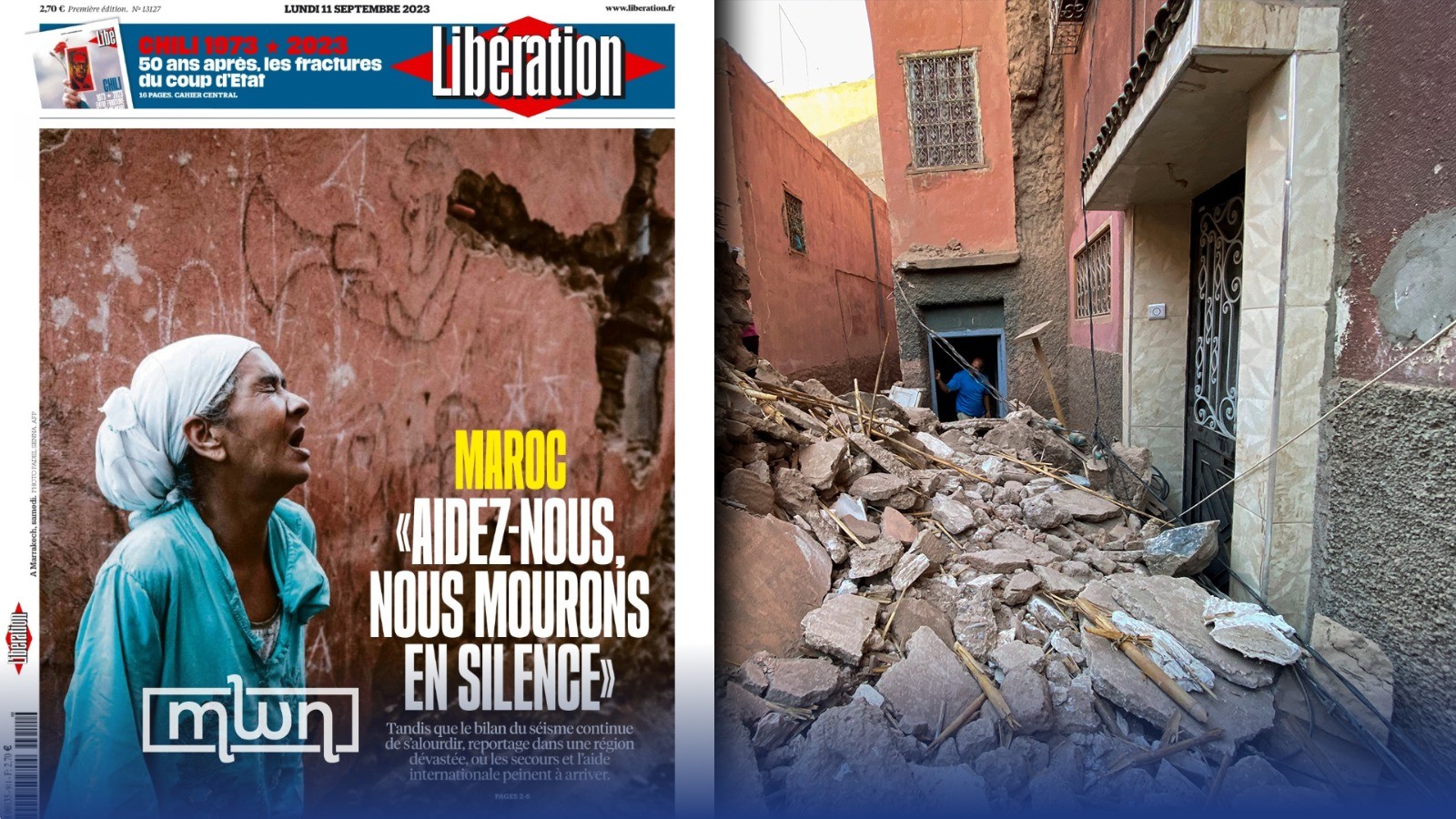
Similarly, Liberation published on September 11 a story featuring a photograph of a woman identified as an earthquake victim along with the title “Aidez nous, nous mourrons en silence,” meaning “Help us, we are dying in silence.”
Upon verification of the woman’s statement circulating on social media in a video, the Council said it discovered that the published content contradicted her actual words.
“This undermines the credibility and professionalism that should be demonstrated when dealing with issues of a humanitarian nature, especially in moments of natural disasters,” the statement said.
The Moroccan National Press Council pointed out that Liberation violated ethical standards in multiple ways. First, the newspaper published a photo of an elderly lady, claiming she had made a comment that was, in fact, fabricated by the newspaper.
As the Council sees it, such a brazenly misleading portrayal aimed to undermine the relief efforts of Moroccan authorities, volunteers, and rescue teams from other countries.
The Council went on to accuse the newspaper of disregarding the necessity for human solidarity and professionalism in journalism by spreading “false news and distorted facts.”
It underlined that “dealing with victims of humanitarian disasters requires a cautious approach, refraining from exploiting their images for cheap sensationalism.”
Read also: Morocco Earthquake: France Has Crossed the Threshold of Tolerability
The statement highlighted the broader context of Charlie Hebdo and Liberation’s violations, which came amid heightened tensions as several French media outlets criticized Morocco for allegedly rejecting France’s offer of rescue assistance and humanitarian aid following the earthquake.
As Morocco recovers from the tragic earthquake that claimed the lives of nearly 3,000 people, many in the North African country have in recent days taken to social media to denounce several French media outlets’ insensitive and paternalistic coverage of the September 8 earthquake.
Seemingly spurred by France’s offer of aid, these outlets have insinuated that Morocco is deliberately withholding assistance and endangering lives that are in desperate need of aid. In response, irate Moroccans have accused them of orchestrating a smear campaign that aimed to tarnish Morocco’s image and unfairly criticize its disaster response.
Amid the controversy, France’s President Emmanuel Macron addressed all Moroccans “directly” to express his solidarity with Morocco following the earthquake, as well as to acknowledge the ongoing smear campaign by French media.
However, Macron’s decision to directly address the Moroccan people has ignited immense backlash from Moroccans, with many stressing that King Mohammed VI is the only person with the legitimacy to solemnly address Moroccan citizens.


