Join on WhatsApp
 Join on Telegram
Rabat – Morocco has placed the digital transition at the core of its vision for administrative reforms, and for the first time, the country has a government with a ministry responsible for the digital transition.
This is according to Ghita Mezzour, Delegate-Minister to the Head of Government in charge of Digital Transition and Administration Reform, who presented a defense of Morocco’s vision for digital transition during a public debate on Tuesday.
Speaking on Tuesday during a public debate on digitizing the Moroccan administration organized by business-focused magazine La VieEco, Mezzour explained the country’s vision for administrative reforms “has already been defined by King Muhammad VI.”
“He [King Mohammed VI] clearly insisted in his speech,” she said, adding: “it is important to simplify and digitize public services and to make it easy, fast, and accessible for citizens, for a good quality of public services, whether it is a reduction in delay.”
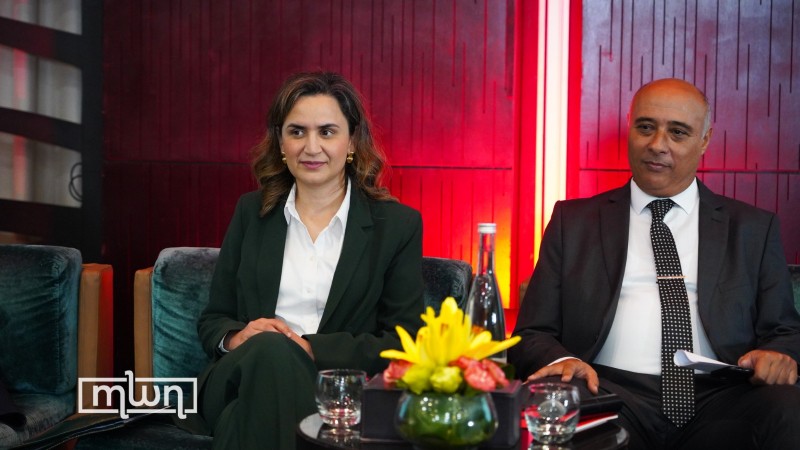
Ghita Mezzour, Minister of Digital Transition and Administrative Reform
Ghita Mezzour, Minister of Digital Transition and Administrative Reform, Younes Ouahid, Manager of Organization and Information Security,
Under the new vision, the minister went on to explain, that digitizing and simplifying the Moroccan administration means “simplifying the investor’s path” to the country’s economy.
While highlighting the importance Morocco attaches to the digital transition, Mezzour said “the new model of development also focuses on this vision.”
She added: “A good part of it talks about the importance of digitizing public services, giving better public services to citizens, to companies. There are laws in the country, law 5519, law 54, the public service charter, which also talks about digitization, the better quality of public services.”

Fahd Iraqi, director of La VieEco
Read also: 3rd Global Industry 4.0 Conference Explores Benefits of AI for Services
The minister acknowledged that much work remains to be done to implement the country’s vision for digital transformation, adding that her ministry is finalizing a new strategy to scale digital transformation in the Moroccan government.
She cited the Massar platform, which allows parents to monitor their children’s performance at school, as an example of the progress already made.
With regard to health insurance, she mentioned the Taawidaty platform of the National Social Security Fund (CNSS), which allows citizens to access online information about their benefits.
“We see the emergence of new digital services on public services every day. It is undeniable,” she stressed. “But it also raises the question of democratization of access to citizens, of education of citizens, of the use of this kind of services. Is there a strategy or a deployment in parallel to help citizens to appropriate these services, to familiarize themselves with them.”
For his part, Fahd Iraqi, director of La VieEco, stressed the need to embrace the digital transition to ensure effective reforms for Morocco’s public administration. “The reform and transformation of the administration is no longer possible without taking into account this digital dimension, as it allows traceability, efficiency and communication between different administrative entities,” he explained.
For Iraqi, digitization is an integral part of modernization. “Whether it’s the General Directorate of National Security or other areas, you’ll find digitalization wherever you look. This is because, once again, digitalization is the key to modernizing and reforming the administration,” he explained.