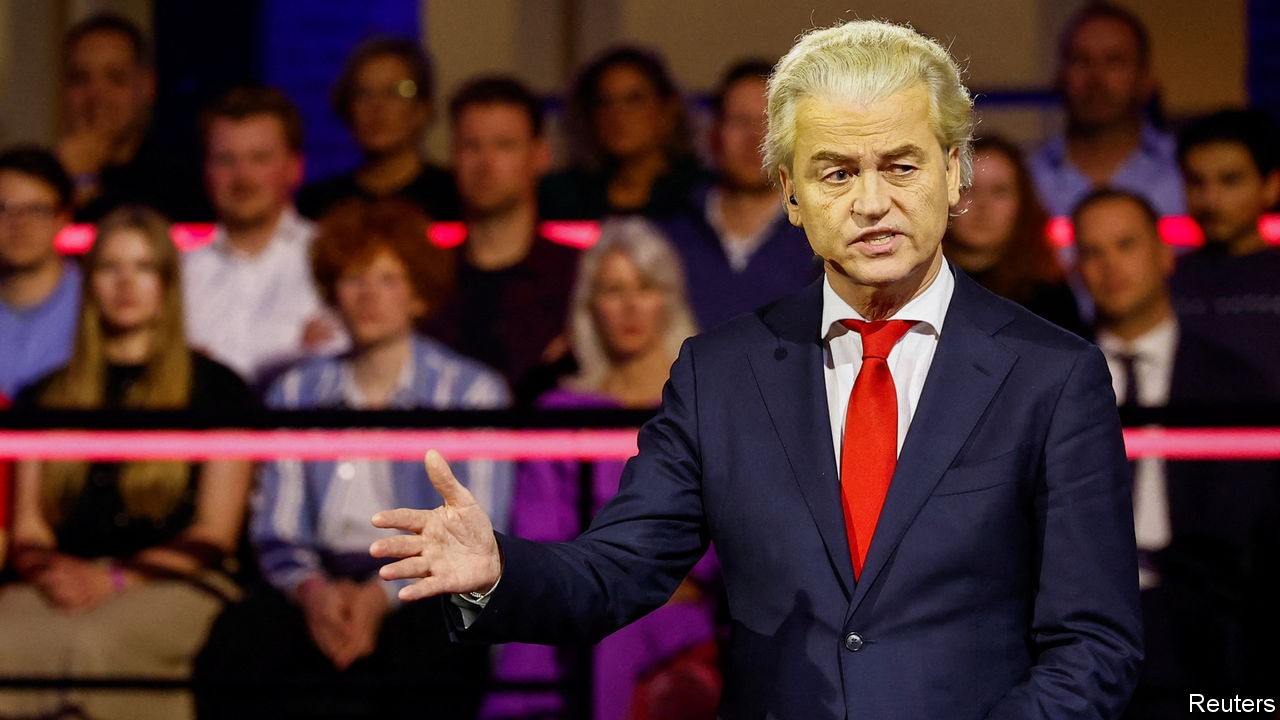
Minneapolis – Dutch nationalist politician Geert Wilders has shown impressive resilience as both the Netherlands and the European Union have undergone dramatic change over the past two decades. When he was first elected to the Dutch parliament in 1998, Bill Clinton was still president of the United States and the Euro was still four years away from becoming a day-to-day currency.
Fast forward to 2023. Wilder’s far-right Freedom Party (PVV) was the shock winner of the November general election. The PVV took nearly a quarter of the vote, winning 37 seats in the 150-seat parliament.
But with over a dozen other parties also winning seats, the PVV will need at least two partners (likely more) to form a coalition government. The PVV needs to find almost forty more votes in parliament to form a government.
As 2023 comes to an end, the difficult coalition-building process for the PVV has begun this week with at least three parties agreeing to sit down and (just) talk about core principles and any shared interests: the Farmer-Citizen Movement (BBB), People’s Party for Freedom & Democracy (VVD) and the New Social Contract (NSC).
Behind closed doors, Wilders will find himself pitching moderation and consensus over absolutism and confrontation. Can the firebrand politician assemble any kind of governing coalition? The mediator tasked with guiding the discussions has described their status as being in a “radio silence” phase, as reported by local media.
Wilders’ political journey begins in the middle. As a member of the established People’s Party for Freedom and Democracy (VVD), he perceived an elite political class that was far removed from the day-to-day struggles of Henk and Ingrid, fictional regular Dutch citizens whom he regularly cites (and defends) in campaign speeches.
He would leave the VVD in 2004 to start his own political movement. The rest, as they say, is history.
The PVV has demonstrated durable electoral success in key municipal elections beginning back in 2010—harnessing popular skepticism across a broad range of policy issues, from Euroscepticism to education standards to immigration to tax policy.
“I want to be prime minister,” he reportedly told Dutch media in March 2009 as he sensed that his views were beginning to take hold across the Netherlands.
He has survived seemingly career-ending headlines. In September 2020, a Dutch appeals court found Wilders guilty of insulting Moroccans — he had led his supporters in anti-Moroccan chants at a political rally in 2016. The court acquitted him of the more serious charge of inciting hatred and discrimination aimed at the 400,000 Moroccan nationals living in the Netherlands.
Wilders at age 60 may now be able to establish himself as a bridge between the various factions within the establishment right and the far right.
Immigration is the top political issue in the Netherlands in 2023. Last year the total population grew by 220,000 — all of which came from net migration. Natural population growth (births minus deaths) during the last three years has been either nominal or negative in the Netherlands. The nation is facing a common challenge in the West: an aging population and a shortage of workers.
If Wilders senses that he is close to forming a governing coalition in the coming months, it may give him pause to re-evaluate rhetoric towards Islam and migrants from Muslim nations who constitute an important component of modern Dutch society.
Ahmed Aboutaleb, a Moroccan from the Rif, for example, has entered his second decade as the mayor of Rotterdam, home to the largest seaport in Europe.
Wilders will continue to advocate significant changes to migration and citizenship laws though he may tone down his inflammatory rhetoric. He is now buoyed by the recent French Assembly vote to overhaul the nation’s asylum, immigration and citizenship system.
Part of those changes includes more statutory limits on migrants who seek to bring family members to France and longer waiting periods for migrants seeking access to welfare benefits. A new EU-wide asylum system agreement also speaks to priorities that Wilders has often championed.
It is also not lost on Wilders the last-minute support given by Marine Le Pen for the immigration reform legislation passed by the French Assembly. The decades-long tradition of coalition governing by a rotating mix of center, center-right and center-left parties across Europe has seemingly come to an end.
Wilders has previously promised a public referendum on leaving the European Union, a so-called Nexit. How this position evolves during coalition talks will say a lot about the core governing principles of Wilders and his PVV.
As Europe discovered following the 2016 vote by the United Kingdom to leave the EU, talk of leaving is one thing, the actual separation process is something very different. There is a moderate level of Euroscepticism among the Dutch population, but the financial and political benefits of membership are not abstract. Post-Brexit, euro-denominated share trading has migrated from London to Amsterdam.
Whether Wilders succeeds in forming a government is very much in question. But he not only has a seat at the table, he will set the agenda in the coming months on a broad range of domestic and international issues. Coalition talks will likely be a long waiting game, one that Geert Wilders is familiar and quite comfortable with.
Read Also: Dutch Far-Right Victory Marks Continued European Lurch to Extremism