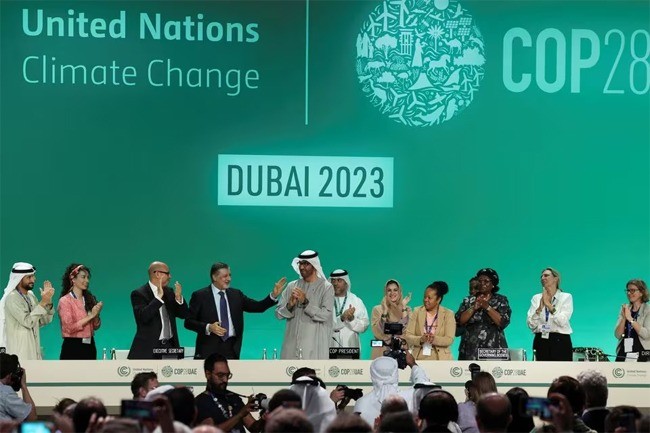
Representatives from over 200 countries convened today in Dubai at COP28 to agree to reduce global consumption of fossil fuels. This is the first deal in 30 years that has made such a commitment to target the phasing out of “fossil fuels,” a signal that the world is united in directing efforts to cut out a major driver of the climate crisis.
Following two weeks of negotiations in the UAE, COP28 President, Sultan al-Jaber praised the “historic” deal, though he stressed that its ultimate success will be dictated by “implementation”, proclaiming at the summit that “we are what we do, not what we say.”
The COP28 deal, proposed on Wednesday, calls for “transitioning away from fossil fuels in energy systems, in a just, orderly and equitable manner … so as to achieve net zero by 2050 in keeping with the science.”
It also proposes to “triple the world’s installed renewable energy generation capacity” by 2030, and to increase energy efficiency improvements.
EU representatives have welcomed the deal, and EU Climate Chief Wopke Hoekstra said in praise that “humanity has finally done what is long overdue,” according to the Guardian.
Read also: COP28: Morocco Joins Calls to Triple Nuclear Energy Product
Also applauding the deal was Danish Climate and Energy Minister Dan Jørgensen, who said, “We’re standing here in an oil country, surrounded by oil countries, and we made the decision saying let’s move away from oil and gas.”
However, the Alliance of Small Island States (AOSIS) has expressed concerns over the deal, criticizing that the pact contains a “litany of loopholes.” In a statement, the AOSIS argued that the pact is “incremental” and not “transformational.”
The low-lying small island states are most vulnerable to the effects of climate change, with its representatives at the summit speaking out in favor of phasing out fossil fuels, which was supported by the United States, Canada, Norway and the EU bloc.
Meanwhile, Saudi Arabia-led Organization for Petroleum-Exporting Countries (OPEC), has protested during the COP28 summit against using terms which address phasing out oil, advocating instead for emission-reducing technology, such as carbon capture.