
 Join on WhatsApp
 Join on Telegram
Rabat – While Morocco’s 2024 Finance Law partially aligns with initial ambitions set forward by the Confederation of Moroccan Businesses (CGEM), the law falls short of the expectations of Moroccan businesses, said Chakib Alj, CGEM chairman on Friday.
“At the publication of the PLF, business leaders were somewhat surprised. The treatment of VAT reform towards neutrality was deemed incomplete, and certain measures deeply concerned the business world,” Alj said during a press conference.
Morocco’s 2024 Finance Law, designed to bolster job creation, economic value, and prioritize investment development, contains a reform for the Added-Value Tax (VAT) that has been deemed inadequate, he explained.
He further explained that certain measures, which were implemented without prior consultation with affected sectors have sparked worries among Moroccan businesses.
Specific provisions, such as the application of solidarity measures concerning VAT for directors and officials could potentially impact investment decisions. Solidarity measures entail holding directors or officials accountable for ensuring VAT compliance or payment within their organizations.
While commanding the government’s efforts to boost Morocco’s profile as an investment destination of choice, the CGEM president warned that maintaining confidence through fiscal stability is paramount. The perceived uncertainties arising from certain aspects of the Finance Law might hinder this, prompting concerns about investment intentions.
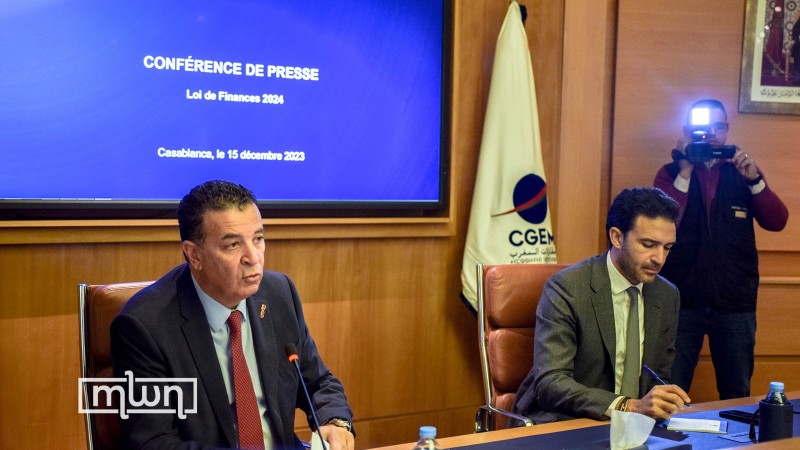
CGEM’s Chairman, Chakib Alj, answering questions during the press conference on Friday
According to Alj, CGEM was able to push for tax reforms in the parliament. “The text regarding solidarity among directors was framed and amended to target offenders only after a final court decision,” he clarified.
Through intensive rounds of negotiations with the government, CGEM was able to push for decreased taxes for a number of vital sectors including the pharmaceutical sector, education, and freight.
Custom tax in 2024 finance law
The confederation welcomed the tax reform which decreased import duties on a range of products. However, representatives of the organization criticized the government’s slow move toward tax neutrality.
“The reduction of customs duties from 40% to 30% for a range of products, requested by our Confederation for some time, was welcomed by all,” Alj said, adding that “the increase of TIC and customs duties from 2.5% to 30% for another set of products was economically irrelevant, as it would only strengthen the informal sector instead of integrating it.”
TIC tax is levied on various products, including alcohol, tobacco, and soft drinks. The tax largely targets items considered non-essential or potentially harmful to health.
“We would have hoped for a more balanced Finance Law for 2024, more in line with commonly held principles,” Alj said, expressing CGEM’s discontentment with the 2024 financial law.
CGEM’s objective is to continue consultations and keep advocating for the voice of Moroccan businesses and our recommendations for future exercises to finalize all the projects of the fiscal reform, he explained.
“The intended objective of which is crystal clear from our perspective: improving revenue through growth, broadening the base through informal sector integration, and reducing fiscal pressure for economic operators,” Alj stressed.
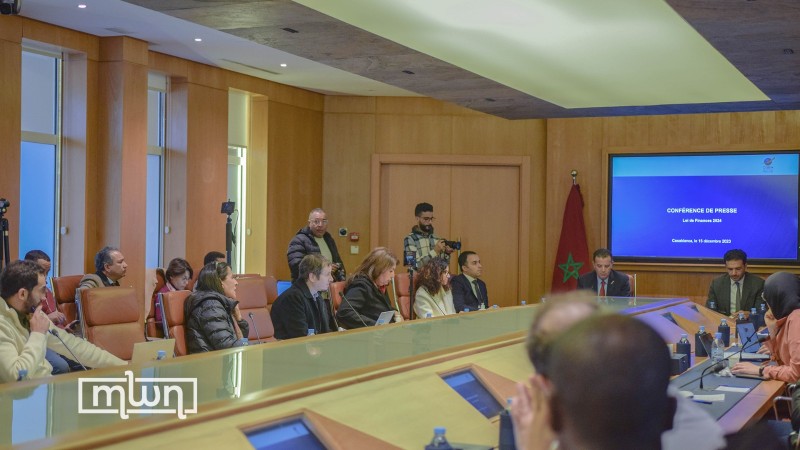
Press conference at CGEM’s headquarters in Casablanca
Morocco’s economic objectives
Morocco has established productive private investment as the flagship for its economy, aiming to reach two-thirds of private investment and create 500,000 jobs.
For Alj, the objectives align with Morocco’s ambitions to host the CAN 2025 and the 2030 World Cup, which offer countless opportunities.
To seize the opportunities, Morocco’s economy “must remain competitive.” The business environment also plays a determining role, and the Finance Law is just one component, he explained.
“We must double our efforts for the effective deployment and operationalization of economic reforms identified, agreed upon, but struggling to materialize,” he said referring to the government’s sluggish response to calls for reforming provisions of the labor code.
“We signed a historic social agreement in 2022, binding the Government, the most representative trade unions, and CGEM,” he recalled.
He went on to explain that the law on the exercise of the right to strike, which was supposed to be published in January 2023, has not yet been issued, adding the Labor Code reform is long overdue as it has not been updated in 20 years.
Human capital development is another equally important issue that the CGEM is calling for reconsideration. The confederation is calling on the government to reform the vocational training system, which has long faced “clear malfunction.”
Read Also: Morocco’s Competition Council, CGEM, Issue Legal Compliance Guide for Businesses