
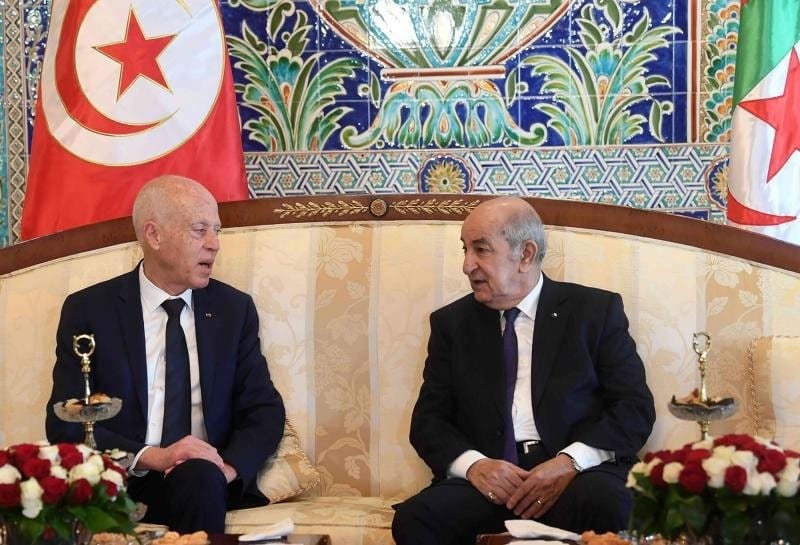
Marrakech – Tunisian President Kais Saied has appointed diplomat Tarek Ben Salem as the new Secretary-General of the Arab Maghreb Union (AMU) for a three-year term starting June 2024, the Tunisian News Agency reported on Monday, citing a statement by the Ministry of Foreign Affairs.
Ben Salem will succeed his compatriot and former Tunisian Foreign Minister Taieb Baccouche, who was appointed to the position in May 2016.
The appointment comes just five weeks after a meeting held in Tunis on April 22 to discuss the Algerian Maghreb project without Morocco’s participation, raising concerns about the viability of the AMU without the involvement of a key regional player.
‘The final nail in the coffin’
Algeria had previously refused to recognize the outgoing Secretary-General Baccouche, with Algerian Foreign Minister Ahmed Attaf stating that the AMU “has no activity, not even a Secretary-General.”
Algerian journalist and analyst Oualid Kebir responded to the Tunisian announcement, saying: “Kais Saied is driving the final nail in the coffin of the military gang’s project, which died before it was born.” He added that the “military gang” failed in its endeavor and had no choice but to resort to “Ben Battouch” and establish a bloc with the “Tindouf Republic.”
The appointment of Ben Salem “coincides with the consensus of the members of the Maghreb Union, which [has] experienced a state of clinical death” in recent years, the Algerian media outlet Echourouk reported on Tuesday.
Echourouk’s report went on to suggest that Ben Salem’s appointment is a welcome development for Algeria’s regional leadership as it mainly aimed at ending his predecessor’s alleged collusion with Morocco to undermine Algerian interests and regional unity.
“The decision to remove Taieb Baccouche, who was described by Foreign Minister Ahmed Attaf as an ‘impersonator’, could bring about some breakthroughs in the work of the Maghreb Union, especially since he played a negative role during his tenure in office,” Echourouk claimed.
“[Baccouche] was transformed from Secretary-General into an implementer of Morocco’s hostile policies against Algeria, as he was behind the appointment of a Moroccan diplomat that represented it in the African Union without consulting the member states, then directed false accusations against Algeria saying that it did not pay its financial share in the Maghreb Union,” the news outlet added.
The Algerian website further recalled recent efforts by Algeria to exclude Morocco from its newfound Maghreb Union project, noting the holding of “a tripartite meeting” between President Tebboune, his Tunisian counterpart Kais Saied, and the head of the Libyan Presidential Council, Mohamed Younes el-Menfi, in Tunisia.
Read also: Arab Summit: King Mohammed VI ‘Regrets’ Maghreb Union’s Stagnation
According to Echourouk, the three leaders notably agreed to coordinate efforts to secure common borders, develop border regions, and unify positions in dialogue with countries concerned with irregular migration in the Mediterranean and sub-Saharan Africa. They also called for establishing major projects in grain and fodder production and seawater desalination to achieve water and food security for the three countries.
These developments take place against a backdrop of regional tensions. In April, Algeria faced backlash after news emerged of its maneuvers to revive the Maghreb Union without Morocco.
Notably, Libya rejected Algeria’s attempts to exclude Morocco from a revamped Maghreb Union project, with a Libyan envoy stressing the need to strengthen the regional entity founded in 1989 by all five countries.
In response, Algiers has emphasized that its consultation initiative with Tunisia and Libya only aimed to discuss common issues and problems and was not directed against any third countries.
Algerian Foreign Minister Ahmed Attaf has notably argued that the new, tripartite consultation framework is not a substitute for the original AMU and remains open to everyone with political intention and will.
Despite Algeria’s claim that its efforts to establish a tripartite bloc in the Maghreb are not directed against any other state and that its door is open to all countries, the rationale behind Ben Salem’s appointment is bound to revive suggestions that Algeria and Tunisia are indeed determined to pursue a revamped Maghreb Union “dream” that excludes Morocco.