Read on app Read on app
✕
Prayer Times
  • Morocco
  • Lifestyle
  • Western Sahara
  • Login
Morocco World News
  • Home
  • Culture
  • Politics
  • Society
  • Economy
  • Opinion
  • Education
  • Sustainability
  • Tech
  • Sport
  • GITEX 2026
No Result
View All Result
Morocco World News
  • Home
  • Culture
  • Politics
  • Society
  • Economy
  • Opinion
  • Education
  • Sustainability
  • Tech
  • Sport
  • GITEX 2026
No Result
View All Result
Morocco World News

Home > Headlines > Oldest Known Human Face Reconstructed from 300,000-Year-Old Moroccan Remains

Oldest Known Human Face Reconstructed from 300,000-Year-Old Moroccan Remains

The face of the oldest known human, whose remains were discovered in Jebel Irhoud, Morocco, has been reconstructed by scientists, revealing his appearance for the first time in 300,000 years.

Adil FaouzibyAdil Faouzi
Jun, 21, 2024
0 0
A A
Oldest Known Human Face Reconstructed from 300,000-Year-Old Moroccan Remains

Oldest Known Human Face Reconstructed from 300,000-Year-Old Moroccan Remains

Follow the latest news from Morocco World News

Join on WhatsApp Join on Telegram

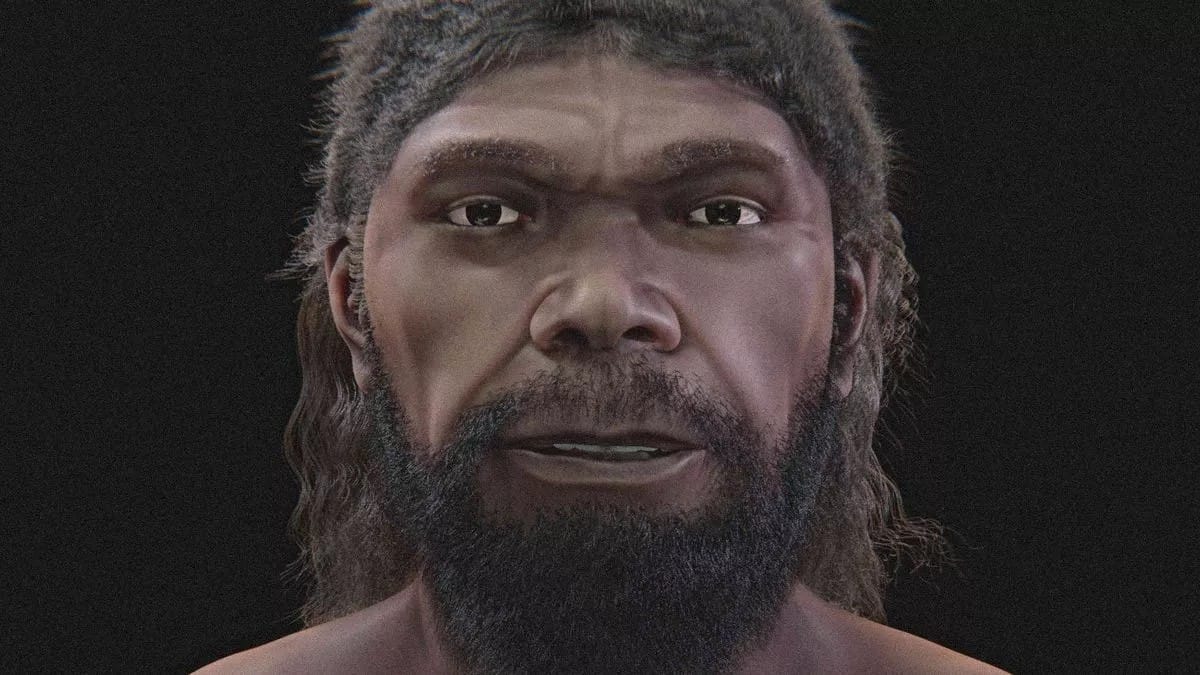
Beni Mellal – The face of the oldest known human, whose remains were discovered in Jebel Irhoud, Morocco, has been reconstructed by scientists, revealing his appearance for the first time in 300,000 years.

According to the Mirror, the Jebel Irhoud remains pushed back the lineage of Homo sapiens by 100,000 years and proved that our ancestors outgrew the “cradle of mankind” in east Africa millennia earlier than previously thought, spreading across the continent.

Brazilian graphics expert Cicero Moraes completed the facial reconstruction using data provided by researchers at the Max Planck Institute. Moraes described the resulting face as “strong and serene.”

The process involved scanning the skull in 3D and using anatomical deformation techniques, as reported by the Mirror. The tomography of a modern human was adapted to fit the Jebel Irhoud skull, generating a compatible face. Further data from modern humans was used to predict the thickness of soft tissue and the projection of facial structures.

The Sun adds that Moraes chose to give the skeleton a male face because he found the skull to be more robust and masculine. The skull itself is a composite of various fossils, recreated into a coherent whole. According to the Max Planck Institute, the Jebel Irhoud remains present a “modern-looking face and teeth, and a large but more archaic-looking braincase.”

The Daily Mail also reports that the ancient skull proved Homo sapiens appeared 100,000 years earlier than previously thought and migrated out of Africa before prior evidence had suggested.

The donor skull used in the reconstruction was digitized and chosen because it appeared the closest to that of the ancient skull, allowing researchers to fill in the missing parts of the remains.

While the true gender of the individual is unknown due to the absence of pelvic bones, the skull was unearthed alongside stone tools and animal bones at Jebel Irhoud by researchers at the Max Planck Institute.

Previously, the oldest Homo sapiens fossils were known from the site of Omo Kibish in Ethiopia, dated to 195,000 years ago, leading most researchers to believe that all humans living today descended from a population that lived in East Africa around that time.

Professor Jean-Jacques Hublin, who led the study, stated, “We used to think that there was a cradle of mankind 200,000 years ago in east Africa, but our new data reveal that Homo sapiens spread across the entire African continent around 300,000 years ago. Long before the out-of-Africa dispersal of Homo sapiens, there was dispersal within Africa.”

The Jebel Irhoud site has been known since the 1960s for its human fossils, and the latest discovery brings the total number of remains to 22, including skulls, teeth, and long bones from at least five individuals – two adults and three children. The findings at Jebel Irhoud have significantly altered our understanding of human history and the origins of our species.

Read also: Study: Ancient Moroccan Hunter-Gatherers Relied Heavily on Plants

 

Tags: Homo Sapien Discovery in MarrakechHomo sapiens
TweetShareShareSendShareScan

Recent News

Morocco Assistant Coach Joao Sacramento: ‘The Dream Is Still Alive.. It’s Time for the Next Stage’

Morocco Assistant Coach Joao Sacramento: ‘The Dream Is Still Alive.. It’s Time for the Next Stage’

June 27, 2026
hot weather europe

Why Europe Is Hotter Than Morocco This Summer

June 26, 2026
achraf hakimi rape trial

Achraf Hakimi Appeals French Court Decision to Stand Trial in Rape Case

June 26, 2026
Ecuador Declares National Holiday After Historic World Cup Qualification

Ecuador Declares National Holiday After Historic World Cup Qualification

June 26, 2026
belgium new zealand world cup

2026 World Cup: Belgium vs. New Zealand Preview, Expected Lineups, Prediction

June 26, 2026

USEFUL LINKS

  • About
  • Privacy Policy
  • Contact
  • Careers
  • Terms Of Use
  • Cookies Policy

TOPICS

  • Mawazine 2025
  • Environment
  • Politics
  • Lifestyle
  • Sports
  • Western Sahara

REGIONS

  • International
  • Maghreb
  • Middle East
  • Africa

Download our App


Download the Morocco World News app on Google Play for Android

Download the Morocco World News app on the Apple App Store for iPhone and iPad

Copyright 2026 Morocco World News. All rights reserved. Morocco World News is not responsible for the content of external sites.
Read about our approach to external linking.

Welcome Back!

Login to your account below

Forgotten Password?

Retrieve your password

Please enter your username or email address to reset your password.

Log In
  • Login
No Result
View All Result
  • Home
  • Culture
  • Politics
  • Society
  • Economy
  • Opinion
  • Education
  • Sustainability
  • Tech
  • Sport
  • GITEX 2026

Useful Links

  • Prayer Times

Useful Links:

  • Prayer Times

All Right Reserved © 2025 Morocco World News .

Contact us
Are you sure want to unlock this post?
Unlock left : 0
Are you sure want to cancel subscription?