 Join on WhatsApp
 Join on Telegram
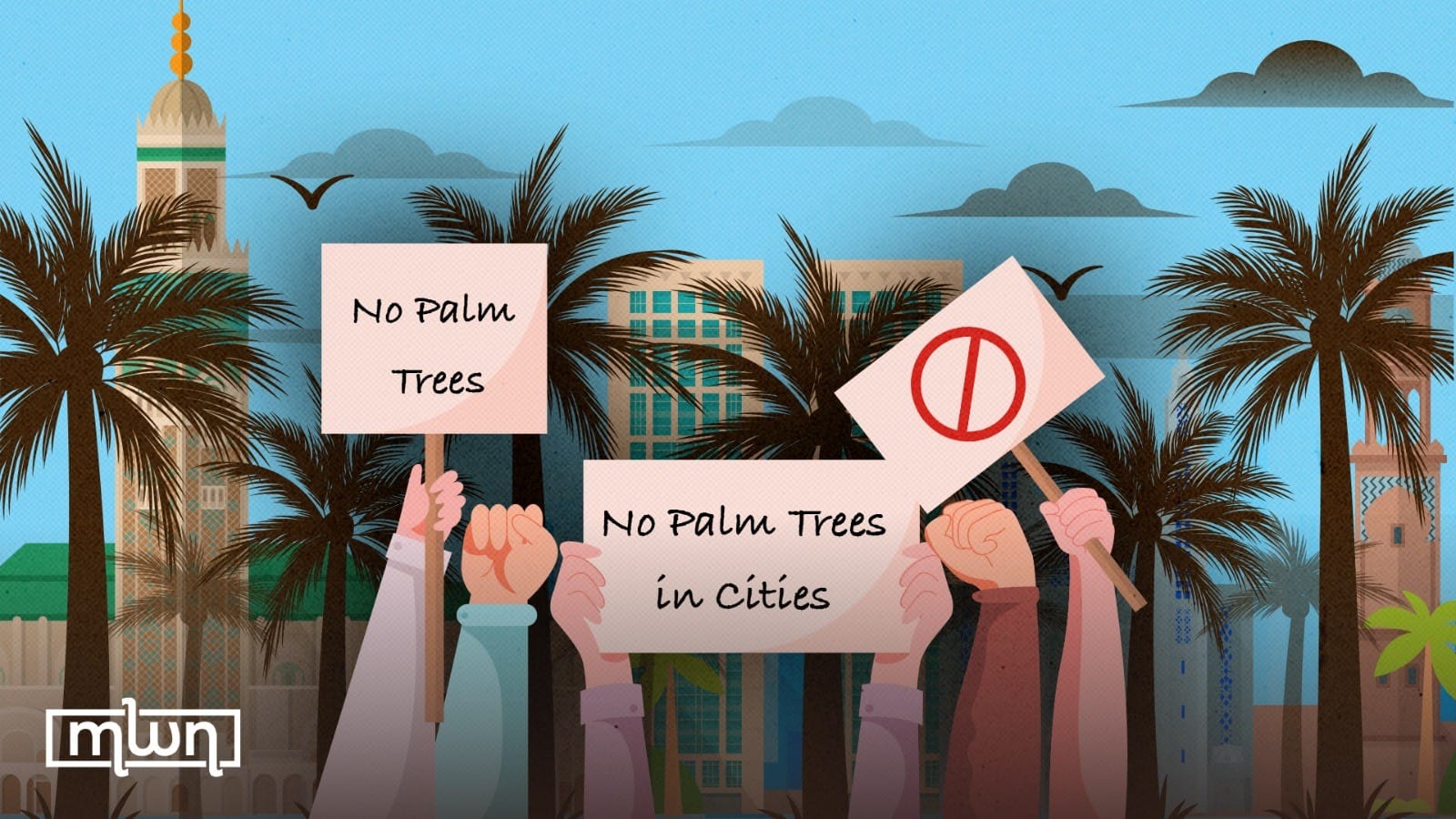
Marrakech – As the scorching summer heat descends upon Morocco each year, a contentious debate resurfaces: the widespread planting of palm trees in cities across the North African country.
In recent years, the proliferation of these towering plants sparked concerns among citizens who question the suitability and ecological impact of this landscaping trend.
At the forefront of this debate is the environmental movement “Morocco Environment 2050,” which has been leading a campaign to halt the “random” planting of palm trees in Moroccan cities and villages.
The movement advocates for a more thoughtful and tailored approach to urban greenery, one that takes into account the unique environmental and geographical characteristics of each region.
For the past three years, the organization has been pressuring local authorities to stop planting palm trees outside of their natural habitat in oases.
Through social media campaigns and petitions directed at relevant authorities, “Morocco Environment 2050” argues that the accelerated “palmification” policies of recent years have been detrimental to the environment and aesthetics of Moroccan cities, offering little ecological or environmental benefit.
The decision to plant palm trees outside their original domain in desert regions and oases represents a grave environmental “sin,” describing it as an “environmental crime with all the elements in place” against Moroccans and the country’s geography, Salima Belemkaddem, the president of the movement, said.
She emphasizes that Morocco “ranks second in terms of biodiversity in the Mediterranean basin,” noting that each region of the country has its own unique trees, vegetation, and climate. It remains unnatural to plant palm trees in environments that are not suitable for them, she argued.
The movement calls for respecting the specificities of each region by encouraging the planting of trees that are appropriate to their territorial and climatic characteristics.
The controversy
Critics of the palm tree planting trend argue that it is a “blind and excessive palmerization” that not only generalizes the local date palms (Phoenix dactylifera) in territories where they do not naturally belong, such as the northern half of the country, but also imposes an “intruder” from across the Atlantic: the American palm tree “Washingtonia” or “Pritchardia.”
This species is considered incompatible with Moroccan soil, even in areas where local palm trees can naturally exist.
Belemkaddem points out that palm trees, especially the tall varieties, are expensive and costly for municipal budgets.
She also highlights the importance of preserving the “identity and visual memory of the territorial space” by adopting the most appropriate tree species for cities. This, she argues, has significance for the mental health of residents, societal security, and enriching the conditions for national and international tourism.
Environmental concerns and ecological impact
On an environmental level, Belemkaddem stressed that palm trees, outside their specific areas of spread in oases and deserts, do not help in performing any important ecological or environmental roles.
For example, unlike other trees, they do not assist in absorbing carbon dioxide or protecting against soil erosion. Additionally, they do not provide shade for residents unless planted in high density, which makes them financially costly.
A former president of one of Casablanca’s wealthiest municipalities, who spoke anonymously to Maroc Hebdo, raised suspicions about the motives behind the proliferation of palm trees, suggesting that someone influential may be commercially benefiting from the sale of Washingtonia palms.
“A single palm tree can be expensive, and it can represent a lucrative market. It’s quite curious that nothing has been done to stop the palm trees when all the logical arguments are there,” he remarked.
Environmental awareness
Environmental activists stress the need for a participatory approach in urban planning that involves public debate and exchange to achieve optimal results.
El Mehdi Limina, coordinator of the associative coalition for environmental protection, attributes the proliferation of palm trees in Casablanca to the “disinterest” of political actors towards the environment. The current context, heavily impacted by the challenges of climate change and its effects, requires a new approach, he stressed.
“And then the development of the city does not respect the principle of the participatory approach, which is nevertheless enshrined in the Constitution. We must open the door to debate and exchange to arrive at good results. And then those in charge must understand that roads and leisure places are not everything. We need green spaces that respect the characteristics of Casablanca,” Limina added.
A glimmer of hope
Despite the challenges, there have been some positive responses to the movement’s demands. The municipality of Chichaoua, near Marrakech, has committed to stopping the planting of palm trees in its streets and replacing them with trees.
Meanwhile, Ain Chock, a district of Casablanca, has promised to launch a tree-planting campaign last year.
Last year as well, a report by the Regional Court of Accounts on the Greater Casablanca Development Project (PDGC) and the functioning of Local Development Corporations (SDL) issued recommendations aimed at clarifying the relationship between these corporations and the municipality of Casablanca.
As the financier of the projects, the municipality is supposed to have the power of monitoring and supervising the projects executed by the SDL, particularly in terms of expenditure.
Moving forward
As the debate surrounding palm tree planting in Moroccan cities continues, it is clear that a more environmentally conscious and participatory approach is needed.
The efforts of organizations like “Morocco Environment 2050” have brought the issue to the forefront, sparking a necessary conversation about the importance of preserving the unique ecological identity of each region and the need for sustainable urban landscaping practices.
With growing awareness and pressure from environmental activists, there is hope that local authorities will increasingly prioritize the planting of suitable tree species that respect the territorial and climatic characteristics of each area.
By doing so, Morocco can protect its biodiversity, create more environmentally friendly urban spaces, and ensure a greener future for generations to come.