 Join on WhatsApp
 Join on Telegram
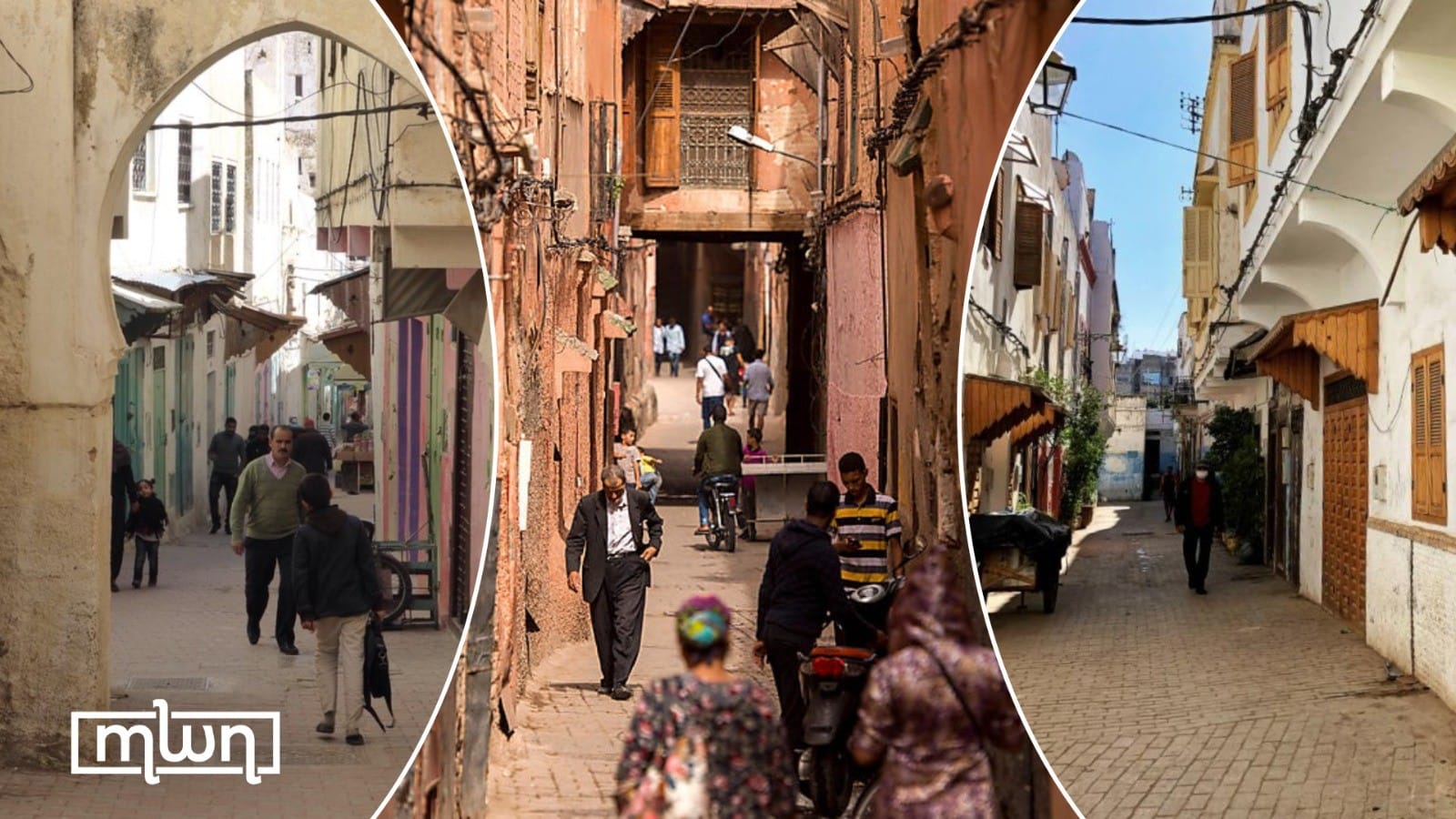
Marrakech – Stepping through the fortified gates of Morocco’s historic “Mellahs” is like entering a world frozen in time. These historic Jewish quarters, once bustling with life and culture, today lie largely silent and empty, overgrown with vines and exposed to the elements. Yet the faded beauty of their architecture hints at the vibrant communities that once filled these streets.
The Mellahs were Jewish districts established in Moroccan cities starting in the 15th century. The name itself comes from the Arabic word for “salt” and refers to the first Mellah created in Fez next to an area known for its salt trade.
While these quarters started out spacious and well-appointed, overcrowding soon turned them into cramped and impoverished neighborhoods cut off from the medina. Yet within their walls, the Mellahs became thriving centers of Jewish life in Morocco.
Walking through a Mellah today, you can hear the hustle and shouts of the market, smell the spices and freshly baked bread, and see intricately carved doors that mark where prominent Jewish families once lived.
Remnant of the Jewish roots, there are communal bakeries, kosher butchers and small synagogues tucked into the winding alleys. Hidden behind high walls are tranquil courtyards with central fountains for ritual washing.
At their height in the 19th century, Morocco’s historic Mellahs formed the heart of Jewish culture, also serving as important commercial hubs connecting Morocco to the wider world.
The rise of the Mellahs
The first Mellah was established in Fez in 1438, when the Jewish community was forcibly relocated from the city center to a new fortified quarter adjacent to Morocco’s royal palace. The creation of this Mellah likely happened in stages, following outbreaks of anti-Jewish violence in Fez.
The motivation seems to have been both protection and control. The new Jewish quarter could be more easily defended, but its location next to the palace also let the rulers keep a close eye on the Jewish people and their commercial connections abroad.
Similar Mellahs soon rose across Morocco. After Fez, the next was created in Marrakech in 1557. As Marrakech grew into the capital under the Saadian dynasty, the Jewish population expanded rapidly. In a similar move to what happened in Fez, Sultan Moulay Abdallah al-Ghalib decided to relocate the entire community to a walled district beside his Kasbah, overlooking the city.
This set the pattern for Morocco’s other historic Mellahs in Meknes, Essaouira, Tetouan and other cities, which were established by sultans over the next centuries, usually beside royal fortifications. While initially intended to protect the Jewish communities, the crowded Mellahs soon declined into poverty-stricken neighborhoods.
Nonetheless, these walled districts also allowed Jewish cultural traditions to flourish largely autonomously through the centuries of changing rulers and fashions. The Mellahs became thriving centers of Jewish life in Morocco, home to synagogues, schools, ritual baths and other community structures. They had their own systems of local governance and justice under the overall rule of the sultan.
Microcosms of Jewish life
Life in the Mellahs was lived almost entirely within their walls. Residents relied on internal markets and services that catered to their culinary needs as a religious minority bound by Jewish dietary laws.
At the same time, the Mellah also served as an interface between Jewish and Muslim communities. Set apart but not completely isolated, the Jewish quarter was a meeting point for commercial exchange as well as cultural influence.
Today, a visit to the streets of Marrakech’s Mellah can give insight into the neighborhood’s self-sufficiency. There, you’ll find one of the oldest Jewish cemeteries in Morocco, as well as historic bakeries with communal ovens once used to bake challah bread for the Sabbath. Additionally, a mikveh, or ritual bath, was fed by winter rains channeled through a drainpipe into its pools.
In Tangier, the Mellah’s architecture and design reflect a unique blend of Andalusian, Spanish, and European influences, particularly in the Art Deco style adopted by the Jewish merchants.
Its central position within the medina and its extensions into the new city showcase architectural elements such as patios, sculptured stone and wrought-iron balcony edges, abundant decorative cornices, and large openings on the ground floor, establishing a functional relationship between family gathering rooms and the street.
The facade symbolizes the financial power of the Jewish merchants, with horizontally composed walls animated by transverse pins and emblematic balconies.
In Fez, the Mellah holds the Ibn Danan Synagogue, Torah schools, a Jewish library and the Lazama Synagogue, founded in 1580 and still in use until the 1900s before closing in 1920 after most Jewish people left the neighborhood. Fez also had separate quarters for Jewish immigrants from Spain and Portugal, who clung to their own traditions.
This separation extended even to synagogues and cemeteries, with Fez’s Mellah containing both a Sephardic and a native Moroccan Jewish burial ground. Only in the 18th century did the communities begin to blend together into a more unified Moroccan Jewish identity.
The lasting legacy of Jewish trade
The location of the Mellah was tied closely to economics. Rulers positioned these quarters to control Jewish merchants and artisans, whose trades brought in foreign goods and revenue. Yet this economic activity also benefited the Mellahs, allowing their Jewish communities to thrive for centuries.
Essaouira is perhaps the standout example. This coastal town was the port of Marrakech and a bustling seaport. Its 18th century Mellah still holds architectural traces of the prosperous Jewish merchants who lived there. Essaouira’s Jewish community was known especially for its jewelry, sugar and fishing trade.
In inland cities as well, the Mellah’s central market was often frequented by non-Jews, especially on the Jewish Sabbath when it was even busier than the Muslim souk. Rabbis would sometimes rebuke their congregations for doing business with “Gentile customers” on the holy day. Even today, the legacy of Jewish craftsmanship and commerce lives on in the Mellah’s marketplaces.
End of an era
By the early 1900s, Jewish Moroccans had already begun migrating out of the cramped and crumbling Mellahs to newer quarters in Morocco’s expanding cities. After the creation of Israel in 1948, many of the remaining Moroccan Jews were compelled to leave, driven by intense lobbying and propaganda aimed at creating animosity between Muslims and Jews in Morocco through misleading information. While Jews once numbered over 250,000 in Morocco, today only an estimated 3,000 remain in the country.
Nowhere is this disappearance felt more than in the Mellahs themselves. Once filled with crowded market streets, many of these historic Jewish quarters today are hauntingly empty. Yet even in their abandoned state, they remain powerful landmarks—these walled neighborhoods that safeguarded, nurtured and isolated Jewish life for centuries.
More than merely Jewish quarters, the Mellahs in many ways represent Morocco’s own lost diversity and heritage. Their silent facades and fading passageways are reminders that Moroccan culture was never as monolithic as it might seem today.
Read also: In Shadow of Gaza War, Mimouna Still Unites Jews and Muslims in Morocco